General / Accessories
Product Specification for Corning MIC Unitized Tight-Buffered Interlocking Armored Cable 72F
Quick guide and technical specifications for the Corning MIC 72-fiber unitized tight-buffered interlocking armored cable (072E81-T3131-A1). Includes environmental ratings, mechanical limits, and fiber characteristics.
Table of contents
Quick guide from the manual
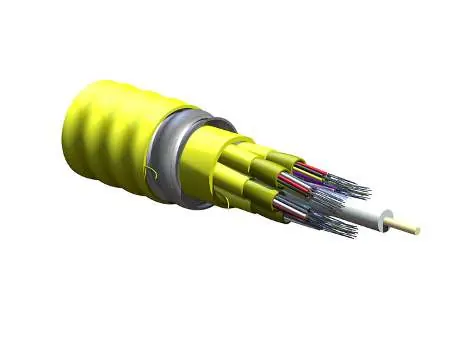
This document provides technical specifications for the Corning MIC Unitized Tight-Buffered, Interlocking Armored Cable (Part Number 072E81-T3131-A1). This cable is designed for indoor intrabuilding backbone and horizontal installations. It features 72 fibers grouped into 12-fiber jacketed subunits, protected by a flexible, spirally wrapped aluminum interlocking armor.
Product Description
The cable utilizes individually jacketed 900 µm buffered fibers, which facilitate easy and consistent stripping and termination. The interlocking armor provides significant crush protection compared to non-armored cables, making it suitable for heavy traffic or challenging mechanical environments. The outer jacket is flame-retardant.
Environmental Conditions
Ensure the cable is handled and stored within the following temperature ranges to maintain integrity:
- Installation: -10 °C to 60 °C (14 °F to 140 °F)
- Operation: -20 °C to 70 °C (-4 °F to 158 °F)
- Storage: -40 °C to 70 °C (-40 °F to 158 °F)
Mechanical Specifications
Adhere to these mechanical limits during installation and operation:
- Max. Tensile Strength (Short-Term): 1320 N (296.75 lbf)
- Min. Bend Radius (Installation): 393 mm (15.47 in)
- Min. Bend Radius (Operation): 262 mm (10.31 in)
- Nominal Outer Diameter: 26.2 mm (1.03 in)
Optical Characteristics
The cable uses SMF-28e+ fiber (Single-mode, G.652.D category). Maximum attenuation is 0.4 dB/km at wavelengths of 1310 nm, 1383 nm, and 1550 nm.
Manufacturer information
Corning Optical Communications
Practical help
Common problems
Signal loss or fiber damage
Ensure the cable is not bent beyond the minimum bend radius (393 mm for installation, 262 mm for operation).
Fiber breakage during installation
Do not exceed the maximum short-term tensile strength of 1320 N.
Material degradation
Ensure storage and installation temperatures remain within the specified ranges (-40°C to 70°C for storage, -10°C to 60°C for installation).
Before use
- Verify part number 072E81-T3131-A1 matches your requirements.
- Check that the installation environment is indoor.
- Ensure tools for stripping 900 µm buffered fibers are available.
- Confirm the installation path allows for the minimum bend radius of 393 mm.
- Verify that the flame rating (Riser/OFCR) meets local building code requirements.
Specs in practice
- Single-mode (OS2)
- Fiber type optimized for long-distance data transmission.
- Interlocking Armor
- Aluminum wrap providing crush protection, allowing for one-step installation.
Images and diagrams
- The cable structure consists of 12-fiber jacketed subunits, a dielectric central member, and an aluminum interlocking armor layer.
Model compatibility
- Compatible with standard G.652.D fiber systems.
- Designed for indoor intrabuilding backbone and horizontal installations.

Manual page author
Emily Carter
User documentation editor
Prepares concise manual descriptions and highlights the most useful setup, operation, and maintenance information for readers.