General / Accessories
Corning ALTOS Loose Tube Cable User Guide
Quick guide for the Corning ALTOS Loose Tube, Gel-Free, All-Dielectric Cable. Includes installation specifications, environmental conditions, mechanical limits, and optical characteristics for the 12-fiber OM1 model.
Table of contents
Manual images
Jump to the sectionQuick guide from the manual
The Corning ALTOS cable is an all-dielectric, gel-free loose tube cable designed for outdoor and limited indoor use. It features FastAccess technology, which simplifies jacket removal and reduces the risk of fiber damage during installation. Because it is all-dielectric, no bonding or grounding is required. Always ensure the cable is stored in a proper temperature environment prior to installation to meet the specified installation temperature range.
Product Description
This cable is designed for campus backbones in lashed aerial and duct installations. The construction includes a medium-density polyethylene jacket that is rugged and durable. The SZ-stranded, loose tube design isolates fibers from installation and environmental rigors while allowing for easy mid-span access. The cable is fully waterblocked using water-swellable materials, eliminating the need for cleaning.
Installation and Environmental Conditions
Adherence to temperature limits is critical for successful installation and long-term performance:
- Installation Temperature: -30 °C to -30 °C (-22 °F to -22 °F)
- Operation Temperature: -40 °C to 70 °C (-40 °F to 158 °F)
- Storage Temperature: -40 °C to -40 °C (-40 °F to -40 °F)
The cable is suitable for outdoor lashed aerial and duct applications, and indoor use when installed according to National Electrical Code (NEC) Article 770.
Mechanical Specifications
The cable must be handled within the following mechanical limits to prevent damage:
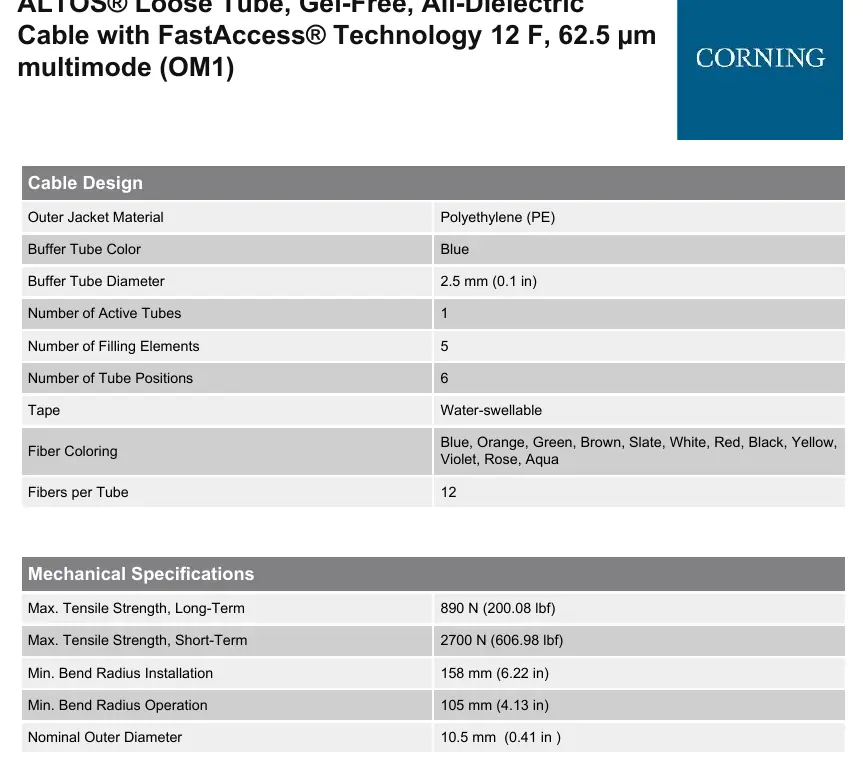
- Max. Tensile Strength (Long-Term): 890 N (200.08 lbf)
- Max. Tensile Strength (Short-Term): 2700 N (606.98 lbf)
- Min. Bend Radius (Installation): 158 mm (6.22 in)
- Min. Bend Radius (Operation): 105 mm (4.13 in)
- Nominal Outer Diameter: 10.5 mm (0.41 in)
Optical Characteristics
This specific model (Part Number 012KU4-T4730D20) features:
- Fiber Category: 62.5 µm Multimode (OM1)
- Wavelengths: 850 nm / 1300 nm
- Maximum Attenuation: 3.4 dB/km / 1.0 dB/km
- Fiber Count: 12
Cable Design
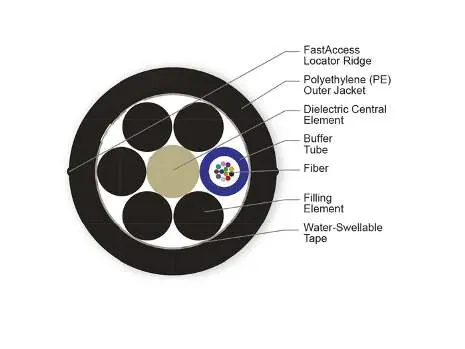
The cable features a blue buffer tube with 12 fibers. The internal structure consists of a dielectric central element, one active buffer tube, and five filling elements, all wrapped in a water-swellable tape and protected by a polyethylene (PE) outer jacket.
Manufacturer information
Corning Optical Communications
Practical help
Common problems
Fiber damage during jacket removal
Utilize the FastAccess technology feature, which is designed to reduce the risk of inadvertent fiber damage and minimize the need for sharp access tools.
Installation failure due to temperature
Store the cable in a proper temperature environment prior to installation to ensure the cable temperature meets the installation temperature range specifications (-30 °C).
Before use
- Verify the installation environment is within the -30 °C temperature range.
- Ensure the installation path allows for the minimum bend radius of 158 mm.
- Confirm the application is compatible (Outdoor lashed aerial or duct).
- Check that the cable is stored in a temperature-controlled environment before deployment.
Specs in practice
- Max. Tensile Strength (Long-Term)
- The maximum tension the cable can withstand over its lifetime without degrading performance (890 N).
- Min. Bend Radius (Installation)
- The tightest curve the cable can be bent during installation without causing permanent fiber damage (158 mm).
- FastAccess Technology
- A jacket feature that reduces cable end access time by at least 50% and improves safety for installers.
Images and diagrams
- The cross-section diagram illustrates the cable's internal components: the dielectric central element, the blue buffer tube containing fibers, filling elements, water-swellable tape, and the polyethylene outer jacket with the FastAccess...
Model compatibility
- Compatible with Gigabit and 10 Gigabit Ethernet applications.
- Suitable for outdoor lashed aerial and duct installations.
- Indoor installation is permitted only when compliant with NEC Article 770.

Manual page author
Michael Turner
Technical manual editor
Reviews PDF manuals for structure, safety notes, and practical product details so readers can find the right information quickly.