General / Accessories
Corning 024KUZ-T4130D20 LSZH Loose Tube Cable Specification
Technical specification and installation guide for the Corning 024KUZ-T4130D20 24-fiber multimode loose tube cable. Includes environmental ratings, mechanical limits, and optical characteristics.
Table of contents
Manual images
Jump to the sectionQuick Guide
The Corning 024KUZ-T4130D20 is a 24-fiber, gel-free, loose tube cable designed for both indoor and outdoor applications. It features an all-dielectric construction, meaning no grounding or bonding is required. The cable is flame-retardant and UV-resistant, making it suitable for interbuilding and intrabuilding installations, including aerial and duct environments.
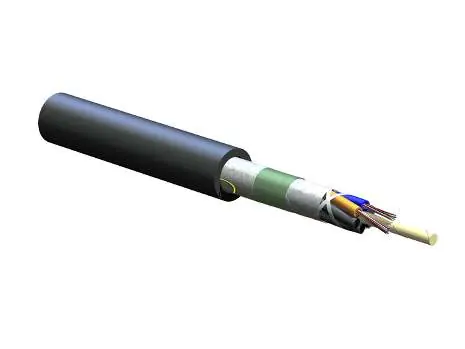
Cable Design and Construction
The cable utilizes a loose tube design to provide mechanical ruggedness and environmental durability. Key construction features include:
- Fiber Count: 24 fibers, 62.5 µm multimode (OM1).
- Water-Swellable Yarn: Eliminates the need for gel-filling compounds, allowing for cleaner and more efficient cable preparation.
- Outer Jacket: Flame-retardant, non-corrosive, low-smoke, zero-halogen (FRNC/LSZH) material.
- Central Element: Dielectric material.
- Buffer Tubes: Two active tubes with 12 fibers each, color-coded according to Telcordia standards.
Installation and Environmental Requirements
To ensure the integrity of the fiber and the longevity of the cable, adhere to the following environmental and mechanical limits:
- Installation Temperature: -30 °C to 60 °C (-22 °F to 140 °F).
- Operation and Storage Temperature: -40 °C to 70 °C (-40 °F to 158 °F).
- Minimum Bend Radius (Installation): 192 mm (7.56 in).
- Minimum Bend Radius (Operation): 128 mm (5.04 in).
- Maximum Tensile Strength (Short-Term): 2700 N (606.98 lbf).
- Maximum Tensile Strength (Long-Term): 810 N (182.1 lbf).
Optical Characteristics
The cable is optimized for multimode performance:
- Fiber Category: OM1 (62.5 µm).
- Wavelengths: 850 nm / 1300 nm.
- Maximum Attenuation: 3.4 dB/km at 850 nm / 1.0 dB/km at 1300 nm.
- Minimum Effective Modal Bandwidth (EMB): 220 MHz*km.
Standards and Compliance
The cable meets various industry standards for safety and performance, including:
- RoHS: Free of hazardous substances according to RoHS 2011/65/EU.
- Approvals: National Electrical Code (NEC) OFCR-LS/Riser, IEEE-1202 flame test, and IEC 60332-3.
- Design Criteria: ANSI/ICEA S-104-696, UL 13, UL 444, UL 1277, UL 1685, and CSA C22.2.
Manufacturer information
Corning Optical Communications
Practical help
Common problems
Signal loss due to excessive bending
Ensure the cable is not bent tighter than the minimum installation radius of 192 mm.
Fiber damage during installation
Do not exceed the short-term maximum tensile strength of 2700 N during the pulling process.
Installation failure due to temperature
Verify that the ambient temperature is within the -30 °C to 60 °C range before beginning installation.
Before use
- Verify the cable type is suitable for the intended environment (Indoor/Outdoor).
- Confirm the fiber count matches project requirements (24 fibers).
- Check that the installation path allows for the minimum bend radius of 192 mm.
- Ensure no grounding is required, as this is an all-dielectric cable.
- Confirm the cable is compatible with the intended duct or aerial installation method.
Specs in practice
- Min. Bend Radius (Installation)
- 192 mm - The tightest curve allowed while pulling the cable to prevent permanent fiber damage.
- Max. Tensile Strength (Short-Term)
- 2700 N - The maximum force that can be applied to the cable during installation.
- Fiber Category
- 62.5 µm MM (OM1) - Specifies the core diameter and multimode performance standard.
- Operating Temperature
- -40 °C to 70 °C - The range in which the cable maintains performance after installation.
Images and diagrams
- The cable cross-section diagram illustrates the arrangement of the dielectric central element, buffer tubes, water-swellable tape, and the flame-retardant outer jacket.
Model compatibility
- Suitable for indoor/outdoor use.
- All-dielectric construction requires no grounding.
- Compatible with aerial, direct buried, and duct installations.

Manual page author
Emily Carter
User documentation editor
Prepares concise manual descriptions and highlights the most useful setup, operation, and maintenance information for readers.