General / Accessories
Corning MIC Tight-Buffered Cable 024E88-33131-29 Specification Sheet
Technical specifications and installation guidelines for the Corning MIC Tight-Buffered 24-fiber plenum cable. Includes environmental ratings, mechanical limits, and construction details.
Table of contents
Manual images
Jump to the sectionQuick guide from the manual
The Corning MIC Tight-Buffered Cable is designed for indoor use in plenum, riser, and general-purpose environments. It features an all-dielectric construction, meaning no grounding or bonding is required. When installing, ensure you adhere to the specific temperature ranges and minimum bend radius limits to maintain signal integrity.
Product Description
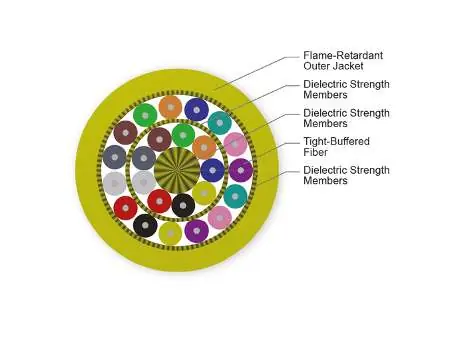
This is a 24-fiber, single-mode (OS2) cable utilizing 900 µm buffered fibers, which are designed for easy and consistent stripping during termination. The fibers are protected by dielectric strength members and a flame-retardant outer jacket.
Installation and Environmental Conditions
- Installation Temperature: 0 °C to 60 °C (32 °F to 140 °F).
- Operation Temperature: 0 °C to 70 °C (32 °F to 158 °F).
- Storage Temperature: -40 °C to 70 °C (-40 °F to 158 °F).
- Environment: Indoor use only.
Mechanical Specifications
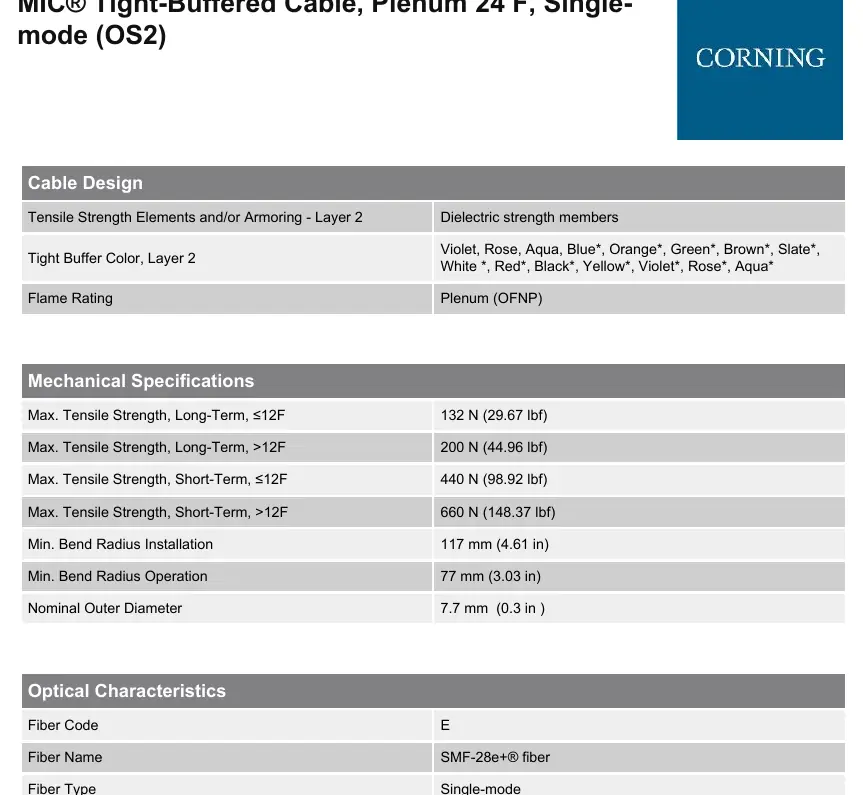
- Minimum Bend Radius (Installation): 117 mm (4.61 in).
- Minimum Bend Radius (Operation): 77 mm (3.03 in).
- Max. Tensile Strength (Short-Term, >12F): 660 N (148.37 lbf).
- Nominal Outer Diameter: 7.7 mm (0.3 in).
Standards and Compliance
The cable meets the application requirements of the National Electrical Code (NEC) Article 770 and is OFNP and FT-6 listed. It is RoHS compliant (free of hazardous substances).
Manufacturer information
Corning Optical Communications
Practical help
Common problems
Exceeding bend radius
Ensure the cable is not bent tighter than 117 mm during installation or 77 mm during operation to prevent signal loss or fiber damage.
Exceeding tensile strength
Do not exceed 660 N of short-term pulling force for cables with more than 12 fibers.
Temperature violation
Ensure installation occurs within the 0 °C to 60 °C range.
Before use
- Confirm the environment is indoor.
- Verify the path allows for the 7.7 mm outer diameter.
- Ensure tools are compatible with 900 µm buffered fibers.
- Check that the installation route respects the minimum bend radius.
Specs in practice
- All-dielectric
- Contains no conductive metal elements, eliminating the need for grounding or bonding.
- Single-mode (OS2)
- Optimized for long-distance data transmission.
Images and diagrams
- The cross-section diagram illustrates the internal structure, including the flame-retardant outer jacket, dielectric strength members, and the arrangement of the 24 tight-buffered fibers.
Model compatibility
- Compatible with NEC Article 770 applications.
- Meets OFNP and FT-6 listing requirements.
- RoHS 2011/65/EU compliant.

Manual page author
Michael Turner
Technical manual editor
Reviews PDF manuals for structure, safety notes, and practical product details so readers can find the right information quickly.