General / Other Manuals
Installation Guide for Danfoss ETS 5M Electric Expansion Valve
Complete installation guide for the Danfoss ETS 5M Electric Expansion Valve. Includes technical specifications, safety requirements for flammable refrigerants, brazing procedures, and wiring connections.
Table of contents
Manual images
Jump to the sectionQuick guide from the manual
The Danfoss ETS 5M is an electric expansion valve designed for refrigeration systems. Key operational requirements include ensuring the valve is in the open position before brazing, adhering to strict mounting angles, and using the correct controller/driver. The valve is compatible with various flammable refrigerants and must be installed in a closed-circuit system.
Safety and Compatibility
This product is validated in accordance with ATEX, EN 378, ISO 5149, ASHRAE 15, and IEC 60335-2-x standards. It is specifically designed for systems using flammable refrigerants, including R454C, R454A, R1234ze, R290, R32, R452B, R454B, R455A, and R1234yf.
- Closed Circuit Only: The valve must only be used in closed-circuit refrigeration systems where no oxygen is present.
- Third-Party Approval: In countries where safety standards are not an indispensable part of the safety system, Danfoss recommends obtaining third-party approval for the system.
- Electrical Safety: Do not connect the valve directly to an AC/DC power source. Connect only to an appropriate controller or driver.
Mounting and Installation
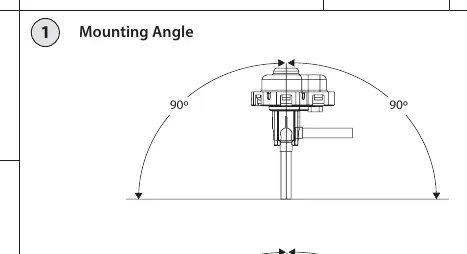
The valve must be installed within the specified mounting angle to ensure proper operation. Refer to the mounting angle diagram for the allowed orientation (90-degree range).
Brazing Procedure
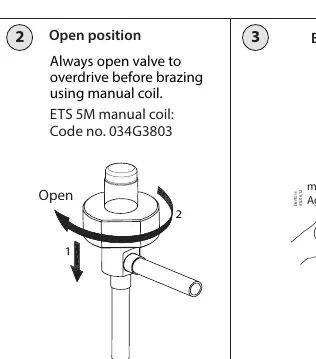
To prevent damage to the valve during brazing, you must always open the valve to the overdrive position using the manual coil (Code no. 034G3803) before starting.
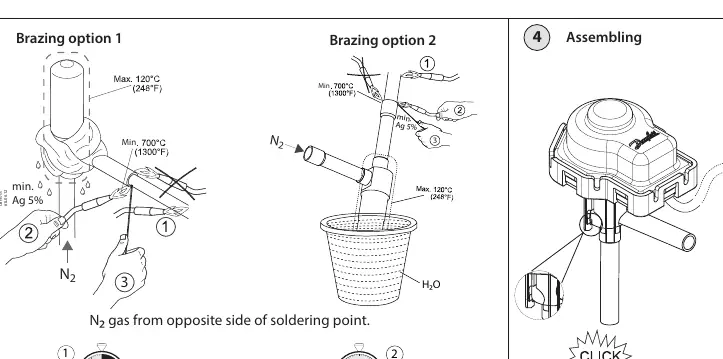
- Preparation: Use N2 gas from the opposite side of the soldering point to prevent oxidation.
- Brazing Option 1: Maximum 30 seconds.
- Brazing Option 2: Maximum 15 seconds.
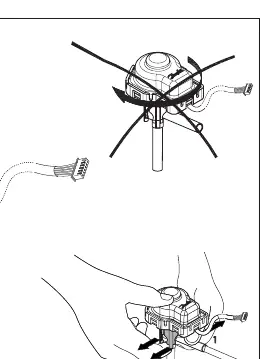
- Warning: Do not operate the valve while assembling or disassembling.
Electrical Connection
The valve uses a unipolar stepper motor. Ensure correct wiring based on the following sequence:
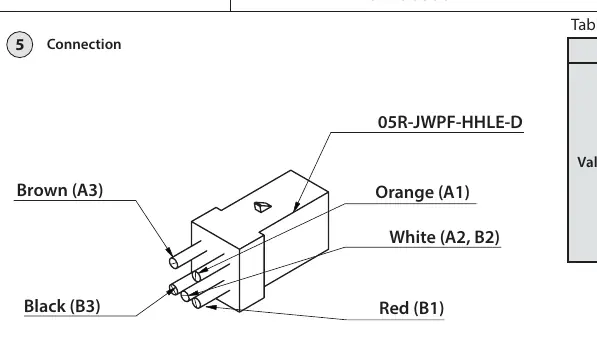
- Orange (A1)
- Brown (A3)
- Red (B1)
- Black (B3)
- White (Com)
Refer to the provided connection diagram for the 05R-JWPF-HHLE-D connector pinout.
Manufacturer information
Danfoss A/S
Practical help
Common problems
Valve damage during brazing
Always open the valve to the overdrive position using the manual coil (034G3803) before brazing.
Overheating during brazing
Keep brazing time under 30 seconds (Option 1) or 15 seconds (Option 2) and use N2 gas.
Incorrect electrical operation
Do not connect directly to AC/DC power; connect only to an appropriate controller or driver.
Before use
- Verify refrigerant compatibility (R454C, R290, etc.).
- Ensure the system is a closed circuit.
- Obtain the manual coil (034G3803) for brazing.
- Check that the mounting angle is within the 90-degree specification.
- Confirm the controller/driver is compatible with unipolar stepper motors.
Specs in practice
- Max. working pressure
- 4.9 MPa / 49 barg / 710 psig.
- Refrigerant temperature
- -30 °C to 70 °C (-22 °F to 158 °F).
- Stepper motor type
- Unipolar.
- Phase current
- 113 mA.
Images and diagrams
- Mounting Angle: Shows the allowed 90-degree orientation for the valve.
- Brazing Options: Illustrates the use of N2 gas and heat application limits.
- Connection: Wiring diagram for the 05R-JWPF-HHLE-D connector.
Model compatibility
- Compatible with flammable refrigerants: R454C, R454A, R1234ze, R290, R32, R452B, R454B, R455A, R1234yf.
- Must be used in closed circuit refrigeration systems only.

Manual page author
David Miller
Documentation analyst
Organizes user manual content into clear summaries, with attention to model details, product context, and everyday usability.