Software / Apps Services
Falmec Virgola Evolution Range Hood User Guide
Quick guide for the Falmec Virgola Evolution range hood, covering installation, operation, filter maintenance, and safety warnings.
Table of contents
Quick guide from the manual
This document provides essential information for the installation, operation, and maintenance of the Falmec Virgola Evolution range hood. It is intended for qualified personnel for installation and for the user for daily operation and maintenance.
Device Description
The Virgola Evolution is a domestic range hood designed to extract cooking fumes. It can be installed in various configurations, including external exhaust or internal recirculation (filtering) modes.
Installation
Installation must be performed by qualified personnel in compliance with local regulations. Ensure the cabinet has front access. The hood must be securely fastened to the wall using the provided kit, which is suitable for masonry walls. For other wall materials, use appropriate alternative fastening systems, considering the wall's strength and the hood's weight.
- Minimum Distance: Generally 65 cm for gas cookers, though this may be reduced according to EN60335-2-31 as specified in the installation instructions.
- Electrical Connection: Must be performed by a qualified electrician. Ensure the mains voltage matches the data plate inside the hood. The socket must be easily accessible.
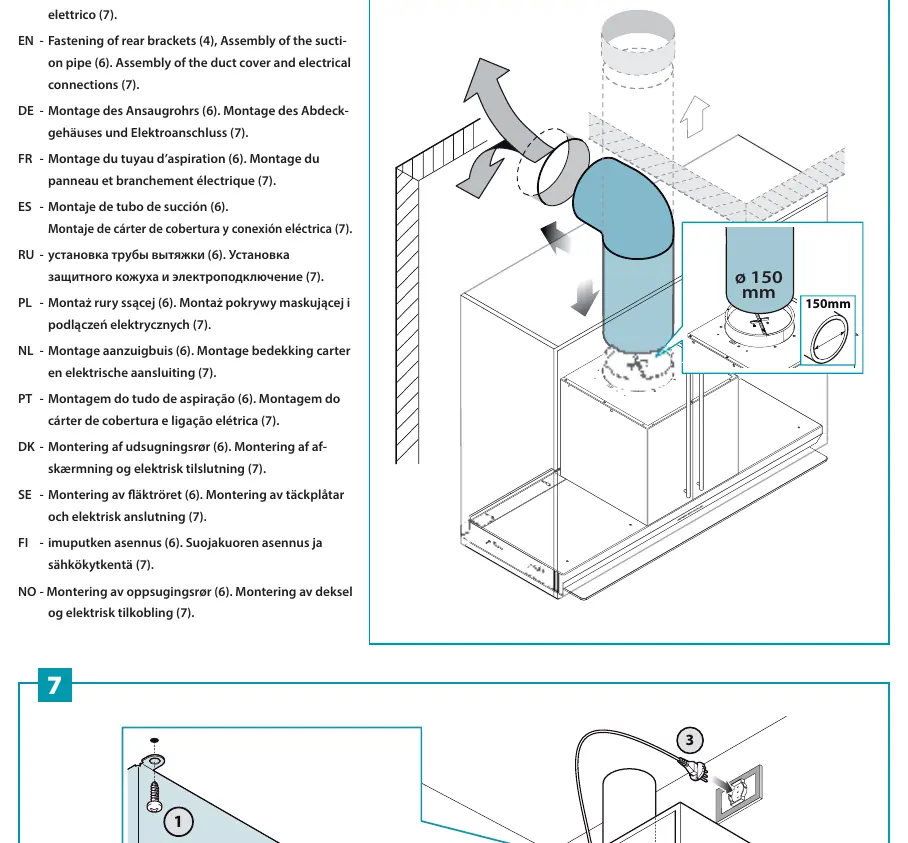
- Fumes Discharge: Do not connect to combustion exhaust pipes (boilers, fireplaces, etc.). For external exhaust, use a pipe with a diameter not less than the hood fitting, with minimal bends and a slight downward slope.
Operation
Switch on the hood at least one minute before cooking to direct fumes towards the suction surface. Leave it running after cooking until all odors are extracted (the timer function allows for automatic shutdown after 15 minutes).
- Speed 1: Low energy consumption, clean air.
- Speed 2: Normal use.
- Speed 3: Strong odors and vapors.
- Speed 4: Rapid disposal of odors and vapors.
Maintenance
Always disconnect the power supply before cleaning or maintenance. Do not use abrasive or corrosive detergents.
- External Surfaces: Clean at least every 15 days using a damp cloth and neutral detergent or the manufacturer-recommended 'Magic Steel' wipes.
- Metal Grease Filters: Wash at least once a month in hot water with dish soap or in a dishwasher (low temperature, max 55°C).
- Active Carbon Filters (KACL.960): Replace every 3-4 months under normal use.
- Carbon-Zeolite Filters (KACL.961): Regenerate every 18 months in a domestic oven at 200°C for 1 hour; replace every 3 years.
Safety
Do not use the hood with wet hands or bare feet. Do not flambé food under the hood. Always supervise deep-frying. Ensure adequate room ventilation if other gas-powered appliances are used simultaneously.
Manufacturer information
Falmec S.p.a.
Practical help
Common problems
Pushbutton panel is completely inactive
Temporarily disconnect the power supply (about 5 seconds) using the main switch to restore normal operation.
Grease filters are dark or discolored
This can happen if washed in a dishwasher; use low-temperature cycles (max 55°C) to reduce this.
Before use
- Ensure the hood is correctly installed and connected to the power supply.
- Check that the voltage matches the data plate inside the hood.
- Verify that the grease filters are properly installed.
- Ensure the room is well-ventilated if other gas appliances are in use.
Specs in practice
- Minimum distance from cooker
- Usually 65 cm for gas cookers, but check specific installation instructions.
- Maximum weight on hood
- Do not exceed 1.5 kg for any objects placed or hung on the hood.
- Filter cleaning frequency
- Metal grease filters should be cleaned every 30 hours of operation.
Images and diagrams
- The manual includes detailed diagrams for installation, including cabinet height configurations and wall mounting measurements.
- Diagrams show the correct procedure for removing and installing grease filters.
- Diagrams illustrate the replacement of LED spotlights.
Model compatibility
- The installation kit is only for masonry walls; other wall types require different fastening systems.
- For external exhaust, a check valve is required for motors with 800m3/h or higher capacity.
- The check valve must NOT be installed in the internal recirculation (filtering) version.

Manual page author
Michael Turner
Technical manual editor
Reviews PDF manuals for structure, safety notes, and practical product details so readers can find the right information quickly.