Tools / Saws
User Manual for Fieldmann FDK 201202-E Circular Saw
Quick guide for the Fieldmann FDK 201202-E circular saw. Includes setup, blade replacement, safety instructions, maintenance tips, and technical specifications.
Quick answers from the manual
Quick answer
- The Fieldmann FDK 201202-E is a 1200W circular saw for wood. Always disconnect from power before maintenance or blade changes. p. 9, 10
Key actions
- Changing the saw blade p. 9
- Adjusting depth of cut p. 9
First start
- Ensure voltage is 230V, check blade condition, wear protective gear. p. 4, 9
Problems and fixes
Overheating
Run without load for 2 minutes.
p. 10Maintenance and reset
- Replace carbon brushes when they wear down to the limit mark. p. 10
Technical specifications
| Parameter | Value | Meaning | Pages |
|---|---|---|---|
| Rated Voltage | 230V~ 50Hz | Power supply requirement | p. 15 |
| Input Power | 1200W | Motor power | p. 15 |
| No Load speed | 5000/min | Rotational speed | p. 15 |
Where to find it in the PDF
- Safety Instructions p. 3, 4, 5, 6
- Overview p. 8
- Technical Data p. 15
Table of contents
Manual images
Click an image to enlargeQuick guide from the manual
The Fieldmann FDK 201202-E is a circular saw designed for cutting wood and wooden materials. Before use, ensure the power supply matches the 230V rating. Always wear eye and ear protection. Never operate the saw if the lower guard does not move freely or if the blade is damaged. Always disconnect the power plug before performing any adjustments or maintenance.
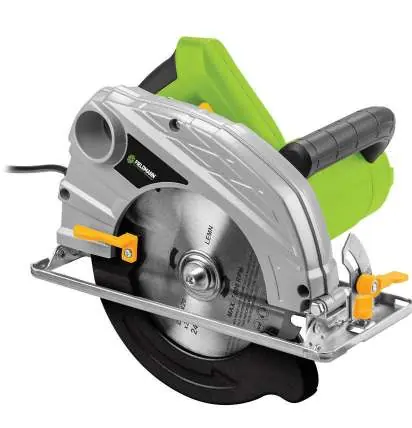
Overview
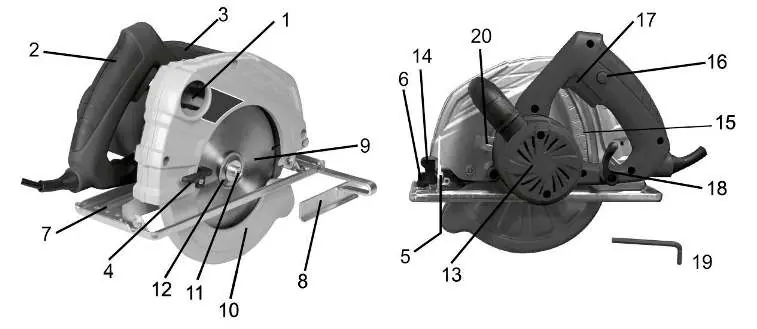
The saw features an extractor connection, depth adjustment lever, bevel scale, and a parallel stop. Refer to the diagram on page 8 for specific part identification, including the operating switch (17) and switch-on locking device (16).
Preparation
- Depth of Cut: Release the locking lever (18), adjust the motor section (13) to the desired depth using the scale (15), and re-tighten the lever. The depth should be 3mm longer than the workpiece thickness.
- Parallel Stop: Insert the parallel stop (8) into the shoe (7) and secure with the locking screw (6).
- Bevel Adjustment: Loosen the locking screws (14) on the front and rear of the shoe, set the desired angle, and tighten the screws.
Changing the Saw Blade
- Disconnect the power plug.
- Move the motor section to the top position and lock it.
- Press the shaft lock (20) to prevent rotation.
- Use the hex key (19) to loosen the hexagon bolt (11).
- Remove the bolt, flange, and blade.
- Install the new blade and tighten the bolt securely.
Maintenance
Keep the engine vent holes clean and dust-free. Replace carbon brushes when they wear down to the limit mark. Always disconnect the power before cleaning. Do not use solvents. If the machine becomes too hot, allow it to run without a load for two minutes.
Safety
Always hold the saw with both hands. Do not use grinding discs. Ensure the arrow on the blade matches the running direction of the saw. Never cut objects while holding them in your hand.
Manufacturer information
Fieldmann
Practical help
Common problems
Machine overheating
Allow the machine to run without a load for two minutes.
Blade pinching
Support large panels, ensure the blade is sharp, and do not force the saw.
Abnormal noise or smell
Stop working immediately and have the tool serviced.
Before use
- Check that the voltage matches the type label (230V).
- Ensure the blade is sharp and undamaged.
- Verify all locking levers (depth, bevel) are tight.
- Wear eye and ear protection.
- Ensure the lower guard moves freely and closes instantly.
Specs in practice
- Rated Voltage
- 230V~ 50Hz
- No Load speed
- 5000/min
- Max Cutting depth
- 63mm
Model compatibility
- Only use wood saw blades.
- Do not use grinding discs.
- Not for cutting stone or metal.

Manual page author
David Miller
Documentation analyst
Organizes user manual content into clear summaries, with attention to model details, product context, and everyday usability.