Power / Batteries & Chargers
User Manual for Fieldmann FDSP 200652-E Electric Spray Gun
Comprehensive user guide for the Fieldmann FDSP 200652-E electric spray gun. Includes setup, viscosity testing, operation, cleaning, maintenance, and troubleshooting instructions.
Quick answers from the manual
Quick answer
- The Fieldmann FDSP 200652-E is an electric spray gun for household use, suitable for various paints and preservatives. It operates on 230-240V and requires proper viscosity testing of materials before use. p. 11, 12
Key actions
- Fill the paint container and screw it onto the spray gun. p. 12
- Clean the device after use by spraying water or solvent through the nozzle. p. 13
First start
- Check material viscosity, fill the container, connect to power, and test spray. p. 11, 12
Problems and fixes
Product cannot be started
Connect to power source or check cable/plug.
p. 15Maintenance and reset
- Regularly clean the nozzle, air cap, and paint container. Replace the air filter if dirty. p. 13
Technical specifications
| Parameter | Value | Meaning | Pages |
|---|---|---|---|
| Max. viscosity | 35DIN-S | Maximum material thickness | p. 14 |
| Power | 650 W | Power consumption | p. 14 |
Where to find it in the PDF
- Safety Instructions p. 6, 7, 8, 9
- Technical Data p. 14
Table of contents
Manual images
Click an image to enlargeQuick guide from the manual
The Fieldmann FDSP 200652-E is an electric spray gun designed for household use. It is suitable for applying solvent-based and water-based paints, glazes, wood preservatives, and stains. Always ensure the workspace is well-ventilated and keep the device away from explosive environments. Before starting, verify the material viscosity and ensure the device is connected to a compatible power source (230-240V).
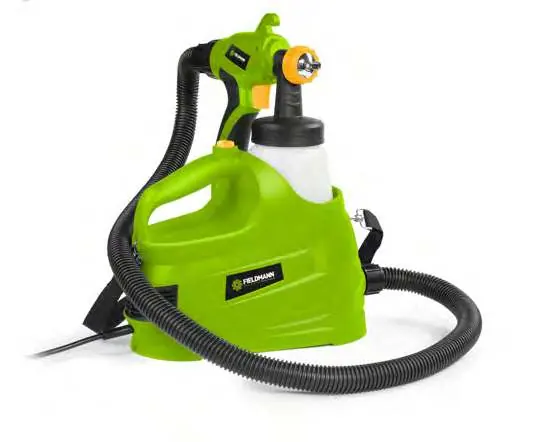
Device Description
The spray gun consists of several key components:
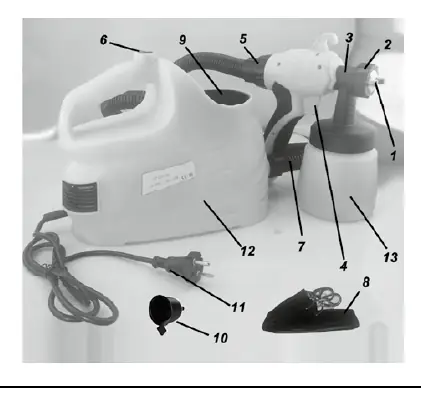
- Air cap/Nozzle: The output point for the paint.
- Spray gun: The main handheld unit.
- Air hose: Connects the main body to the gun.
- Paint container: Holds the material to be sprayed.
- Main body: Contains the motor and air supply.
Viscosity Testing
If the material viscosity is unknown, perform a test:
- Stir the material thoroughly.
- Fill the viscosity cup to the brim.
- Lift the cup and measure the time it takes for the material to flow out completely. This time corresponds to the viscosity.
Operation
- Unscrew the paint container and fill it with the prepared material.
- Screw the container back onto the spray gun.
- Place the gun on its stand.
- Connect the appliance to a suitable power outlet.
- Attach the shoulder strap.
- Lift the gun, aim at the object, and maintain a distance of 5 to 15 cm.
- Turn on the power switch and press the trigger to spray.
- To stop, release the trigger and turn off the power switch.
Cleaning and Maintenance
Regular cleaning is essential for reliable operation:
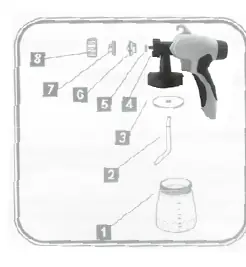
- Disconnect from the power supply before cleaning.
- Press the trigger to let material flow back into the container.
- Empty the container and clean the tube.
- Fill the container with water or solvent, attach it, and spray until clean liquid comes out.
- Clean the nozzle and air cap with a brush and solvent/water.
- Regularly check the air filter and replace it if dirty.
Safety
Always wear eye protection, hearing protection, and a dust mask. Do not use toxic or flammable materials. Keep the device away from children and pets. If the power cable is damaged, it must be replaced by an authorized service center.
Manufacturer information
Fieldmann
Practical help
Common problems
Product will not start
Check if it is connected to a power source. If the cable or plug is damaged, have it checked by a qualified electrician.
Product does not reach maximum performance
Ensure the extension cable is suitable, check for low voltage, and clean the air vents.
Unsatisfactory results
Check if the nozzle is worn or damaged and replace if necessary. Ensure the nozzle is suitable for the material.
Excessive vibration or noise
Check if the nozzle is worn or damaged. Tighten any loose screws or nuts.
Before use
- Check package contents for all parts.
- Verify that the power supply voltage matches the device specifications.
- Test the viscosity of the paint material.
- Ensure the workspace is clean and well-ventilated.
- Wear appropriate personal protective equipment (goggles, mask, ear protection).
Specs in practice
- Max. viscosity
- 35DIN-S; indicates the maximum thickness of material the gun can spray.
- Protection class
- II; indicates the device is double-insulated.
Images and diagrams
- 1: Air cap/Nozzle
- 13: Paint container
Model compatibility
- Allowed materials: Solvent/water-based paints, glazes, wood preservatives, stains, vehicle topcoats.
- Prohibited materials: Wall paint (dispersion type), lye, acidic paint, toxic materials, flammable materials.

Manual page author
Emily Carter
User documentation editor
Prepares concise manual descriptions and highlights the most useful setup, operation, and maintenance information for readers.