Power / USB Chargers
User Manual for Hama Charger 2x USB-A 2.4A
Quick guide and user manual for the Hama 2x USB-A 2.4A charger. Includes safety instructions, operating procedures, technical specifications, and maintenance tips.
Quick answers from the manual
Quick answer
- This Hama charger (model 73210587) is a 2x USB-A wall charger with a total output of 12W (5V/2.4A). It is designed for indoor use with a mains voltage of 100-240V. p. 2, 3
Key actions
- Connect your device to the USB charging socket using a suitable USB cable. p. 3
- Disconnect the charger from the mains when not in use for a long period. p. 3
First start
- Plug the charger into a properly installed and easily accessible power socket, then connect your device. p. 3
Problems and fixes
Device not charging
Check connections and ensure the total power draw does not exceed 12W.
p. 2, 3Maintenance and reset
- Disconnect from power before cleaning. Use only dry, soft cloths. p. 3
Technical specifications
| Parameter | Value | Meaning | Pages |
|---|---|---|---|
| Output | 5.0 V DC / 2.4 A / 12.0 W | Total output power | p. 3 |
Where to find it in the PDF
- Operating Instructions p. 2, 3
Table of contents
Quick guide from the manual
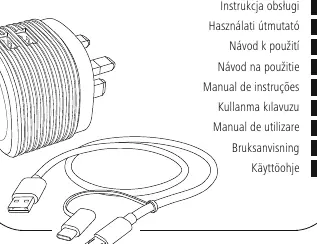
This Hama charger (model 73210587) is designed for charging mobile devices via USB. It features two USB-A ports with a total power output of 12W. It is suitable for worldwide use with a mains voltage of 100-240V, though a country-specific adapter may be required.
Safety Notes
- Indoor use only: Use the product only in dry, indoor environments.
- Protection: Protect the product from dirt, moisture, and overheating.
- Handling: Do not drop the product or expose it to major shocks. Do not modify the device, as this voids the warranty.
- Cables: Lay all cables to avoid tripping hazards. Do not bend or crush cables. Always pull on the plug, not the cable, when disconnecting.
- Damage: Do not use the product if it is visibly damaged or if the AC adapter/cables are damaged.
- Children: Keep out of reach of children.
Operation
Before connecting a device, ensure the charger can supply sufficient power and that the total power draw of all connected devices does not exceed 12W.
- Connect your terminal device to a USB charging socket using a suitable USB cable.
- Connect the charger to a properly installed and easily accessible power socket.
- Charging progress is displayed on your terminal device.
- Disconnect the terminal device from the charger if you want to interrupt charging or if the device is fully charged.
- Disconnect the charger from the mains when not in use for a long period.
Care and Maintenance
Only use dry, soft cloths for cleaning. Disconnect the device from the power supply before cleaning or if it will not be used for a long period.
Technical Specifications
- Input voltage: 100 – 240 V
- Input AC frequency: 50 – 60 Hz
- Output voltage / Output current / Output power: 5.0 V DC / 2.4 A / 12.0 W
- Ambient temperature: 0°C – 40°C
Recycling Information
Electric and electronic devices, as well as batteries, must not be disposed of with household waste. Consumers are obliged by law to return electrical and electronic devices as well as batteries at the end of their service lives to the public collecting points set up for this purpose or point of sale.
Manufacturer information
Hama GmbH & Co KG
Practical help
Common problems
Device not charging
Ensure the charger is securely plugged into the wall socket and the USB cable is properly connected to both the charger and the device.
Total power limit exceeded
Ensure the combined power draw of all connected devices does not exceed 12W.
Before use
- Verify the mains voltage is between 100-240V.
- Ensure the total power of connected devices is 12W or less.
- Use only in dry, indoor environments.
- Ensure the power socket is easily accessible.
- Check that the charger and cables are not damaged.
Specs in practice
- Ambient temperature
- Operating range is 0°C – 40°C.
Model compatibility
- Suitable for devices requiring USB-A charging.
- Total power output is limited to 12W.

Manual page author
David Miller
Documentation analyst
Organizes user manual content into clear summaries, with attention to model details, product context, and everyday usability.