Music / Guitar Effects
User manual for Harley Benton JF-01 Vintage Overdrive Pedal
Quick start guide for the Harley Benton JF-01 Vintage Overdrive pedal. Learn about controls, connections, power requirements, and safety instructions for your guitar effects pedal.
Table of contents
Quick guide from the manual
This guide provides essential information for the safe operation of the Harley Benton JF-01 Vintage Overdrive pedal. Always ensure correct polarity when using batteries or power adapters. If you pass the product on to others, please include this guide.
Controls and connections
The pedal features the following controls and connection points:
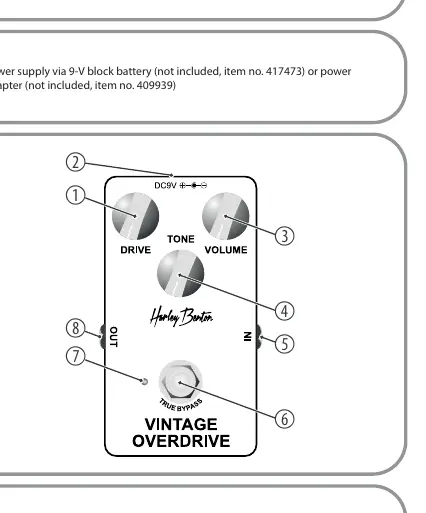
- 1 DRIVE: Overdrive control. Turn clockwise to increase the degree of overload.
- 2 DC9V: Connection for an external 9V DC power supply. Connecting an external supply automatically cuts off the battery power.
- 3 VOLUME: Volume control. Turn clockwise to increase the output level.
- 4 TONE: Tone control.
- 5 IN: 1/4" jack socket to connect your instrument.
- 6 TRUE BYPASS: Foot switch for enabling or disabling the pedal effect.
- 7 LED: Indicates pedal status. If the LED is off or dim during use, the battery is exhausted and must be replaced.
- 8 OUT: 1/4" jack socket to connect to an amplifier.
Power supply
The device can be powered by either a 9-V block battery (not included) or an external power adapter (not included). When using an external adapter, ensure the input voltage matches the device requirements (100 - 240 V ~ 50/60 Hz). The adapter must provide 9 V DC with a centre negative polarity.
Technical specifications
- Input impedance: 500 kΩ
- Output impedance: 10 kΩ
- Current consumption: 7 mA
- Degree of protection: IP20
- Dimensions (W × H × D): 72 mm × 55 mm × 120 mm
- Weight: 280 g
- Ambient conditions: Temperature range 0 °C to 40 °C; Relative humidity 20% to 80% (non-condensing)
Safety instructions
Intended use: This device is designed for sound processing of signals from musical instruments with electromagnetic pickups. Any other use is considered improper.
General handling:
- Never use force when handling the product.
- Never immerse the product in water. Clean only with a dry cloth; do not use liquid cleaners.
- Do not use the product in extreme temperatures, humidity, or dusty areas.
- Remove batteries if the device will not be used for a long period to prevent damage from leaking.
- Ensure correct polarity when inserting batteries to avoid fire risk or device damage.
Practical help
Common problems
LED is dim or off during use
The battery is exhausted and must be replaced.
No sound output
Check that the instrument is connected to the IN jack and the amplifier is connected to the OUT jack. Ensure the pedal is engaged via the True Bypass switch.
Device does not power on
Check that the power adapter is properly connected or that the 9V battery is inserted with the correct polarity.
Before use
- Ensure the power adapter voltage matches the device requirements (9V DC).
- Verify the power adapter polarity is centre negative.
- Check that the battery is inserted with correct polarity if not using an adapter.
- Ensure the environment is dry and free from extreme dust.
- Connect the guitar to the IN jack and the amplifier to the OUT jack.
Specs in practice
- Input impedance (500 kΩ)
- Determines how the pedal interacts with guitar pickups; standard for passive guitar signals.
- Current consumption (7 mA)
- Low power draw, ensuring long battery life with a standard 9V block battery.
- Degree of protection (IP20)
- The device is protected against solid objects over 12.5mm but is not waterproof.
Images and diagrams
- The diagram illustrates the top panel of the pedal, identifying the Drive, Tone, and Volume knobs.
- It highlights the location of the IN and OUT jacks on the sides of the pedal.
- It shows the DC9V power input location and the True Bypass footswitch.
Model compatibility
- Requires 9V DC power supply (centre negative) or 9V block battery.
- Designed specifically for electric guitars with electromagnetic pickups.

Manual page author
David Miller
Documentation analyst
Organizes user manual content into clear summaries, with attention to model details, product context, and everyday usability.