Industrial / Vacuum Cleaners
Hilti VC 20-U and VC 40-U Series Vacuum Cleaner Operating Instructions
Comprehensive operating guide for Hilti VC 20-U and VC 40-U series industrial vacuum cleaners. Includes setup, safety, maintenance, filter replacement, and troubleshooting procedures.
Quick answers from the manual
Quick answer
- The Hilti VC 20-U and VC 40-U are industrial wet/dry vacuum cleaners. They feature automatic filter cleaning and are designed for professional use with Hilti tools. Always ensure the correct dust bag and filter are installed for the specific dust class (L or M) of your model. p. 5, 8, 9
Key actions
- Fitting a dust bag p. 12
- Emptying the container p. 15
- Replacing the filter p. 16
First start
- Initial setup p. 12
Problems and fixes
Warning tone
Check dust bag, filter, hose blockage, or hose diameter setting.
p. 17Maintenance and reset
- Filter replacement p. 16
Technical specifications
| Parameter | Value | Meaning | Pages |
|---|---|---|---|
| Container capacity (VC 20) | 21 l | Total volume of the waste container. | p. 11 |
| Container capacity (VC 40) | 36 l | Total volume of the waste container. | p. 11 |
Where to find it in the PDF
- Product Overview p. 2
- Assembly p. 3
- Technical Data p. 10, 11
Table of contents
Manual images
Click an image to enlargeQuick Guide
The Hilti VC 20-U and VC 40-U series are industrial wet/dry vacuum cleaners designed for professional use. Before initial operation, ensure the vacuum is on a stable surface and wheel brakes are engaged. Always use the correct dust bag for the material being collected (e.g., plastic for mineral dust, paper for wood chips). The vacuum features an automatic filter cleaning system that activates upon startup.
Product Overview
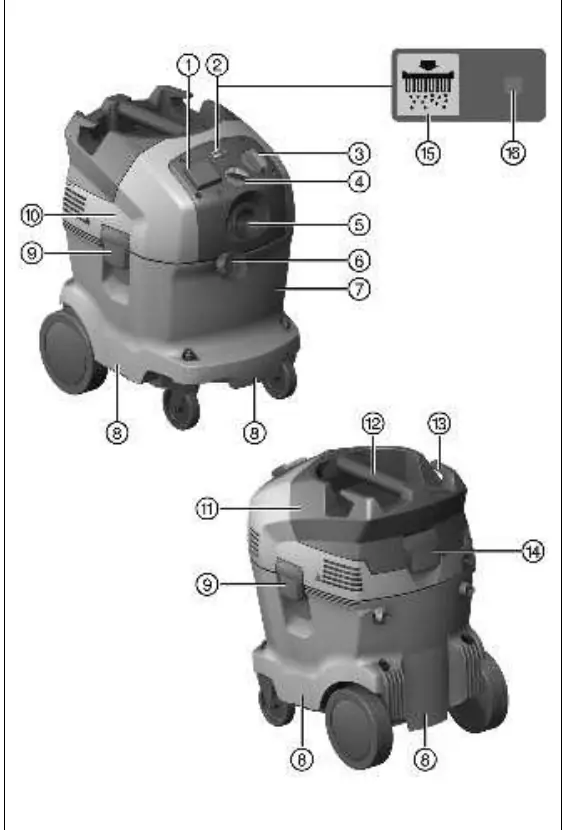
The vacuum cleaner consists of a waste material container, a top section containing the motor and filter, and various controls including a power switch, hose socket, and filter cleaning button. Specific models (UM/UME) include a hose diameter setting switch and a warning tone feature to alert the user if air speed drops below 20 m/s.
Safety Instructions
- General: Read all instructions before use. Do not use the appliance for purposes other than intended.
- Electrical: Ensure the power outlet is properly earthed. Do not use damaged cords.
- Hazardous Materials: Do not pick up flammable, explosive, or aggressive liquids/dusts. Class L and M models are designed for specific hazardous dust exposure limits; ensure the correct filter is installed.
- Personal Safety: Wear appropriate protective gear (eye protection, gloves, breathing protection) when handling hazardous dust.
Operation
First Time Setup
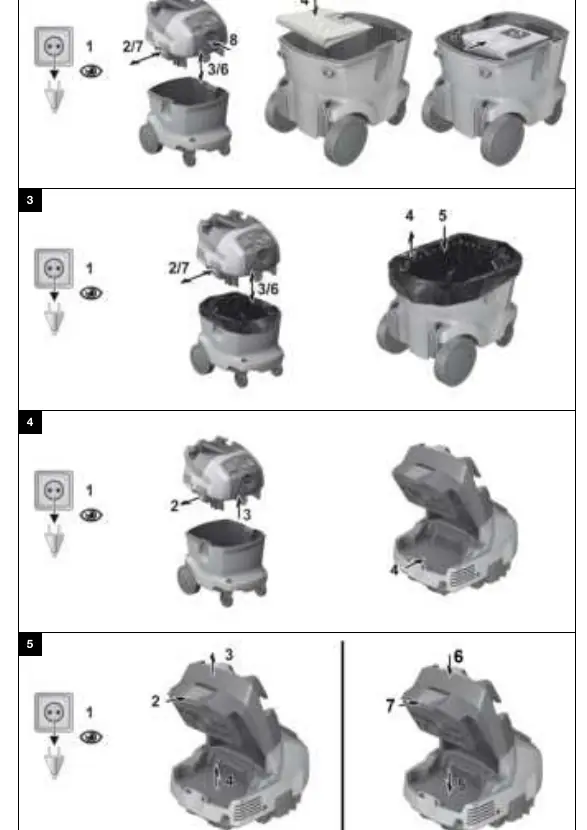
- Open the two catches and remove the top section.
- Remove accessories and packaging from the container.
- Fit the appropriate dust bag.
- Replace the top section and secure the catches.
- Connect the suction hose.
Picking Up Materials
For dry dust, ensure the correct dust bag is fitted. For liquids, ensure the filter element is dry and installed. If picking up liquids, empty the container regularly and clean the electrodes and filter element.
Maintenance
- Filter Cleaning: The automatic system cleans the filter during operation. Do not use compressed air to clean the filter manually.
- Filter Replacement: Replace the filter element at least every six months, or more frequently with intensive use.
- Cleaning: Keep the appliance clean and free from oil/grease. Clean air vents with a dry brush.
Troubleshooting
If the vacuum cleaner exhibits reduced suction, check if the dust bag is full, the filter is clogged, or the hose is blocked. If the motor fails to restart, check the circuit breaker or allow the motor to cool down if the overheating protection has triggered.
Manufacturer information
Hilti Corporation
Practical help
Common problems
Warning tone (reduced suction)
Check if the dust bag is full, the filter element is clogged, the suction hose is blocked, or the hose diameter setting is incorrect.
Motor does not restart
Check if the circuit breaker has tripped, the container is full, or the motor overheating protection has activated (allow to cool for 5 minutes).
Dust is blown out of the appliance
Ensure the filter element is fitted correctly and is not damaged.
Appliance switches off or static discharge occurs
Ensure the appliance is connected to an earthed/grounded power outlet and use an antistatic suction hose.
Before use
- Engage the wheel brakes to ensure the vacuum stands securely.
- Ensure the correct dust bag (paper or plastic) is fitted for the material type.
- Verify the filter element is dry and correctly installed.
- For UM/UME models, set the hose diameter switch to match the suction hose used.
- Check that the supply cord is not damaged.
Specs in practice
- Dust Class L
- Suitable for dry, non-flammable dusts, liquids, wood chips, and hazardous dusts with an exposure limit value > 1 mg/m³.
- Dust Class M
- Suitable for dry, non-flammable dusts, liquids, wood chips, and hazardous dusts with an exposure limit value ≥ 0.1 mg/m³.
- Warning Tone
- Emitted if air speed in the suction hose drops below 20 m/s (UM/UME models).
Images and diagrams
- Page 2: Overview of product components including power outlet, filter cleaning button, and container catches.
- Page 3: Visual guide for assembly, bag installation, and filter access.
Model compatibility
- VC 20-UL / VC 40-UL: Dust Class L.
- VC 20-UM / VC 20-UME / VC 40-UM / VC 40-UME: Dust Class M.

Manual page author
David Miller
Documentation analyst
Organizes user manual content into clear summaries, with attention to model details, product context, and everyday usability.