Garden / Brushcutters & Trimmers
Operator's Manual for Husqvarna Climbing Rope 11.5/11.8 mm
Quick guide for the Husqvarna Climbing Rope 11.5/11.8 mm. Includes safety instructions, inspection procedures, maintenance, and technical specifications.
Table of contents
Manual images
Click an image to enlargeQuick guide from the manual
The Husqvarna Climbing Rope 11.5/11.8 mm is a synthetic fiber rope designed for rope-assisted work, such as descender devices, work positioning systems, and fall arrest systems. Do not use this product as lifting equipment.
Safety instructions
Always read and understand the safety chapter before use. Key safety points include:
- Ensure the operator has necessary knowledge and training.
- Do not use the product if you are unsure of its previous usage.
- Avoid knots, as they decrease breaking load.
- Apply load longitudinally; avoid transversal loading (e.g., do not use two carabiners in an end connection).
- Keep the rope away from UV radiation, chemicals, and temperatures above 100°C.
- Ensure the work positioning system is always in tension.
Operation
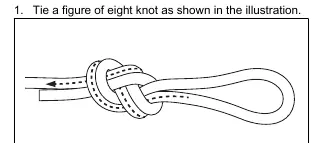
To create an end connection, tie a figure-of-eight knot. Ensure the load-bearing part aligns with the arrow in the illustration. Secure the knot with a second knot, such as a double overhand knot.
Product inspection
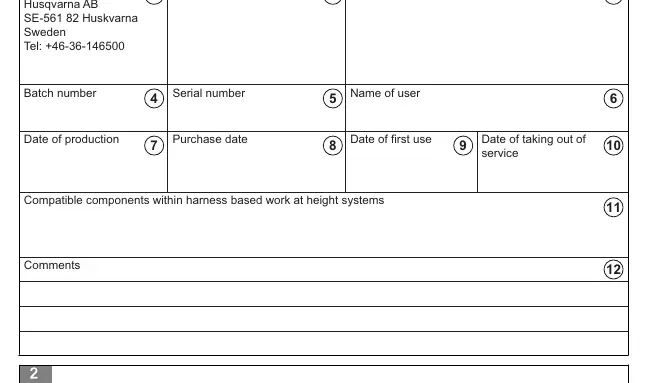
Product inspections must be performed before and after each use by the operator. A thorough inspection must be performed at least every 12 months by a competent person or the manufacturer.
- Before each use: Visual inspection of the product and end connection; feel for hidden core damage.
- After each use: Visual inspection for damage, swellings, discoloration, abrasion, or cuts.
- Every 12 months: Check general condition, label, mechanical damage (cuts, cracks, fibrillation, kinks, crush damage), thermal/chemical damage, and end connection integrity.
Maintenance
Repairs must only be performed by the manufacturer. Clean the product with warm water and a rope detergent. Disinfect only when absolutely necessary using disinfectants that do not damage synthetic materials (e.g., 70% isopropyl alcohol).
Service life
The service life depends on the condition of the product and usage frequency. The maximum service life is 10 years from the date of manufacture for ropes without end connections, and 7 years from the day of removal from the package for ropes with end connections. Discard immediately if damaged or if it shows signs of wear.
Transportation and storage
Store in a clean, dry, and loose condition in a protective bag. Ensure storage temperature is 15–25°C, with sufficient airflow and no exposure to UV radiation, chemicals, or sharp objects.
Technical data
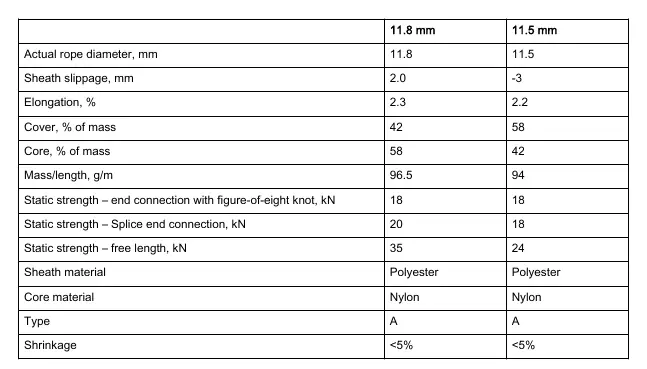
Refer to the technical data table in the manual for specific values regarding diameter, elongation, mass, and static strength for different configurations.
Manufacturer information
Husqvarna
Practical help
Common problems
Rope becomes too hot
Perform rappelling operations slowly to prevent high temperatures.
Knots in the rope
Ensure there are no knots, as they decrease the breaking load.
Uncertainty about product safety
If you are not sure the product is safe to use, take it out of service immediately.
Before use
- Perform a visual inspection of the product and end connection.
- Feel along the product to identify hidden core damage.
- Ensure all components in the work positioning system are compatible.
- Check that metal components have no burrs or sharp edges.
- Prepare a risk assessment including emergency procedures.
Specs in practice
- Breaking load
- Specified for longitudinal load; transversal load must be avoided.
- Service life (no end connections)
- Maximum 10 years from date of manufacture.
- Service life (with end connections)
- Maximum 7 years from the day removed from the package.
Images and diagrams
- Figure-of-eight knot: Tie as shown in the illustration and secure with a second knot at the end.
- Inspection record sheet: Use the provided sheets to document inspections.
Model compatibility
- Must comply with EN 1891:1998 for low stretch kernmantle ropes.
- Other PPE components must comply with EU 2016/425 (e.g., EN 341, EN 358, EN 363).
- ANSI Z133-2017 requires a minimum diameter of 12.7 mm for arborist climbing ropes, with specific exceptions.

Manual page author
Michael Turner
Technical manual editor
Reviews PDF manuals for structure, safety notes, and practical product details so readers can find the right information quickly.