Automotive / Parts Accessories
LeoVince LV One EVO Full System Exhaust for Vespa GTS 300
Enhance your Vespa GTS 300 performance with the LeoVince LV One EVO full exhaust system. Designed for durability and optimal flow, this stainless steel system offers a significant weight reduction compared to the stock exhaust.
Table of contents
Product Overview
The LeoVince LV One EVO is a high-performance full exhaust system engineered specifically for the Vespa GTS 300 HPE series (including Racing Sixties, Super, Sei Giorni, Sport, Tech, and Touring models). Constructed from high-quality stainless steel, this system provides a significant weight reduction, weighing 4.36 kg compared to the 7.02 kg stock exhaust.
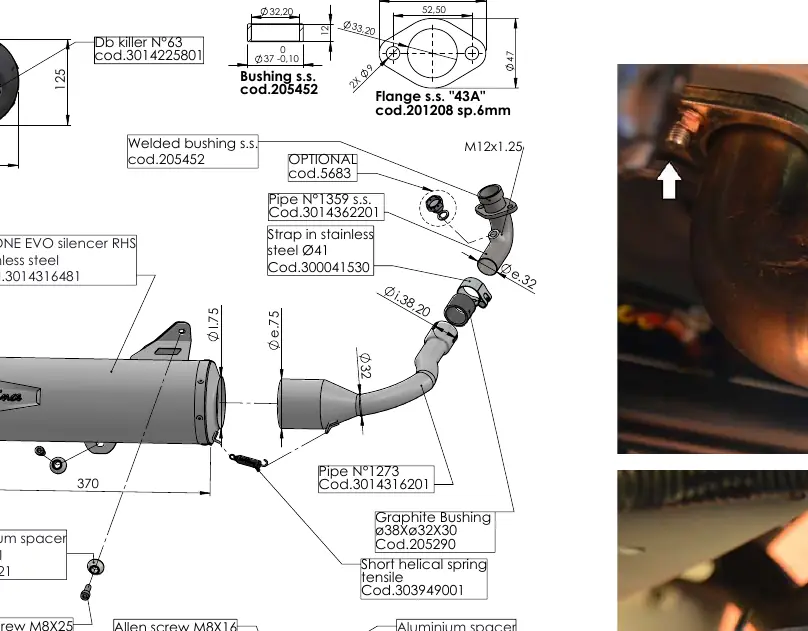
Installation Instructions
Installation should be performed by a qualified professional. Before starting, ensure the engine and exhaust system have cooled completely to prevent burns or damage to heat-sensitive components.
- Remove the original exhaust system and disconnect the Lambda probe.
- Fit the new manifold onto the cylinder seat, ensuring the flange is correctly positioned with the graphite gasket if applicable. Do not fully tighten the nuts initially to allow for alignment.
- Secure the manifold to the flange using the provided springs.
- Connect the final manifold to the primary manifold and secure with springs.
- Attach the silencer to the final manifold, verify orientation, and secure with the remaining spring.
- Install spacers, washers, and support brackets as indicated in the technical drawing, then tighten all fasteners.
- Reconnect the Lambda probe to the designated point on the LeoVince manifold.
- Start the engine, allow it to reach operating temperature, and check for any gas leaks.
Safety and Maintenance
Important: During the first few kilometers, the exhaust system will settle, and minor gas leakage may occur. After approximately 100 km, perform a thorough check of all fasteners and tighten them if necessary. Ensure that the exhaust components do not interfere with other parts of the vehicle, such as the radiator or fairings.
Regularly inspect all brackets and fasteners for wear. The silencer can be cleaned using gasoline, diesel oil, or alcohol; do not use any solvents. Discoloration of the silencer is a normal result of heat and material properties. Any modification or tampering with the exhaust system is strictly prohibited and will void the manufacturer's warranty.
Related manuals
Related manuals from the same brand or category.
Automotive / Parts Accessories
LeoVince LV One EVO Slip-On Exhaust for Moto Guzzi V85 TT
LeovinceAutomotive / Parts Accessories
LeoVince 14414EU EVO Exhaust System Instruction Manual
LeovinceAutomotive / Parts Accessories
LeoVince LV Pro Slip-On Exhaust for KTM Duke 125 / 390
LeovinceAutomotive / Parts Accessories
LeoVince LV One EVO Slip-On Exhaust for Honda NC 750 X
LeovinceAutomotive / Parts Accessories
LeoVince LV One EVO Slip-On Exhaust for KTM 690 Enduro R / 690 SMC R
LeovinceHome Appliances / Washing Machines
LeoVince LV One EVO Slip-On Exhaust for Triumph Tiger 900
LeovinceHome Appliances / Washing Machines