Industrial / Electrical
User Manual for Schmersal AZM 161 Solenoid Interlock
Quick guide for the Schmersal AZM 161 solenoid interlock. Includes technical specifications, wiring diagrams, installation dimensions, and operating instructions for safe use.
Table of contents
Manual images
Click an image to enlargeQuick guide from the manual
The Schmersal AZM 161 is an electromechanical solenoid interlock designed for safety guards, including sliding, removable, and hinged types. This device features a thermoplastic enclosure, double insulation, and a manual release mechanism. It is rated for 24 VAC/DC operation and provides IP67 protection.
Product Description
The AZM 161 series is built for long-term reliability in industrial environments. Key features include:
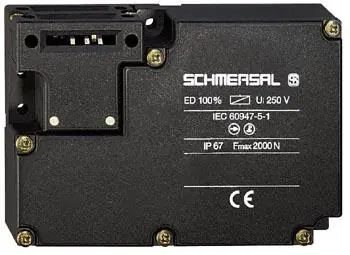
- Enclosure: Thermoplastic, glass-fibre reinforced, self-extinguishing.
- Contacts: 6 contacts (4 safety, 2 auxiliary).
- Protection: IP67 rating (dust-tight and protected against water immersion).
- Manual Release: Allows for manual unlocking during maintenance or installation using an M5 triangular key.
- Locking Principle: Power to lock (the device locks when power is applied).
Technical Specifications
- Rated Control Voltage (Us): 24 VAC/DC.
- Power Consumption: Max 10 W.
- Mechanical Life: > 1,000,000 operations.
- Ambient Temperature: -25 °C to +60 °C.
- Cable Section: 0.25 mm² to 1.5 mm² (including conductor ferrules).
- Clamping Force: 2000 N.
- Utilisation Category: AC-15: 230 V / 4 A; DC-13: 24 V / 2.5 A.
Installation and Wiring
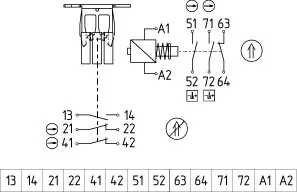
The device uses screw connections for electrical wiring. Ensure the cable section is within the specified range of 0.25 mm² to 1.5 mm². The wiring diagram provided in the manual details the contact configuration (13-14, 21-22, 41-42, 51-52, 63-64, 71-72) and the solenoid connection (A1-A2).
Operation and Maintenance
The interlock includes a manual release feature for maintenance and installation purposes. If the device needs to be unlocked manually, an M5 triangular key (available as an accessory) must be used. The device is designed to prevent incorrect locking.
Dimensions
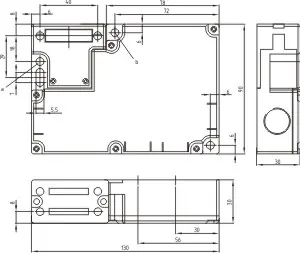
The sensor dimensions are 130 mm (width) x 90 mm (height) x 30 mm (length). Refer to the dimensional drawings in the manual for precise mounting hole locations and clearances.
Accessories
Various actuators are available for the AZM 161 series, including models with ball latches, magnetic latches, and centering guides for small actuating radii. A triangular key (TK-M5) and specific mounting sets (MS AZM 161) are also available.
Manufacturer information
Schmersal
Practical help
Common problems
Device fails to unlock
Verify the power supply (24 VAC/DC) is active. If power is lost, use the manual release with an M5 triangular key.
Wiring connection issues
Ensure the cable cross-section is between 0.25 mm² and 1.5 mm². Ensure ferrules are used.
Before use
- Verify the supply voltage matches the device rating (24 VAC/DC).
- Ensure the ambient temperature is within the -25 °C to +60 °C range.
- Check that the cable section is within 0.25 mm² to 1.5 mm².
- Confirm the safety guard type is compatible (sliding, removable, or hinged).
- Ensure the correct actuator is selected for the specific guard application.
Specs in practice
- Power to lock
- The locking mechanism engages when power is applied to the solenoid.
Images and diagrams
- Wiring diagram shows contacts 13-14, 21-22, 41-42, 51-52, 63-64, 71-72 and solenoid terminals A1/A2.
- Switch travel diagram indicates contact states (closed/open) during the actuation sequence.
Model compatibility
- Compatible with various actuators: AZM 161-B1, B1E, B1ES, B1F, B1S, B6, B6S.
- Requires M5 triangular key for manual release (sold separately).
- Only for Us: 24 VAC/DC models support LED indicators.

Manual page author
David Miller
Documentation analyst
Organizes user manual content into clear summaries, with attention to model details, product context, and everyday usability.