Automotive / Garage Equipment
Sealey 1030CXDK Trolley Jack and Axle Stands
Quick guide for the Sealey 1030CXDK trolley jack and axle stands. Includes safety instructions, operating procedures, maintenance tips, and troubleshooting for safe vehicle lifting.
Table of contents
Manual images
Click an image to enlargeQuick guide from the manual
This document provides instructions for the safe operation and maintenance of the Sealey 1030CXDK trolley jack and axle stands. The most critical safety rule is that the jack is a lifting device only and must never be used to support the load. Always use the provided axle stands in pairs on a hard, level surface (concrete) to support the vehicle before working underneath it. Never use the equipment on tarmacadam as the jack may sink.
Safety Precautions
- Always use axle stands in pairs on a hard, level surface.
- Do not exceed the rated capacity of the jack (2 tonnes) or the axle stands (1 tonne each).
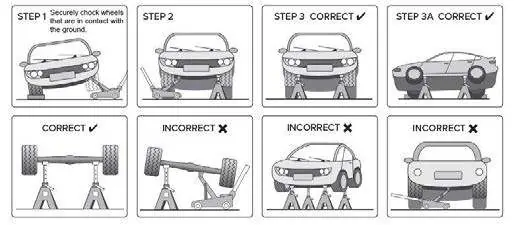
- Ensure the vehicle handbrake is engaged and wheels are chocked before lifting.
- Never work under a vehicle supported only by the jack.
- Do not use the jack to move the vehicle.
- Ensure a minimum distance of 0.5m between the vehicle and static objects.
Specifications
- Trolley Jack Capacity: 2 tonnes (2000 kg)
- Jack Lift Range: 130mm to 330mm
- Axle Stand Capacity: 1 tonne each (2 tonnes per pair)
- Axle Stand Height: 275mm to 365mm
Before First Use
Before using the jack, you must purge the hydraulic unit to eliminate air:
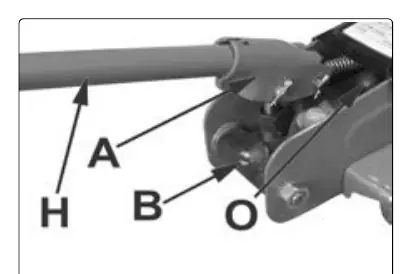
- Locate the handle onto the release valve nut and turn it anti-clockwise to open the valve.
- Place the handle into the jacking point and pump for 30 to 40 seconds.
- Close the release valve by turning the nut clockwise.
- Lubricate moving parts and place a few drops of hydraulic jack oil on the pump piston.
Operation
Jacking the Vehicle
- Ensure the vehicle is on level, solid ground.
- Close the release valve (turn clockwise).
- Position the jack saddle under the manufacturer's recommended lifting point.
- Pump the handle to raise the vehicle.
Using Axle Stands
- Ensure the stand legs are fully extended.
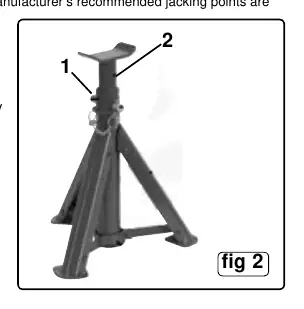
- Adjust the height and insert the locking pin completely through the centre column.
- Position the stands under the vehicle's recommended points.
- Slowly lower the vehicle onto the stands, ensuring the jacking points sit in the centre of the saddles.
Lowering the Vehicle
- Raise the jack slightly to remove the axle stands.
- Slowly turn the release valve anti-clockwise to lower the vehicle. Control the speed by the amount you turn the handle.
Maintenance
- Cleaning: Keep the jack clean and lubricate moving parts regularly with acid-free oil.
- Inspection: Before each use, check for broken, cracked, or loose parts.
- Oil Level: To check the oil, fully lower the jack and remove the filler screw. The level should be at the bottom of the screw hole. Use only hydraulic jack oil; do not use brake fluid.
- Repair: Hydraulic maintenance must only be performed by a qualified person.
Troubleshooting
If the jack fails to lift or hold a load, check for air in the system (purge as described above), low oil levels, or an open release valve. If the jack feels "spongy," it usually indicates air in the system. If the jack will not hold a load, check for dirt on the valve seats or a partially open release valve.
Manufacturer information
Sealey Group
Practical help
Common problems
Jack will not lift the load
Check for overload, low oil level, air in the system, or an open release valve. Ensure the release valve is closed.
Jack feels 'spongy'
There is air in the hydraulic system. Open the release valve and pump the handle several times to purge the air.
Jack will not hold load
The release valve may be partially open, or there is dirt on the valve seats. Check and close the valve, or clean the valve seats.
Jack will not lower completely
The unit may require lubrication, or the release valve is not fully open. Check for bent parts or air in the system.
Before use
- Check jack and stands for damage, cracks, or leaks.
- Purge the hydraulic system of air before first use.
- Ensure the vehicle is on a hard, level surface (concrete).
- Chock the vehicle wheels.
- Verify axle stands are in good condition and locking pins are present.
- Lubricate moving parts.
Specs in practice
- Jack Capacity
- Maximum weight the jack can lift is 2 tonnes (2000 kg).
- Axle Stand Capacity
- Maximum weight per stand is 1 tonne (1000 kg); 2 tonnes per pair.
- Jack Lift Range
- The saddle height adjusts from 130mm to 330mm.
- Axle Stand Height
- Adjustable height range from 275mm to 365mm.
Images and diagrams
- Fig 1: Shows the jack components, including the jacking point (A), release valve nut (B), and filler screw (O).
- Fig 2: Shows the axle stand components, including the locking pin (2.1) and centre column (2.2).
- Placement Guide: Illustrates the correct and incorrect ways to position the jack and axle stands under a vehicle.
Model compatibility
- Do not use on tarmacadam; the jack may sink.
- Use axle stands in pairs only.
- Use only hydraulic jack oil; do not use brake fluid.
- Consult vehicle manufacturer's handbook for correct lifting points.

Manual page author
Michael Turner
Technical manual editor
Reviews PDF manuals for structure, safety notes, and practical product details so readers can find the right information quickly.