Tools / Pressure Washers
User Manual for SIP 12T Hydraulic Pipe Bender
Quick guide for the SIP 12T Hydraulic Pipe Bender (03683). Includes setup, operation, maintenance, safety warnings, and part list.
Table of contents
Manual images
Click an image to enlargeQuick Guide
The SIP 12T Hydraulic Pipe Bender is designed for bending steel pipes (galvanized and black). It is not suitable for thin-walled tubes like copper. Always operate on a level, stable surface and ensure the work area is clear of bystanders.
Description
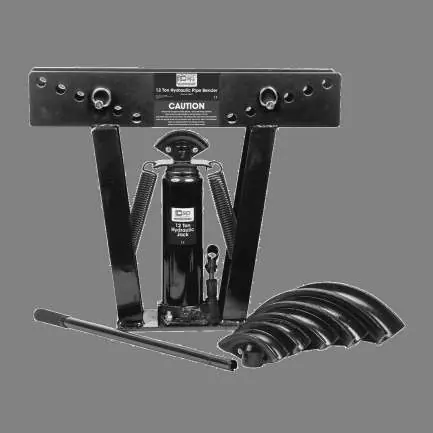
The unit features a 12-ton hydraulic ram and comes with six bending formers to accommodate various pipe sizes. It is a manual tool requiring physical operation of the pump handle.
Safety Instructions
- Capacity: Never exceed the 12-ton maximum capacity.
- Material: Use only for steel pipe. Do not use for thin-walled tubes (e.g., copper) or for compressing springs.
- Operation: Always operate on a level, stable surface. Never stand on the product.
- Maintenance: Keep hands and limbs clear of moving parts. Do not adjust safety overload valves.
- Protection: Always wear eye protection and heavy protective clothing.
- Inspection: Before use, check for cracked welds, loose bolts, or oil leaks. Do not use if damaged.
Operation
The tool includes six bending formers for British Standard Pipe (BS1387) sizes: 1/2", 3/4", 1", 1-1/4", 1-1/2", and 2 inches.
- Setup: Place the pipe in the former. Secure guide rollers using the R-clips.
- Valve Control: Close the hydraulic valve by turning it fully clockwise.
- Bending: Pump the operating lever gently. For best results, bend progressively by adjusting the guide rollers.
- Removal: Once the bend is complete, open the hydraulic valve (turn anticlockwise) to release pressure and remove the work.
- Former Removal: If the former sticks, use a hammer and brass drift to tap it gently. Never hammer directly on the edges of the former.
Maintenance
- Cleaning: Keep the tool clean.
- Storage: Store in an upright position with the ram in its lowest position. Do not store on its side to prevent air from entering the system.
- Bleeding the Ram: If performance is poor due to air in the system:
- Keep the ram in a vertical position.
- Close the release valve (clockwise).
- Remove the rubber bung on the upper cylinder.
- Pump the handle several times to expel air.
- Replace the rubber bung.
Parts and Assembly
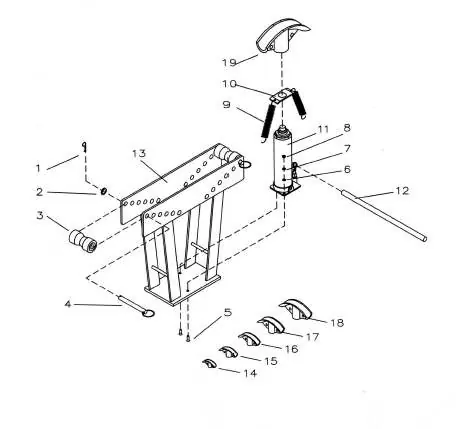
Refer to the exploded drawing and part list for identifying components such as the R-clip, rollers, springs, and specific pipe formers (1/2" to 2").
Guarantee and Disposal
The product is covered by a 2-year parts and labour warranty against manufacturer defects. Dispose of packaging and the product responsibly at a local recycling facility; do not dispose of electrical equipment or batteries with domestic waste.
Practical help
Common problems
Poor performance or ram not lifting
Air may be in the system. Bleed the ram by removing the rubber bung on the cylinder and pumping the handle.
Bend quality is poor
Ensure the correct bending former is used for the specific pipe size and that the pipe is located securely and square in the die.
Ram will not extend
Ensure the hydraulic release valve at the base of the ram unit is closed by turning it fully clockwise.
Before use
- Check for cracked welds or structural damage.
- Ensure no oil is leaking from the unit.
- Verify all parts are present and secure.
- Ensure the work area is clean, tidy, and well-lit.
- Wear appropriate eye protection and heavy protective clothing.
Specs in practice
- Bending Formers
- Six included dies for pipe sizes 1/2, 3/4, 1, 1-1/4, 1-1/2, and 2 inches.
- Hydraulic Valve
- Controls ram movement; turn clockwise to close/pump, anticlockwise to open/release.
Images and diagrams
- Exploded Drawing: Illustrates the assembly of the frame, hydraulic pump, and the correct placement of the bending formers.
- Part List: Provides the reference numbers and SIP part numbers for all components, including R-clips, washers, and formers.
Model compatibility
- Designed for steel pipe only (galvanized and black).
- Not suitable for thin-walled tubes such as copper.

Manual page author
Michael Turner
Technical manual editor
Reviews PDF manuals for structure, safety notes, and practical product details so readers can find the right information quickly.