Power / Transformers & Supplies
Installation Guide for SloanLED 100L1D 24 VDC Power Supply
Installation and wiring guide for the SloanLED 100L1D 24 VDC Power Supply. Includes mounting instructions, wiring diagrams, safety clearances, and troubleshooting steps.
Table of contents
Manual images
Click an image to enlargeQuick guide from the manual
This document provides installation instructions for the SloanLED 100L1D 24 VDC Power Supply (PN 701895-100L1D). The unit is a NEC Class 2 output power supply. Installation must be performed by a licensed electrician. Ensure the power supply is mounted in an appropriate enclosure and that all safety clearances are maintained.
Tools and Supplies Required
Before beginning the installation, ensure you have the following:
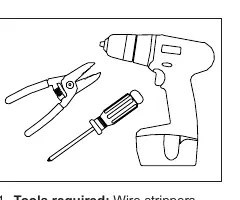
- Tools: Wire strippers, drill, and screwdriver.
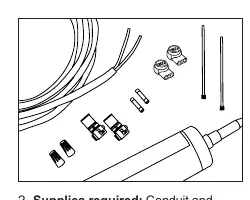
- Supplies: Conduit and electrical enclosure (if not placed in a sign made from enclosure-rated material), #8 pan head screws, UL Listed PLTC cable, UL Listed electrical wire connectors (e.g., wirenuts), and silicone.
- Europe specific: Electrical enclosure, M4 pan head screws, PLTC cable, silicone, and 3M Scotchlok connectors.
Installation and Mounting
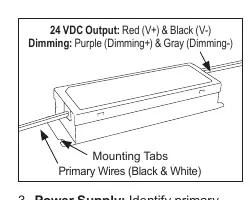
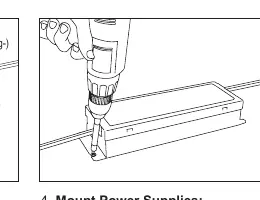
- Identify the primary wires, secondary wires, and the location of the mounting tabs on the power supply.
- Use the mounting tab in the corner to secure the power supply to the enclosure.
- Ensure adequate ventilation. The power supply operating ambient temperature is -40°C to 55°C.
- The power supply must be mounted in an enclosure (e.g., transformer can/raceway).
- Maintain a spacing of 1 inch (25 mm) to thermoplastic, wood, fiber, or other combustible enclosure materials.
- For multiple power supplies, do not mount them closer than 1 inch (25 mm) end-to-end or 4 inches (102 mm) side-to-side.
Wiring Connections
CAUTION: Have a licensed electrician connect the primary wiring.
- 24 VDC Output: Red (V+) and Black (V-).
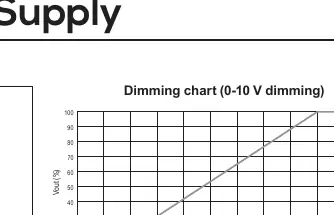
- Dimming: Purple (Dimming+) and Gray (Dimming-).
- Ensure all secondary connections are RED-TO-RED and BLACK-TO-BLACK.
Troubleshooting
If the sign is not functioning properly, check the following:
- Primary voltage is between 120-277 VAC.
- Secondary voltage is 24 VDC.
- Output current is 4.15 Amps or less.
- Power supply is not overloaded (refer to the capacity chart).
- There are no shorts in the secondary wiring.
- All secondary connections are secure and correctly matched.
Technical Specifications
The unit features 0-10 V dimming capability. It is recommended to use photocells or light sensors to prolong the life of the power supply and keep the unit at maximum operating efficiency. Ensure output current is verified to be less than 4.15 DC Amps to prevent overloading.
Practical help
Common problems
Sign not functioning properly
Verify primary voltage (120-277 VAC), secondary voltage (24 VDC), output current (<= 4.15A), check for secondary wiring shorts, and ensure connections are Red-to-Red and Black-to-Black.
Before use
- Ensure ambient temperature is between -40°C and 55°C.
- Verify the enclosure is made of enclosure-rated material.
- Confirm output current is less than 4.15 DC Amps.
- Maintain 1 inch spacing to combustible materials.
- Maintain 1 inch end-to-end and 4 inch side-to-side spacing for multiple units.
Specs in practice
- Primary Voltage
- 120-277 VAC
- Secondary Voltage
- 24 VDC
- Max Output Current
- 4.15 Amps
- Operating Temperature
- -40°C to 55°C
Images and diagrams
- 24 VDC Output: Red (V+), Black (V-)
- Dimming: Purple (Dimming+), Gray (Dimming-)
Model compatibility
- NEC Class 2 Output

Manual page author
David Miller
Documentation analyst
Organizes user manual content into clear summaries, with attention to model details, product context, and everyday usability.