Power / Solar Inverters
Installation Guide and User Manual for Sol-Ark 12K-2P-N Residential Hybrid Inverter
Comprehensive installation and user guide for the Sol-Ark 12K-2P-N Residential Hybrid Inverter. Includes mounting, wiring, battery integration, system configuration, parallel setup, and troubleshooting.
Table of contents
Manual images
Click an image to enlargeQuick Guide from the Manual
The Sol-Ark 12K-2P-N is a residential hybrid inverter designed for 120/240V split-phase systems. Before operating, verify utility voltage and ensure the unit is programmed for 120/240V Split-Phase at 60Hz. The system requires at least one power source (Battery, PV, or Grid) to turn on. Only qualified persons should install this equipment due to high life risk from fire or electrocution.
Installation
Mount the inverter in a location with at least 2 inches of vertical clearance and 6 inches of side clearance for heat dissipation. Protect the LCD screen from direct UV exposure. Use appropriate anchors for the mounting surface (concrete, wood, or metal frame).
Battery Integration
The system is a 48VDC nominal system. Connect batteries in series/parallel to maintain a range of 43VDC to 63VDC. Ensure battery breakers are OFF during wiring. Install the included toroids on battery conductors.
PV and Generator Connection
The inverter features 2 independent MPPTs, each supporting up to 2 PV strings. Max input voltage is 500VDC. Generators can be connected to the "GEN" input (for units <9.6kW) or "GRID" input (for units >9.6kW). Ensure proper phase sequence and use CT sensors for grid-tied or peak-shaving applications.
User Interface and Setup
The LCD touch screen provides access to system status and configuration. Key menus include:
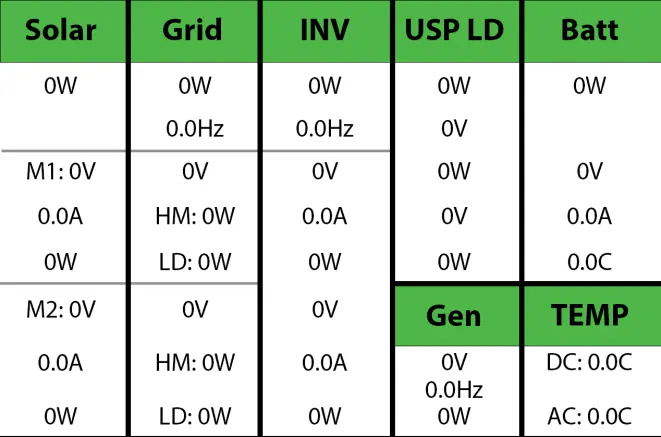
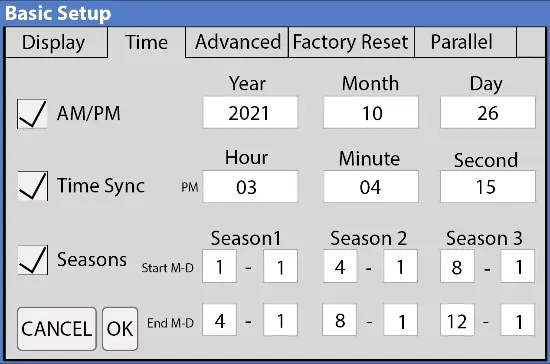
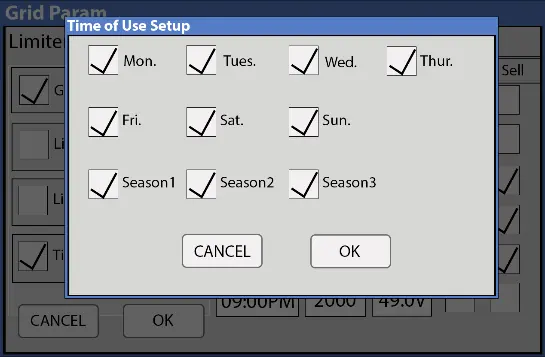
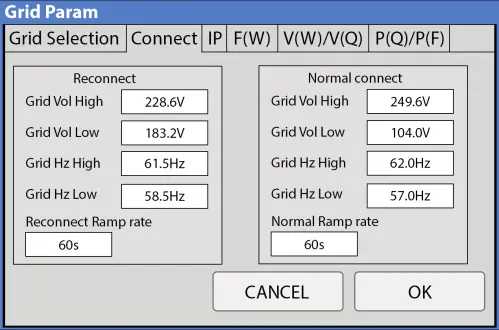
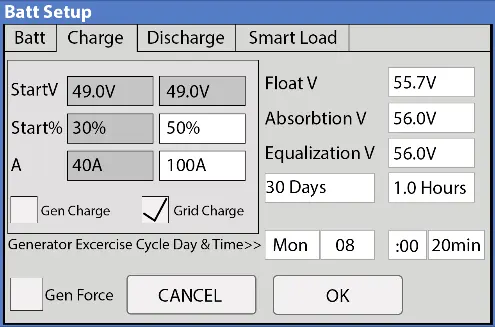
- Basic Setup: Configure brightness, time, and system modes.
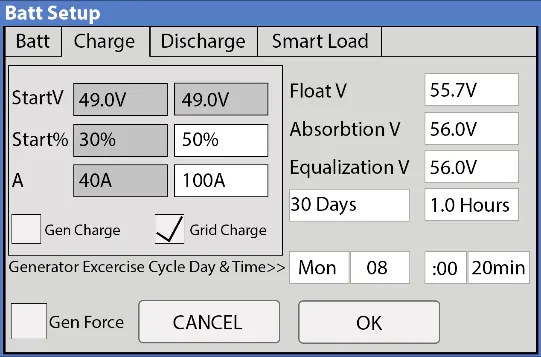
- Battery Setup: Define battery capacity, charge/discharge limits, and battery type (Lithium/Lead Acid).
- Limiter: Configure work modes such as Grid Sell, Limited Power to Home, and Limited Power to Load.
- Grid Setup: Adjust grid mode (General Standard, UL1741, etc.), frequency, and voltage parameters.
Parallel Systems
For parallel operation, all units must share a single battery bank and have the same software version. Assign one unit as "Master" (Modbus SN: 1) and others as "Slave" (Modbus SN: 2-9). Use the DIP switches on the inverter to configure the parallel setup.
Remote Monitoring
The MySolArk platform allows for remote monitoring and configuration. Connect the Wi-Fi/Ethernet dongle to the inverter and follow the setup instructions in the app to create a plant and configure network settings.
Troubleshooting
If the system encounters issues, check the "System Alarms" menu. Common error codes include:
- F15/F18/F20: Overload or overcurrent faults.
- F26: Bus Unbalance fault.
- F63: Arc Fault (check PV connections).
For technical support, contact (USA) +1 (972) 575-8875 ext. 2 or email [email protected].
Practical help
Common problems
LCD not powering on
Check connections; at least one power source (PV, Grid, or Battery) is required. Try pressing the power button or touchscreen.
Panels connected but DC LED is off
Ensure PV DC disconnect is ON, check string polarity, and verify input voltage is above 125V.
Grid Phase Wrong error
Check AC wiring phase sequence (BA-CB-AC convention) on both GRID and LOAD breakers.
System is beeping
Check the System Alarms menu to identify the specific alarm. Most alarms will self-reset.
Before use
- Verify utility voltage before turning ON the unit.
- Check battery bank voltage (must be between 43VDC - 63VDC).
- Ensure proper grounding and neutral bonding (only once in the circuit).
- Verify phase sequence for 3-phase systems.
- Ensure all AC breakers are OFF before initial power-up.
Specs in practice
- Max PV Input
- 13,000W total; 6.5kW per MPPT.
- Max Battery Charge/Discharge
- 185A.
- Enclosure Rating
- IP65 / NEMA 3R (suitable for outdoor installation).
- Backup Transfer Time
- 4ms.
Images and diagrams
- The manual includes wiring diagrams for various configurations: Standard, Line Side Tap, AC Coupling (GEN/LOAD), Whole-Home Generator, Off-Grid, and Parallel Inverter setups.
Model compatibility
- Requires 48V battery bank.
- Compatible with Lithium and Lead Acid batteries.
- AC coupled inverters must be UL 1741SA or UL 1741 certified.

Manual page author
Emily Carter
User documentation editor
Prepares concise manual descriptions and highlights the most useful setup, operation, and maintenance information for readers.