Toys / RC Models & Drones
Spektrum DX Rugged+ 12-Channel Radio System User Manual
Quick guide for the Spektrum DX Rugged+ 12-Channel 2.4GHz DSMR Radio System. Includes setup, binding, AVC tuning, menu navigation, and troubleshooting.
Table of contents
Manual images
Click an image to enlargeQuick guide from the manual
The DX Rugged+ is a 12-channel 2.4GHz DSMR radio system. For daily driving, always turn on the transmitter first, then the vehicle. When finished, turn off the vehicle first, then the transmitter.
Binding Process:
- Place the receiver into Bind mode using a bind plug or the bind button.
- Power on the transmitter.
- Select the desired Model Memory.
- Select Bind from the List menu.
- Move the throttle to the desired failsafe position.
- Select Bind on the screen. Once LEDs turn solid orange, the process is complete.
Identifying controls and switches
The transmitter features various inputs for control:
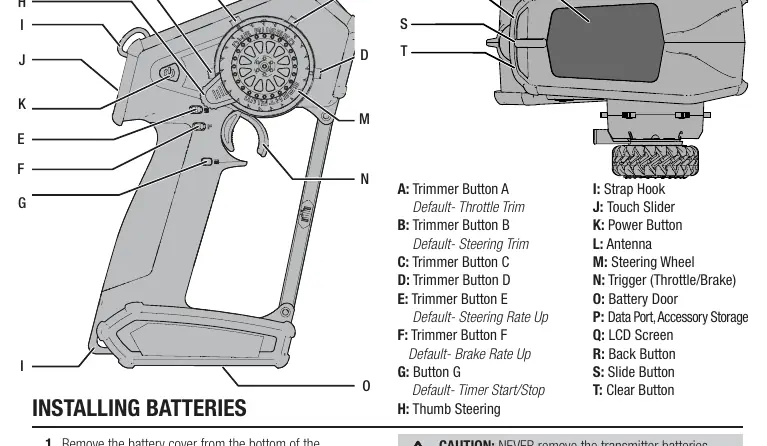
- A-G: Trimmer buttons (default functions include Throttle Trim, Steering Trim, Steering Rate, Brake Rate, and Timer Start/Stop).
- M: Steering Wheel.
- N: Trigger (Throttle/Brake).
- J: Touch Slider for navigation.
- K: Power Button.
- Q: LCD Screen.
Getting started
To install batteries, remove the cover from the bottom of the transmitter and install 4 AA batteries. Ensure all batteries are properly charged before use. Always check servos and connections before each run. Never operate the model near spectators or in adverse weather conditions.
Navigation and interface
The system uses a touch interface. Slide your finger to move through lines or scroll. Use the Back button to return to the previous screen and the Clear button to reset values. Touch OK in the center of the screen to access the Function List.
Menu functions
The Function List provides access to extensive settings, including:
- Model Select: Access up to 20 internal model memory locations.
- Vehicle Type: Configure settings for SLT vehicles.
- Travel/Sub-Trim/Reverse: Adjust servo endpoints, center positions, and direction.
- Rates/Exponential: Fine-tune steering and throttle response.
- Timer: Program countdown or stopwatch functions.
- Mixing: Configure steering mixes (4WS, Dual Steering) and programmable mixes.
- Telemetry: View and edit sensor data (compatible with SMART ESCs).
- Settings: Adjust display, contrast, sounds, and inactive alarms.
Physical transmitter adjustments
The transmitter allows for physical customization:
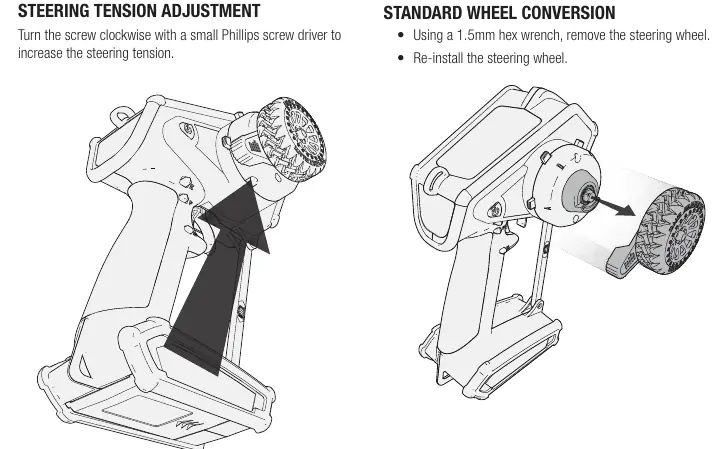
- Steering Tension: Turn the screw clockwise with a small Phillips screwdriver to increase tension.
- Standard Wheel Conversion: Use a 1.5mm hex wrench to remove and re-install the steering wheel.
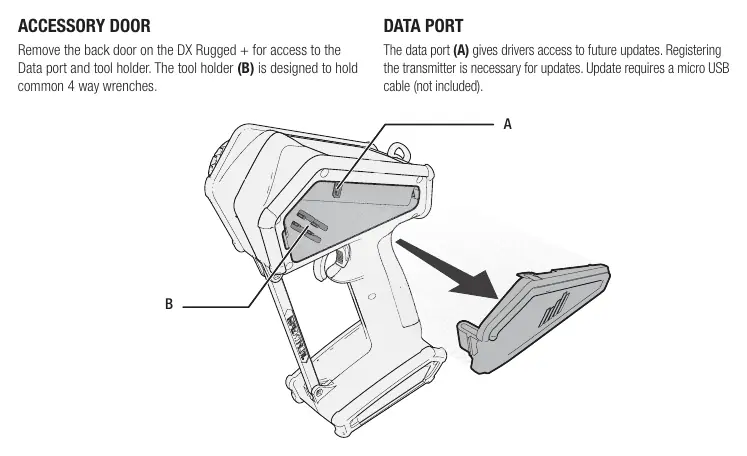
- Accessory Door: Provides access to the Data port and a tool holder for 4-way wrenches.
AVC tuning
The AVC (Active Vehicle Control) menu manages steering gain, throttle gain, and priority. To tune:
- Gain: Adjusts electronic corrections. Start with default values of 50 and adjust in 5-point increments.
- Priority: Determines how much you can override electronic stability with steering commands.
- Heading Hold: Maintains the selected vehicle direction.
If the vehicle oscillates at high speeds, reduce steering gain. If the vehicle fishtails, increase throttle gain.
Troubleshooting
If the system fails to connect, ensure the transmitter and receiver are 8-12 feet apart and not near large metal objects. Verify the correct model memory is selected and the transmitter is bound. If the receiver loses bind, rebind the transmitter. For AVC issues, ensure the receiver is mounted level and properly calibrated.
Manufacturer information
Spektrum
Practical help
Common problems
System will not connect
Move transmitter 8-12 feet from receiver; check if model is bound; check battery charge.
Receiver goes into failsafe mode
Check receiver antenna for damage; ensure antenna is in a tube and above the vehicle.
Receiver loses bind
Rebind transmitter to receiver.
Vehicle oscillates at high speeds
Reduce steering gain.
Can't assign functions to switches
Buttons/switches may already be assigned; re-assign functions to free up the desired switch.
Before use
- Ensure batteries are properly charged
- Check all servos and connections
- Verify model memory selection
- Ensure receiver antenna is positioned correctly
- Perform a control test after adjustments
Specs in practice
- Voltage Range
- 3.5–9.6V
Images and diagrams
- A-G: Trimmer buttons for trim and rates
- M: Steering wheel
- N: Trigger (Throttle/Brake)
- Q: LCD Screen
- P: Data port and accessory storage
Model compatibility
- Compatible with Spektrum DSMR 5.5, DSMR, DSMR+, and SLT receivers.

Manual page author
David Miller
Documentation analyst
Organizes user manual content into clear summaries, with attention to model details, product context, and everyday usability.