Electronics / Monitors
User Manual for Uperfect 16 Inch 120Hz Portable Monitor
Quick guide for the Uperfect 16 Inch 120Hz Portable Monitor. Includes setup instructions, connection methods for Type-C and HDMI, OSD menu settings, and troubleshooting for power and signal issues.
Quick answers from the manual
Quick answer
- This manual provides instructions for setting up, connecting, and adjusting the Uperfect 16-inch 120Hz portable monitor, including troubleshooting common power and signal issues. p. 1, 2
Key actions
- Connect via Type-C p. 5
- Connect via HDMI p. 6
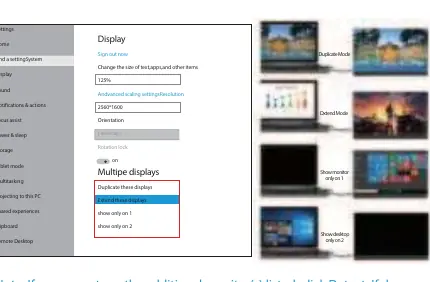
- Set up Windows display modes p. 7
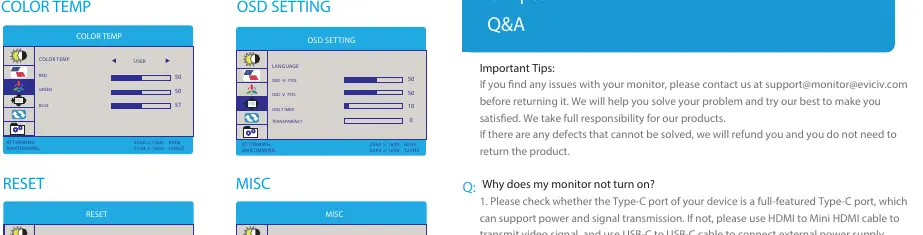
- Adjust OSD settings p. 8, 9
- Save settings p. 9
First start
- Check package contents p. 2
- Install stand case p. 4
- Power on p. 3
Show 4 more answers Show less
Problems and fixes
Monitor does not turn on
Check if Type-C port supports power/signal (Thunderbolt 3). If not, use HDMI and external power (PD 18W minimum).
p. 9
No signal
Ensure device supports USB 3.1/Thunderbolt 3. If not, use Mini HDMI to HDMI cable. Use original cables.
p. 10
Monitor turns off when brightness is increased
Insufficient power supply; use an external power supply.
p. 10
Abnormal conditions (splash screen, spots, restarts)
Insufficient power; use original cable or a power bank with 30W or more.
p. 10
Cannot get 2K resolution or 120Hz on Xbox
Ensure device/game support. Set manually in console settings (Settings > General > TV & Display Options > Video Fidelity & Overscan > Display).
p. 9Maintenance and reset
- Reset monitor settings p. 9
Technical specifications
| Parameter | Value | Meaning | Pages |
|---|---|---|---|
| Panel Type | IPS | Display panel technology | p. 4 |
| Screen Size | 16 inches | Diagonal screen size | p. 4 |
| Aspect Ratio | 16:10 | Width to height ratio | p. 4 |
| Resolution | 2560*1600 | Pixel resolution | p. 4 |
| Refresh Rate | 120 Hz | Screen refresh rate | p. 4 |
| Contrast Ratio | 1200:1 | Contrast ratio | p. 4 |
| Color Gamut | 72% NTSC, 100% sRGB | Color reproduction range | p. 4 |
| VESA | 75*75mm, M4*4mm | Mounting standard and screw size | p. 3, 4 |
| Built-in Speakers | 8Ω 1W * 2 | Speaker impedance and power | p. 3, 4 |
| Interfaces | Mini HDMI, Type-C * 2, 3.5mm Audio Jack | Available ports | p. 4 |
Where to find it in the PDF
- Table of Contents & Package Contents p. 2
- Monitor Introduction & Ports p. 3
- Specifications & Stand Installation p. 4
- Connecting (Type-C) p. 5
- Connecting (HDMI) p. 6
- Windows Setup p. 7
- Screen Adjustment & Rotation p. 8
- OSD Settings & Save Settings p. 9
Table of contents
Manual images
Click an image to enlargeQuick guide from the manual
This monitor is designed for portable use with Type-C and HDMI connectivity. For optimal performance, ensure your source device supports full-featured Type-C (Thunderbolt 3) for single-cable power and signal transmission. If your device does not support this, use an external power supply (minimum 18W) and the HDMI port.
Package Contents
- Portable Monitor
- Power Adapter
- Smart Cover
- Mini HDMI to HDMI Cable
- Type-C to Type-C Cable
- User Guide
Monitor Introduction
The monitor features a Pulley Button for navigation and control:
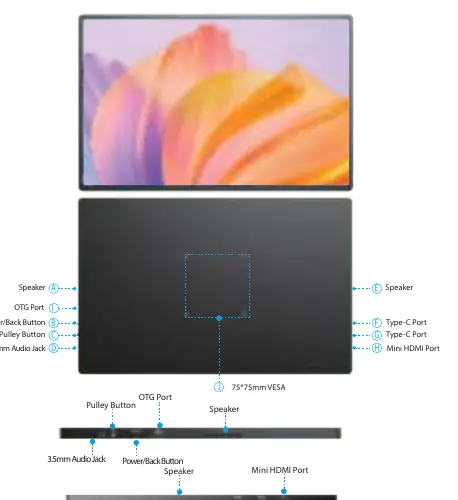
- Power/Back Button: Long press to turn on/off; short press to go back.
- Pulley Button: Scroll up for volume, scroll down for brightness, press to enter the OSD menu.
- Ports: Includes two full-featured Type-C ports, one Mini HDMI port, one OTG port (for mouse/keyboard), and a 3.5mm audio jack.
- VESA: Supports 75x75mm VESA mounts (M4x4mm screws).
Installing the Stand Case
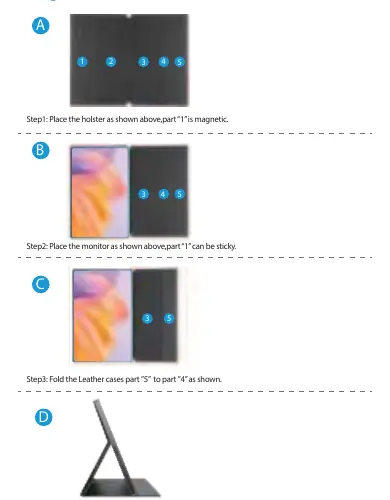
- Place the holster flat; part 1 is magnetic.
- Place the monitor on the holster; part 1 attaches to the monitor.
- Fold the leather case part 5 to part 4.
- Stand up the monitor and adjust the angle.
Connecting the Monitor
Type-C Signal Transfer: Connect the monitor to your device using the Type-C cable. Ensure your device's Type-C port supports audio and video signal transmission (Thunderbolt 3). If the port only supports charging, you must connect the HDMI port for video and use an external power supply.
HDMI Signal Transfer: Connect the monitor via the Mini HDMI to HDMI cable. Use an external power adapter for a stable power supply.
Screen Adjustment (OSD)
Press the Pulley button to open the OSD menu. You can adjust settings such as Brightness, Contrast, Color Temp, and OSD settings. To save settings, ensure the monitor is connected to an external power supply if using a Type-C source.
Troubleshooting
- Monitor does not turn on: Check if the Type-C port supports video/power. If not, use HDMI and an external power supply (min 18W).
- No signal: Ensure the device supports USB 3.1/Thunderbolt 3, use original cables, and try another device.
- Monitor turns off when brightness is high: This indicates insufficient power; connect an external power supply.
- Xbox 2K/120Hz issues: Xbox does not support 2K resolution. Set resolution manually in the console settings.
Practical help
Common problems
Monitor does not turn on
Check if the Type-C port supports power/signal (Thunderbolt 3). If not, use HDMI and an external power supply (min 18W).
No signal
Ensure the device supports USB 3.1/Thunderbolt 3, use original cables, and try another device.
Monitor turns off when brightness is high
Insufficient power supply. Connect an external power adapter.
Cannot get 2K/120Hz on Xbox
Xbox does not support 2K. Set resolution manually in the console settings.
Before use
- Check package contents for damage.
- Verify device Type-C port supports audio/video (Thunderbolt 3).
- Use original cables for best performance.
- Ensure external power supply (min 18W) is available if needed.
Show more Show less
Specs in practice
- Refresh Rate
- 120 Hz for smooth motion.
Images and diagrams
- Pulley Button: Scroll up for volume, down for brightness, press to enter OSD menu.
- Stand Case: Magnetic attachment steps 1-4.
Model compatibility
- Type-C: Requires full-featured port (Thunderbolt 3) for single-cable power/signal.
- Xbox: Does not support 2K resolution.

Manual page author
Michael Turner
Technical manual editor