Electronics / Monitors
User Manual for Uperfect 160B01/160B03 Portable Monitor
Quick guide for the Uperfect 160B01 and 160B03 portable monitors. Includes setup instructions, connection methods, OSD menu settings, and troubleshooting tips.
Table of contents
Manual images
Click an image to enlargeQuick guide from the manual
This document provides setup and operation instructions for the Uperfect 160B01 and 160B03 portable monitors. Key actions include connecting the device via USB-C or HDMI, adjusting the stand, and configuring display settings in Windows. If you encounter issues, refer to the troubleshooting section or contact support at [email protected].
Package Contents
- Portable Monitor
- Power Adapter
- Smart Cover
- Mini HDMI to Standard HDMI Cable
- Type-C to Type-C Cable (x2)
- User Guide
Installing the stand case
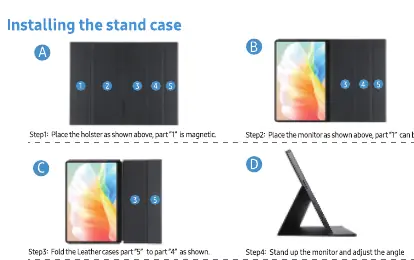
- Place the holster flat.
- Place the monitor on the holster so the magnetic part (1) attaches.
- Fold the leather case part (5) to part (4) to create a stand.
- Stand up the monitor and adjust the angle as needed.
Interface and Ports
The monitor features the following controls and ports:
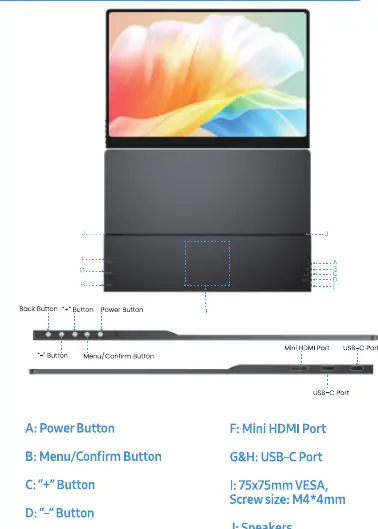
- Buttons: Back, "+", "-", Menu/Confirm, Power.
- Ports: Mini HDMI, USB-C (x2).
- VESA: 75x75mm (Screw size: M4*4mm).
- Audio: Built-in speakers.
Connecting the monitor
Type-C signal transfer: Connect the monitor to your device using the Type-C cable. For a more stable power supply, it is recommended to use the original power adapter.
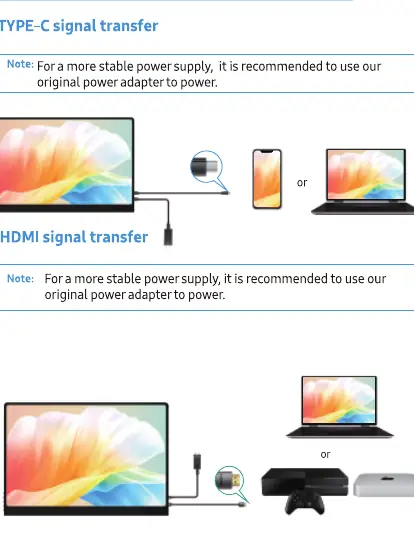
HDMI signal transfer: Connect the monitor to your device using the Mini HDMI to HDMI cable. Ensure you also connect the power adapter for a stable power supply.
OSD Menu Settings
Access the On-Screen Display (OSD) menu to adjust settings:
- Brightness: Adjust brightness, contrast, eco mode, DCR, and sharpness.
- Image: Adjust aspect ratio, black level, hue, and saturation.
- Color Temp: Set color temperature, RGB levels, and low blue light.
- OSD Setting: Adjust language, OSD position, timer, and transparency.
- Reset: Reset settings, HDR mode, and low power mode.
- Misc: Select signal source, mute, and volume.
Windows 10 Setup
To configure display modes (Extend/Duplicate):
- Right-click on the desktop and select Display settings.
- Scroll to Multiple displays and select the desired mode (Duplicate, Extend, etc.).
- Alternatively, use the Windows key + P shortcut to quickly toggle display modes.
Troubleshooting
- Monitor not turning on: Check if the Type-C port supports power/signal. Use the original power adapter. Ensure the power supply is at least 18W.
- No signal: Ensure your device supports USB3.1/Thunderbolt 3. Use original cables. Try connecting to a different device.
- Monitor turns off when brightness increases: This indicates insufficient power. Connect an external power supply.
- Abnormal conditions (splash screen, spots, restarts): Usually caused by insufficient power. Use the original power adapter or a power bank with at least 30W output.
Practical help
Common problems
Monitor does not turn on
Ensure the Type-C port supports power/signal, use the original power adapter, and ensure the power supply is at least 18W.
No signal displayed
Verify device supports USB3.1/Thunderbolt 3, use original cables, or try a different device.
Monitor turns off when brightness is increased
This is due to insufficient power; connect an external power supply.
Screen flickering or constant restarts
Use the original power adapter or a power bank with at least 30W output.
Before use
- Check package contents for all cables and the adapter
- Verify your source device supports USB-C video output
- Use the original power adapter for stable operation
- Ensure the stand case is properly folded and attached
Show more Show less
Specs in practice
- Refresh Rate
- 120 Hz
Images and diagrams
- Stand case folding steps A-D
- Interface button and port locations
- Connection diagrams for Type-C and HDMI
Model compatibility
- Requires USB3.1/Thunderbolt 3 for single-cable USB-C connection
- Supports Windows 10 display settings for extended/duplicate modes

Manual page author
Michael Turner
Technical manual editor