Electronics / Amplifiers Receivers
User Manual for Altec 100A Bass Energizer
Quick guide for the Altec 100A Bass Energizer. Learn how to connect this passive low-frequency booster to your bookshelf speakers, understand compatibility requirements, and use the bypass switching setup.
Table of contents
Manual images
Click an image to enlargeQuick guide from the manual
The Altec 100A Bass Energizer is a passive device designed to improve the low-frequency response of small bookshelf speakers. It acts as an extreme low-pass filter, compensating for the lack of bass often found in smaller enclosures. Because it is a passive device, it requires no external power, but it does introduce some insertion loss, meaning your amplifier must have sufficient power to drive the speakers effectively.
Product Description
The Bass Energizer is designed to be connected between the amplifier output and the speaker input. It helps correct "tinny" sound by boosting the fundamental bass frequencies without negatively affecting the mid-range or high-frequency response. It can also serve as a protective device, preventing speakers from being "blown" by excessive power when used correctly.
Installation and Wiring
The unit is compact (approximately 5.75 inches long, 2.125 inches wide, and 2.125 inches high) and can be mounted on the back of the speaker cabinet or inside the equipment cabinet.
- Basic Connection: Connect the device in series between the amplifier output and the speaker input.
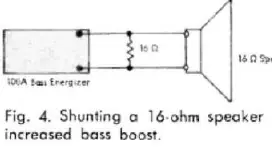
- Shunting for 16-ohm Speakers: To achieve a 10dB rise in low-frequency response with a 16-ohm speaker, you can shunt the speaker input with a 16-ohm wire-wound resistor as shown in the wiring diagrams.
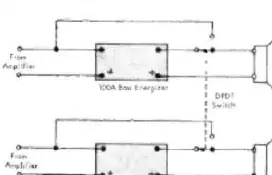
- Bypass Switching: It is recommended to use a DPDT (double pole, double throw) switch to allow the energizer to be switched in and out of the circuit as needed.
Compatibility and Limitations
The Bass Energizer is primarily designed for use with efficient speakers. Because the device causes insertion loss (6dB for 16-ohm speakers, 10dB for 8-ohm speakers), it is not recommended for use with low-efficiency speakers unless they are driven by an amplifier with significant output (50 to 75 watts or more) to overcome this loss.
Technical Specifications
The unit is a passive component and does not require electrical power. It is designed to provide a healthy bass transfusion for any small bookshelf speaker system, effectively simulating the bass response of a much larger cabinet.
Manufacturer information
Altec Lansing
Practical help
Common problems
Tinny sound
This is often caused by too much emphasis on mid-range frequencies. The Bass Energizer helps correct this by boosting the low-frequency spectrum.
Low volume or insertion loss
The device causes an insertion loss of 6-10dB. Ensure your amplifier has sufficient power (50-75W+) to compensate for this loss, especially if using low-efficiency speakers.
Before use
- Verify the impedance of your speakers (16-ohm or 8-ohm).
- Ensure your amplifier has enough power to overcome the device's insertion loss.
- Decide if you need a DPDT switch for a bypass setup.
- Mount the unit securely on the back of the speaker or inside the equipment cabinet.
- Connect the device between the amplifier output and the speaker input.
Specs in practice
- Insertion Loss
- The reduction in signal level caused by the device (6dB for 16-ohm, 10dB for 8-ohm). Requires higher amplifier power to compensate.
- Passive Device
- The unit requires no external electrical power to operate.
Images and diagrams
- Fig 4: Wiring diagram for shunting a 16-ohm speaker to achieve a 10dB rise in low-frequency response.
- Fig 5: Wiring diagram for a DPDT switch setup, allowing the user to switch the Bass Energizer in and out of the circuit.
Model compatibility
- Best used with efficient speakers.
- Not recommended for low-efficiency speakers unless driven by amplifiers with 50-75W or more.

Manual page author
Emily Carter
User documentation editor
Prepares concise manual descriptions and highlights the most useful setup, operation, and maintenance information for readers.