Lighting / Fixtures
User Manual for anko Air Fryer AAF150
Quick guide for the anko AAF150 air fryer. Learn how to use presets, adjust temperature and time, clean the basket, and troubleshoot common issues.
Table of contents
Quick guide from the manual
The anko AAF150 is a compact air fryer designed for household use. Before first use, ensure all packaging is removed, and the basket and rack are cleaned with hot water and a non-abrasive sponge. Always place the unit on a stable, heat-resistant surface with at least 20cm of clearance from walls or curtains. Do not operate under overhead cabinets.
Important safety instructions
- Never immerse the housing in water.
- Do not cover the air inlet or outlet during operation.
- The basket becomes very hot; always use oven gloves when handling.
- Do not fill the basket with oil; this is a fire hazard.
- Do not exceed the MAX fill line in the basket.
- Always unplug the appliance when not in use and allow it to cool completely before cleaning.
Know your air fryer
The unit consists of a main housing with a control panel, a frying basket, and a frying rack. The control panel features an LED display, ON/OFF button, Start/Pause button, Cook menu button, Increase/Decrease buttons, and a Function selection button.
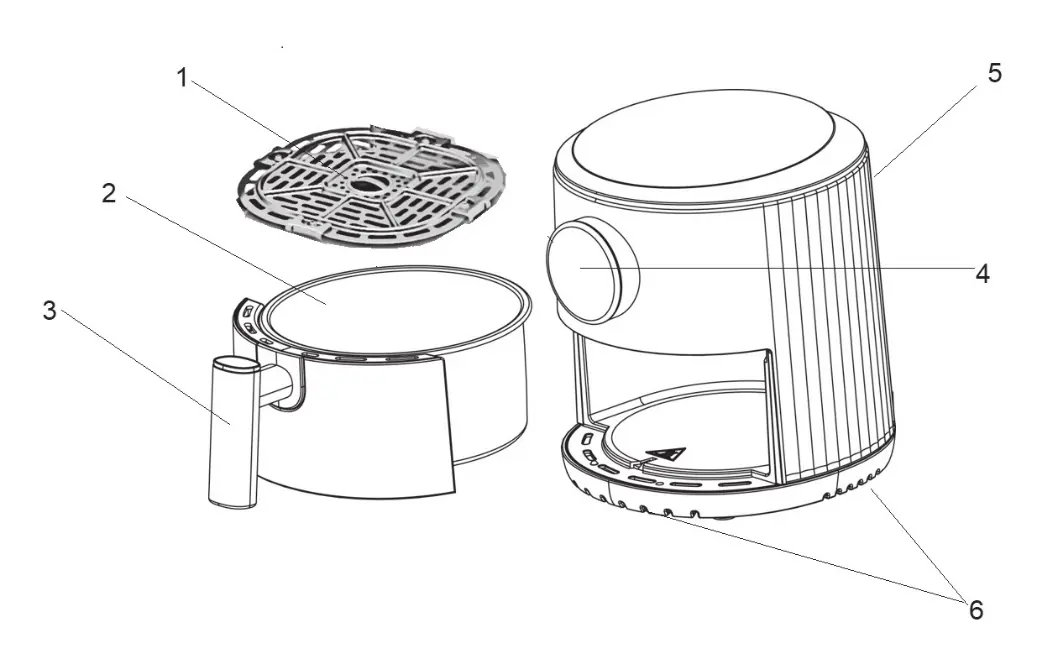
How to use your air fryer
- Connect the power cord to a mains outlet.
- Touch the ON/OFF button to enter standby mode.
- Place ingredients into the basket (do not exceed 1kg).
- Select a preset function or set time and temperature manually using the Increase/Decrease buttons.
- Touch the Start/Pause button to begin cooking.
- You can pull out the basket at any time to check or shake ingredients; the unit will pause automatically and resume when the basket is replaced.
- When the timer ends, the unit will beep.
Cooking presets
The unit includes several pre-programmed settings for common foods:
- 01 Steaks: 15 min, 180°C
- 02 Frozen Chips: 20 min, 200°C
- 03 Fresh Chips: 25 min, 180°C
- 04 Baking: 22 min, 200°C
- 05 Spring Roll: 15 min, 200°C
- 06 Drumstick: 20 min, 180°C
- 07 Prawn: 25 min, 200°C
- 08 Defrost: 20 min, 80°C
Cleaning and maintenance
Always allow the appliance to cool down completely before cleaning. Remove the basket and wash it with hot water and dish-washing liquid using a non-abrasive sponge. The basket is dishwasher safe. Wipe the outside of the unit with a moist soft cloth. If food is stuck to the rack or basket, soak in hot water for 10 minutes.
Troubleshooting
If the fryer does not work, ensure it is connected to a power outlet. If ingredients are not cooked evenly, shake or turn them halfway through the cooking process. If white smoke appears, it is likely due to greasy ingredients; ensure the basket is cleaned thoroughly after each use.
Technical specifications
- Voltage: 220-240V~ 50-60Hz
- Power: 900W
- Food capacity: 1.2L
- Basket capacity: 1.5L
- Max food weight: 1kg
Manufacturer information
Anko
Practical help
Common problems
The fryer doesn't work
Check if the appliance is connected to a mains power outlet.
Ingredients are not done
Reduce the amount of ingredients in the basket, increase the temperature, or increase the cooking time.
Ingredients are fried unevenly
Shake or turn the ingredients halfway through the cooking process.
White smoke comes out
This is caused by greasy ingredients or grease residues in the basket. Clean the basket thoroughly after each use.
Before use
- Remove all packaging materials from the frying basket.
- Clean the basket and rack with hot water and a non-abrasive sponge.
- Place the appliance on a stable, horizontal, flat, and heat-resistant surface.
- Ensure a minimum clearance of 20cm from walls and curtains.
- Check that your home voltage corresponds to the voltage indicated on the appliance.
Specs in practice
- Food capacity
- 1.2L (Max weight 1kg)
- Basket capacity
- 1.5L
Images and diagrams
- 1. Frying Rack
- 2. Frying Basket
- 3. Basket Handle
- 4. Control Panel
- 5. Air outlet
Model compatibility
- For household use only.
- Do not use under overhead cabinets or presses.
- Not recommended for use directly on laminated or vinyl bench tops.

Manual page author
David Miller
Documentation analyst
Organizes user manual content into clear summaries, with attention to model details, product context, and everyday usability.