Health / Laboratory Equipment
User Manual for Apera 201T-S pH and Temperature Electrode
Quick guide for the Apera 201T-S pH and Temperature Electrode. Learn how to install, calibrate, use, clean, and maintain your electrode for accurate readings.
Quick answers from the manual
Quick answer
- The Apera 201T-S is a pH and temperature electrode. It requires a 3-point calibration after installation and must be stored in KCL storage solution (SKU: AI1107) to maintain sensitivity. p. 1, 2
Key actions
- Install the electrode p. 1
- Perform calibration p. 1
- Store the electrode p. 2
First start
- Install and calibrate p. 1
Problems and fixes
Unstable readings
Stir the electrode in the sample solution for a few seconds to remove air bubbles.
p. 1
Electrode failure/aging
Replace the electrode if response is slow or slope is lower than 90%.
p. 2Maintenance and reset
- Cleaning the electrode p. 2
Technical specifications
| Parameter | Value | Meaning | Pages |
|---|---|---|---|
| Range | 0 to 14 pH; 32 to 176°F (0 - 80°C) | Measurement range | p. 1 |
| Connector | 8-pin | Connection type | p. 1 |
Where to find it in the PDF
- Introduction and Specifications p. 1
- Maintenance and Warranty p. 2
Table of contents
Quick guide from the manual
The Apera 201T-S is a pH and temperature electrode designed for general water solutions. It features a built-in temperature sensor for automatic temperature compensation. Key requirements include performing a 3-point calibration immediately after installation and ensuring the electrode is stored in KCL storage solution (SKU: AI1107) when not in use. Note that this electrode is not suitable for long-term high-temperature testing (>122°F/50°C), strong acids/alkalis, or low ionic strength solutions like distilled water.
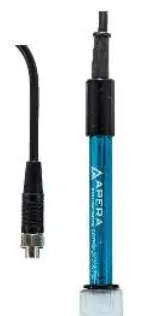
Technical Specifications
- Range: 0 to 14 pH; 32 to 176°F (0 - 80°C)
- Connector: 8-pin
- Cable length: 3 Ft
- Temperature sensor: 30KΩ thermistor
- Reference solution: Gel KCL
Installation
- Locate the 8-pin socket on your pH meter.
- Open the rubber cap on the socket.
- Insert the electrode connector, ensuring the notch is correctly aligned.
- Twist the metal ring to lock the connection securely.
- Perform a 3-point calibration to ensure measurement accuracy.
Usage Instructions
Before measuring, loosen the bottle cap and remove the electrode by twisting counterclockwise. Rinse the electrode with purified water and shake off excess moisture or blot dry with a clean tissue; never rub the glass membrane. Insert the electrode into the sample solution and stir for a few seconds to remove air bubbles, which can cause unstable readings. Wait for a stable reading before recording the measurement. After use, twist the electrode clockwise back into the storage bottle and tighten the cap.
Maintenance and Cleaning
Always rinse the glass bulb sensor with purified water before and after each test. If the electrode becomes dirty, use warm soap water and a soft brush. For specific contaminants, use the following cleaning solutions:
- Inorganic metal oxide: Dilute acid less than 1mol/L
- Organic lipid: Dilute detergent (weak alkaline)
- Resin macromolecule: Dilute alcohol, acetone, or ether
- Proteinic haematocyte sediment: Acidic enzymatic solution
- Paints: Dilute bleacher or peroxide
Keep the connector clean and dry using cotton balls with isopropyl alcohol to prevent short circuits. The typical service life is 1-2 years; replace the electrode if response time becomes slow or the slope is lower than 90%.
Practical help
Common problems
Unstable readings
Stir the electrode in the sample solution for a few seconds to remove air bubbles.
Slow response or inaccurate readings
Check if the slope is lower than 90% during calibration; if so, the electrode may need replacement (1-2 year lifespan).
Dirty connector
Clean with cotton balls and isopropyl alcohol, then blow-dry to prevent short circuits.
Before use
- Ensure the electrode is stored in KCL storage solution (SKU: AI1107).
- Rinse the glass bulb with purified water before and after use.
- Loosen the bottle cap and twist counterclockwise to remove the electrode.
- Perform a 3-point calibration after installation.
Specs in practice
- Temperature sensor
- 30KΩ thermistor for automatic temperature compensation.
Model compatibility
- Designed for general water solutions.
- Not suitable for long-term testing in high-temperature solutions (>122°F/50°C).
- Not suitable for strong alkaline (>12 pH) or acid (<2 pH) solutions.
- Not suitable for low ionic strength solutions (distilled/deionized water).

Manual page author
Emily Carter
User documentation editor
Prepares concise manual descriptions and highlights the most useful setup, operation, and maintenance information for readers.