Music / Guitar Effects
User Manual for Behringer HD300 Heavy Metal Distortion Effects Pedal
Quick guide for the Behringer HD300 Heavy Metal Distortion Effects Pedal. Learn how to connect your instrument, adjust distortion settings, replace the battery, and understand power requirements.
Table of contents
Quick Guide
The Behringer HD300 is a high-quality distortion effects pedal designed for hard rock and heavy metal sounds. Note that the pedal does not have a dedicated on/off switch. It activates automatically as soon as an instrument cable is inserted into the IN connector. To preserve battery life, always remove the cable from the IN jack when the pedal is not in use.
Controls
The pedal features five main control knobs to shape your sound:
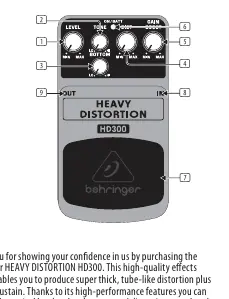
- LEVEL: Adjusts the overall output volume of the pedal.
- TONE: Allows you to shape the overall sound character.
- BOTTOM: Boosts or cuts the low-frequency range.
- DIST: Adjusts the intensity and amount of distortion.
- GAIN BOOST: Adjusts the gain for more extreme distortion sounds.
Additionally, the ON/BATT LED illuminates when the effect is active and also serves as a battery level indicator. The footswitch is used to activate or deactivate the effect.
Power Supply and Battery
The HD300 can be powered by a 9V battery or an external 9V DC power supply (not included). To install or replace the 9V battery:
- Locate the battery compartment underneath the pedal cover.
- Press the hinges on the pedal cover using a ballpoint pen.
- Remove the cover carefully to avoid scratching the unit.
- Insert or replace the 9V battery (type 6LR61).
If using an external power supply, connect it to the DC IN jack on the side of the unit.
Technical Specifications
- Input Connector: 1/4 inch TS
- Input Impedance: 500 kOhm
- Output Connector: 1/4 inch TS
- Output Impedance: 1 kOhm
- Power Supply: 9V DC, 100 mA regulated
- Power Consumption: 30 mA
Safety Information
Do not use the pedal near water or install it near heat sources. Use only authorized accessories. Do not attempt to service the product yourself; contact qualified service personnel for repairs, especially if the power supply cord or plug is damaged.
Manufacturer information
Behringer
Practical help
Common problems
Pedal does not turn on
The pedal has no on/off switch. It activates automatically when a cable is inserted into the IN jack. Ensure the cable is fully inserted.
Battery drains quickly
Remove the instrument cable from the IN jack when the pedal is not in use to prevent battery drain.
Before use
- Ensure you have a 9V battery or a compatible 9V DC power supply.
- Check that your instrument cable is a 1/4 inch TS cable.
- Verify the pedal is placed on a stable surface.
- Ensure the pedal cover is securely closed after battery installation.
Specs in practice
- Input Impedance
- 500 kOhm, designed to match standard guitar pickups for optimal signal transfer.
- Power Consumption
- 30 mA, indicates the current draw required for operation.
Images and diagrams
- The pedal features 5 main control knobs: Level, Tone, Bottom, Dist, and Gain Boost.
- The footswitch activates or deactivates the distortion effect.
- The battery compartment is accessed by pressing the hinges on the pedal cover.
Model compatibility
- Requires 9V DC power supply (negative center) or 9V battery (6LR61).

Manual page author
Emily Carter
User documentation editor
Prepares concise manual descriptions and highlights the most useful setup, operation, and maintenance information for readers.