Electronics / Audio
User Manual for Darkglass Electronics Aggressively Distorting Advanced Machine
Quick guide and setup instructions for the Darkglass Electronics Aggressively Distorting Advanced Machine. Learn how to connect your instrument, use the signal chain, configure presets, and set up the USB audio interface.
Table of contents
Manual images
Click an image to enlargeQuick Start Guide
To begin using your Aggressively Distorting Advanced Machine, follow these steps:
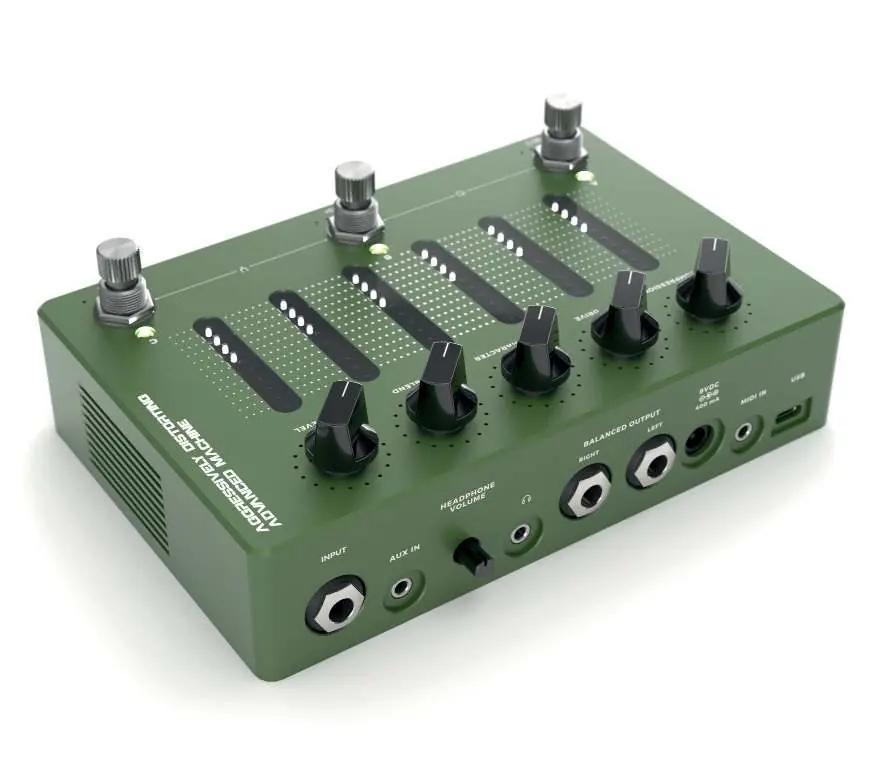
- Connect your instrument to the 1/4 inch INPUT.
- Connect a compatible power supply (9V center negative, minimum 500 mA) to the power connector.
- Connect your output device: headphones to the headphone jack, USB-C cable to your computer, or balanced/XLR outputs to your amplifier or mixing desk.
- The pedal comes pre-programmed with three presets (A, B, and C). Press and hold a footswitch for two seconds to save your current settings to that preset.
Signal Chain
The signal processing follows a specific path to shape your sound:
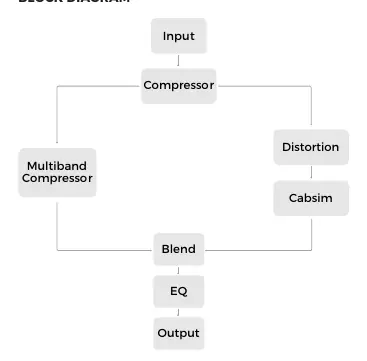
- Input: Primary instrument input.
- Compressor: Sets input gain with intelligent make-up gain. Ratios: 4:1, 8:1, 12:1, 20:1, and ALL IN.
- Distortion: Features 5 distinctive distortion modes.
- Cabinet Simulation: Supports Impulse Response (IR) files with 5 onboard slots.
- Multiband Compressor: Fixed settings in the clean sidechain.
- Blend: Mixes the distorted signal with the clean sidechain signal.
- EQ: Programmable 6-band graphic equalizer.
- Output: Final signal output.
Controls
Smart Potentiometers
Five potentiometers control the core sound:
- Compression: One-knob compression control.
- Drive: Adds distortion and drive.
- Character: Adjusts the tone of the distortion.
- Blend: Mixes distortion and clean signals.
- Level: Master volume control.
The ring of LEDs around each potentiometer indicates the stored position for the current preset.
Touch Sensitive Sliders
Located at the center, these control the 6-band graphic EQ. Swipe upwards to boost or downwards to cut frequencies. Double-tap to reset to 0 dB. Frequency bands: low shelf, 250 Hz, 500 Hz, 1.5 kHz, 3 kHz, and high shelf.
Rotary Footswitch Encoders
Encoders A, B, and C allow for preset switching and parameter adjustments:
- Rotating A: Changes compressor ratio or bypasses the compressor.
- Rotating B: Changes distortion mode or bypasses distortion.
- Rotating C: Changes active IR or bypasses IR.
Basic Operation
- Presets: Edit parameters to enter audition mode. Save by holding a footswitch for two seconds.
- Tuner: Press B and C simultaneously to enter. Supports 5-octave chromatic tuning (B0 to A#5).
- Bypass: Press A and B simultaneously to pass the unprocessed signal.
- Performance Lock: Press A and C simultaneously to prevent accidental parameter changes.
- Bluetooth Pairing: Press and hold an encoder while rotating it until all five LEDs are lit.
USB Audio Interface
The device functions as a USB audio interface. Mac users do not require additional drivers. Windows users must download the latest USB audio drivers from the Darkglass website. You can record processed and unprocessed signals simultaneously.
Technical Specifications
- Input impedance: 1 M Ohm
- Output impedance: 220 Ohm
- Current consumption: ~500mA
- Voltage: 9VDC (center negative)
Practical help
Common problems
No sound or signal issues
Check input connection, ensure power supply is 9V center negative (min 500mA), and verify the pedal is not in Bypass mode.
Windows USB audio not working
Download and install the latest USB audio drivers from the Darkglass website.
Accidental parameter changes during live performance
Use Performance Lock mode (press A and C simultaneously) to lock settings.
Before use
- Connect instrument to 1/4 inch INPUT.
- Connect 9V center negative power supply (min 500mA).
- Connect output (Headphones, Balanced, or Direct) to your monitoring system.
- Ensure USB-C cable is connected if using as an audio interface.
Specs in practice
- Input impedance
- 1 M Ohm; ensures proper signal transfer from instruments.
- Output impedance
- 220 Ohm; standard for connecting to amps or interfaces.
- Power requirement
- 9VDC center negative, 500mA; do not use incorrect voltage.
Images and diagrams
- The signal chain flows from Input through Compressor, Distortion, Cabsim, Multiband Compressor, Blend, EQ, and finally to Output.
Model compatibility
- Headphone output supports 16 - 600 ohms impedance.
- Windows requires specific USB audio drivers; Mac does not.

Manual page author
Michael Turner
Technical manual editor
Reviews PDF manuals for structure, safety notes, and practical product details so readers can find the right information quickly.