Music / Guitar Effects
User Manual for DigiTech Screamin' Blues Overdrive/Distortion Pedal
Quick guide for the DigiTech Screamin' Blues Overdrive/Distortion pedal. Learn how to connect your guitar, adjust tone controls, replace the battery, and understand output options for amps and mixers.
Table of contents
Manual images
Click an image to enlargeQuick Guide from the Manual
The DigiTech Screamin' Blues is an overdrive/distortion pedal designed for guitarists. It offers dynamic response, allowing for mild overdrive when playing lightly and rich harmonics/sustain when the gain is increased. The pedal features two distinct outputs: one for a guitar amplifier and one with speaker cabinet compensation for direct connection to a mixer or recorder.
Controls and Features
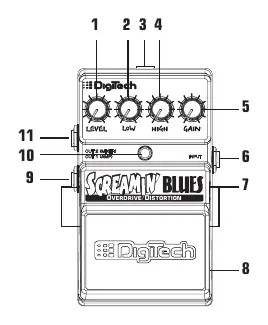
- Level Knob: Controls the effect output level. Turn clockwise to increase volume.
- Low Knob: Boosts or cuts low frequencies.
- High Knob: Boosts or cuts high frequencies.
- Gain Knob: Controls the amount of distortion.
- Input Jack: Connect your instrument here. Connecting a cable engages battery power.
- Out 1 (Amp) Jack: Connect to your guitar amplifier.
- Out 2 (Mixer) Jack: Features speaker cabinet compensation for direct connection to a mixer or recorder.
- Indicator LED: Shows when the effect is active. If dim or off, replace the battery.
Connections
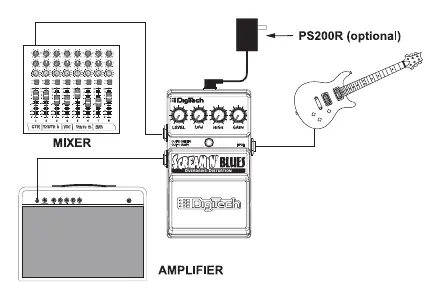
The pedal has a single input and two outputs. You can connect to a guitar amplifier, a mixing console, or both simultaneously. The Mixer output is specifically designed to provide an authentic guitar amplifier sound without needing an actual amp.
Setup Instructions
- Turn down the volume on your amplifier or mixer.
- Connect the pedal output to the amplifier or mixer input.
- Connect your guitar to the pedal input.
- Connect the optional power supply (DigiTech PS200R) if not using a battery.
- Set the Level control on the pedal to the minimum position.
- Turn up your amplifier or mixer to the desired listening level.
- Turn on the pedal by pressing the footswitch and gradually increase the Level control.
Battery Replacement
To replace the 9V battery:
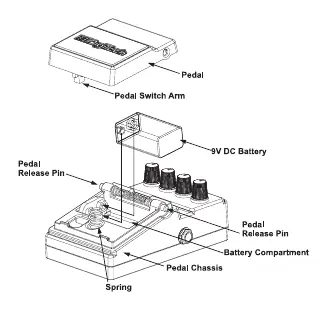
- Use the tip of a 1/4" guitar cable to push in one of the release pins on either side of the pedal.
- Remove the pedal from the chassis.
- Disconnect the old battery and connect a new one.
- Ensure the battery cable does not interfere with the spring or switch arm.
- Place one hole of the pedal over its corresponding pin, then push the opposite pin in to lower the pedal into place.
- Ensure both pins are flush with the outer side of the pedal.
Specifications
- Input Impedance: 1 MOhms
- Output Impedance: 100 Ohms
- Power Supply: 9V Alkaline Dry Battery or optional PS200R power supply
- Battery Life: Approximately 18 hours with continuous usage
- Current Draw: ~23mA (at 9VDC)
Practical help
Common problems
Indicator LED is dim or does not light up
The battery is likely low and needs to be replaced.
No sound output
Check that the guitar cable is fully inserted into the Input jack (this engages power), verify the battery is fresh, or ensure the power supply is connected correctly.
Before use
- Turn down the volume on your amplifier or mixer.
- Connect the pedal output to the amplifier or mixer input.
- Connect the guitar to the pedal input.
- Set the Level control on the pedal to the minimum position.
- Turn on the pedal by pressing the pedal switch.
Specs in practice
- Input Impedance
- 1 MOhms; standard for guitar pickups to maintain signal integrity.
- Output Impedance
- 100 Ohms; low impedance for driving cables and inputs.
Images and diagrams
- The control panel features four knobs: Level, Low, High, and Gain.
- The pedal chassis uses spring-loaded release pins for battery access.
- The connection diagram shows the pedal placed between the guitar and the amplifier/mixer.
Model compatibility
- Requires a Class II power adapter (DigiTech PS200R) that conforms to EN60065 or equivalent.
- The Mixer output is designed for direct connection to mixing consoles or recording devices.

Manual page author
Michael Turner
Technical manual editor
Reviews PDF manuals for structure, safety notes, and practical product details so readers can find the right information quickly.