HVAC / Thermostats & Controls
User Manual for Emerson 1F75P-21PR PTAC Thermostat
Comprehensive user guide for the Emerson 1F75P-21PR programmable PTAC thermostat. Includes installation, wiring, installer menu settings, programming, and troubleshooting steps.
Quick answers from the manual
Quick answer
- The 1F75P-21PR is a programmable PTAC thermostat. It supports single-stage cooling and one or two-stage heating (with auxiliary heat). It features an installer menu for configuring cycle rates, temperature limits, and system types. p. 1, 3
Key actions
- Access Installer Menu p. 3
- Convert PTHP to PTAC p. 3
- Reset Thermostat p. 8
First start
- Install batteries, wire according to terminal designations, set system switch to Heat or Cool, and program schedule. p. 2, 3, 6
Problems and fixes
No Heat/Cool
Check circuit breaker, furnace switch, and wiring connections.
p. 7, 8Maintenance and reset
- Reset by removing batteries for 2 minutes or holding Up, Down, and Set Time buttons. p. 8
Technical specifications
| Parameter | Value | Meaning | Pages |
|---|---|---|---|
| Electrical Rating | 20 to 30 VAC, 50/60 Hz | Power requirements | p. 1 |
| Setpoint Range | 60° to 85° F | Temperature control range | p. 1 |
Where to find it in the PDF
- Index and Specifications p. 1
- Installation and Wiring p. 2
- Installer Menu p. 3, 4
- Operation and Programming p. 5, 6, 7
- Troubleshooting p. 7, 8
Table of contents
Manual images
Click an image to enlargeQuick Guide
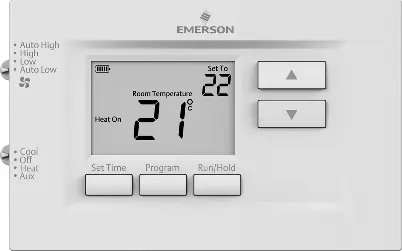
The Emerson 1F75P-21PR is a programmable PTAC thermostat designed for single-stage cooling and one or two-stage heating systems. It features a configurable installer menu for system settings, a jumper wire for converting between PTHP and PTAC modes, and a battery backup for clock retention during power outages.
Installation and Wiring
Before installation, ensure the electrical power to the system is disconnected at the main fuse or circuit breaker box. All wiring must conform to local and national electrical codes.
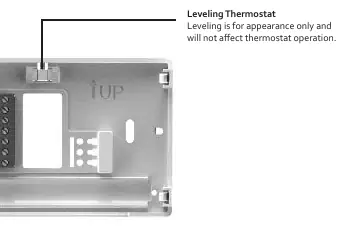
- Terminal Designations:
- GL: Low Speed Fan Relay
- R: Power (24V)
- O/B: Changeover Terminal (Energized in Cool for O, Heat for B)
- Y: Heat and Cool Mode 1st Stage Compressor
- GH: High Speed Fan Relay
- W: Heat Mode – 2nd Stage Heat (Electric)
- C: Common wire for 24V
System Conversion: To convert the system from PTHP to PTAC, cut the jumper wire located on the back of the thermostat and change menu item #20 from HP to AC.
Installer Menu
To access the Installer Menu, set the system switch to the OFF position, then press and hold the temperature Up and Down buttons simultaneously for 3 seconds. Use the Up/Down buttons to navigate and change settings. Press the RUN/HOLD button to exit.
- Item 20: Algorithm (AC or HP)
- Item 30: Heat Cycle Rate (SLO, MEd, FAS)
- Item 32: Aux Cycle Rate (Available if HP is selected)
- Item 35: Cool Cycle Rate
- Item 50: Compressor Lockout (Protects from short cycling)
- Item 65/66: Maximum Heat/Minimum Cool Limits
- Item 74: Schedule Type (7-Day, 5-1-1 Day, or Non-Programmable)
- Item 83: Continuous Display Light (Requires C wire)
Operation and Programming
The thermostat supports a 7-day programmable schedule. To set the current time and day, press the SET TIME button and use the Up/Down arrows to adjust. To enter a heating or cooling program, move the system switch to the desired mode (Heat or Cool), press the PROGRAM button, and follow the on-screen prompts to set times and temperatures for each period (Wake, Leave, Return, Sleep).
Troubleshooting
If the thermostat is not functioning correctly, check the following:
- No Heat/Cool/Fan: Check for a blown fuse or tripped circuit breaker, ensure the furnace power switch is ON, and verify the furnace blower compartment door is properly installed.
- No First Stage Heat: Verify the system switch is set to Heat, check wiring connections, and ensure menu item 20 and the jumper wire configuration match.
- Call for Service Icon: This indicates the system cannot reach the setpoint within 2 hours or there is a compressor issue.
Technical Specifications
- Electrical Rating: 20 to 30 VAC, NEC Class II, 50/60 Hz
- Terminal Load: 1.5 A per terminal, 2.5A maximum all terminals combined
- Setpoint Range: 60° to 85° F (16° to 29° C)
- Operating Ambient: 32°F to +105°F (0° to +41°C)
- Operating Humidity: 90% non-condensing maximum
Practical help
Common problems
No Heat/Cool/Fan
Check circuit breaker, furnace power switch, furnace blower door panel, and wiring connections.
No First Stage Heat
Verify system switch is set to Heat, check wiring, and ensure menu item 20 matches the jumper wire configuration.
Thermostat display and thermometer disagree
Adjust the display temperature using menu item 81 (+/- 5 degrees).
Call for Service icon displayed
Check if the system can reach the setpoint within 2 hours; if the icon is flashing, the compressor self-diagnostic is detecting an issue.
Before use
- Disconnect electrical power to the system before installation.
- Verify wiring matches the terminal designations (GL, R, O/B, Y, GH, W, C).
- Determine if the system is PTHP or PTAC; cut the jumper wire on the back if converting to PTAC.
- Set the O/B switch to B (default) or O based on heat pump requirements.
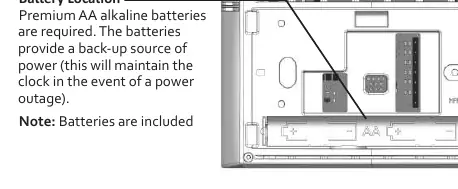
- Install premium AA alkaline batteries for backup power.
Specs in practice
- Electrical Rating
- 20 to 30 VAC, NEC Class II, 50/60 Hz.
- Terminal Load
- 1.5 A per terminal, 2.5A maximum for all terminals combined.
- Setpoint Range
- 60° to 85° F (16° to 29° C).
Images and diagrams
- The wiring terminal block shows connections for fan speeds (GL, GH), power (R), heat pump changeover (O/B), compressor (Y), heat (W), and common (C).
Model compatibility
- Designed for PTAC/PTHP systems.
- Requires 24V power.

Manual page author
Michael Turner
Technical manual editor
Reviews PDF manuals for structure, safety notes, and practical product details so readers can find the right information quickly.