Home / Electrical Accessories
Installation Guide for Enerlites 61501/62001-1A1C5 Dual USB Charger
Learn how to install and use the Enerlites 61501/62001-1A1C5 Dual USB Charger. This guide covers wiring instructions, compatibility, and safety precautions for your tamper-resistant receptacle.
Table of contents
Manual images
Click an image to enlargeQuick Guide from the Manual
This document provides installation instructions for the Enerlites 61501/62001-1A1C5 Dual USB Charger. Important: Turn off the power at the circuit breaker before beginning any installation. This device is intended for installation in accordance with the National Electric Code and local regulations. It is recommended that a qualified electrician performs the installation. Do not use this receptacle if the outlet you are replacing has the top and bottom outlets controlled by separate circuit breakers.
Description
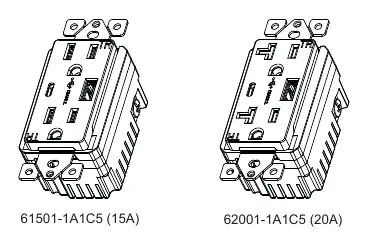
The 61501/62001-1A1C5 is a duplex Tamper-Resistant Receptacle featuring two USB charging ports. It includes one Type A port (2.4A) and one Type C port (3.0A), with a combined total output of 5A, allowing for simultaneous charging of multiple devices.
Features
- Two USB ports with a total high-current power of 5 Amp, 5VDC.
- Individual output: Type A (2.4A) or Type C (3.0A).
- Charges most USB compatible electrical devices directly without an adapter.
- 2011 NEC Code compliant Tamper-Resistant Shutters.
- Replaces a standard duplex receptacle.
- Back wire terminals for quick and easy installation.
Compatibility
This high-speed dual USB charger is compatible with a wide range of electronic devices, including but not limited to:
- iPad Pro, iPad Air, iPad Mini, iPod
- iPhone 6/6 Plus
- Samsung Galaxy S4, Samsung Galaxy J7, Samsung Galaxy Note 3
- HTC One X9, HTC One S9
- Nexus 6P, Lenovo ZUK Z1
- Tablets, Mobile Phones, Bluetooth Headsets, Digital Cameras, Nook e-readers, and GPS Devices.
Installation Instructions
Ensure the power is turned off at the circuit breaker before proceeding.
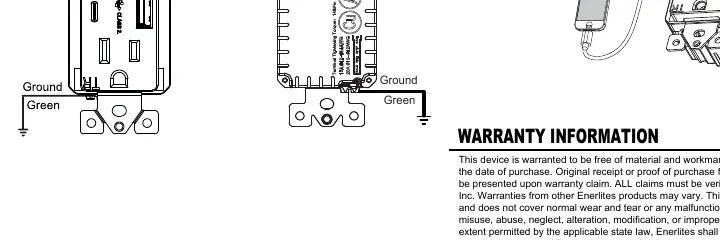
- Insert wire(s) through terminal holes in the back.
- Tighten terminal screws.
- Connect the HOT wire to the HOT terminal.
- Connect the NEUTRAL wire to the NEUTRAL terminal.
- Connect the Ground wire to the GREEN screw.
Note: Use copper wire only.
Specifications
- Receptacle Rating: 15/20 Amp, 125VAC
- Single Port USB Rating: Type A (5V/2.4A), Type C (5V/3A)
- Dual USB Ports Combined: 5V/5A
- Wire Terminals: #14-#12 AWG
- Operating Temperature: -4 to 140°F (-20 to 60°C)
- USB Compatibility: USB 1.1/2.0/3.0 devices
- Receptacle Dimension: 3-3/4” x 2-1/4” x 3-3/16”
Warranty Information
This device is warranted to be free of material and workmanship defects for 2 years from the date of purchase. Original receipt or proof of purchase from an authorized retailer is required for warranty claims. The warranty does not cover normal wear and tear, misuse, abuse, neglect, alteration, modification, or improper installation.
Practical help
Common problems
Outlet controlled by separate circuit breakers
This USB receptacle CANNOT be used if the outlet you are replacing has the top and bottom outlets controlled by separate circuit breakers.
Improper wiring
Ensure HOT wire is connected to the HOT terminal, NEUTRAL to the NEUTRAL terminal, and Ground to the GREEN screw. Use copper wire only.
Before use
- Turn off the power at the circuit breaker.
- Verify the outlet is not controlled by separate circuit breakers.
- Ensure you have #14-#12 AWG copper wire.
- Consult a qualified electrician for installation.
- Read and understand all instructions before installing.
Specs in practice
- Receptacle Rating
- 15/20 Amp, 125VAC capacity for standard electrical plugs.
- Operating Temperature
- Safe to operate between -4°F and 140°F (-20°C to 60°C).
Images and diagrams
- The wiring diagram illustrates the correct connection points: Black wire to the Hot terminal, White wire to the Neutral terminal, and Green wire to the Ground screw.
Model compatibility
- Compatible with USB 1.1/2.0/3.0 devices including Apple products, Samsung Galaxy series, and various tablets/phones.

Manual page author
David Miller
Documentation analyst
Organizes user manual content into clear summaries, with attention to model details, product context, and everyday usability.