Smart Home / Sensors Buttons
Homematic IP Wall switch – double action HmIP-WRC2-2
Quick guide for the Homematic IP Wall switch – double action (HmIP-WRC2-2). Learn about installation, mounting options, technical specifications, and smart home integration.
Quick answers from the manual
Quick answer
- The Homematic IP Wall switch (HmIP-WRC2-2) is a wireless, battery-operated switch for smart home control. It can be mounted using adhesive strips or screws and integrates into existing 55mm switch series. p. 1, 2
Key actions
- Mounting the switch p. 2
- Pairing the device p. 2
First start
- Insert batteries and pair p. 2
Technical specifications
| Parameter | Value | Meaning | Pages |
|---|---|---|---|
| Battery | 2x 1.5V LR03/Micro/AAA | Power supply | p. 2 |
| Battery life | 4 years (typ.) | Expected battery duration | p. 2 |
Where to find it in the PDF
- Product Overview p. 1
- Technical Data and Mounting p. 2
Table of contents
Manual images
Click an image to enlargeQuick guide from the manual
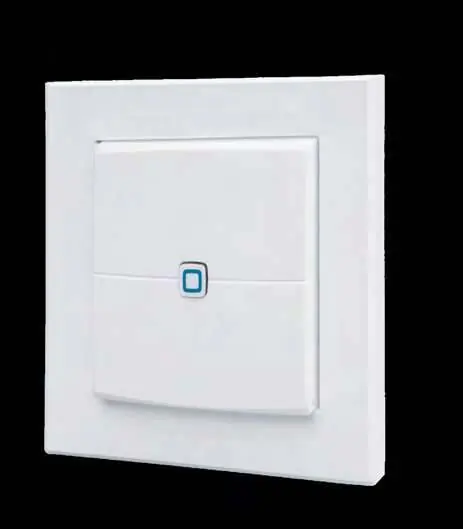
The Homematic IP Wall switch (HmIP-WRC2-2) is a wireless, battery-operated device designed for smart home control. It allows for intuitive operation of devices or system functions, such as switching lights, activating eco-modes, or controlling shutters. The device is designed for flexible installation and can be integrated into existing 55mm switch series or mounted independently.
Mounting and Installation
The wall switch offers high flexibility through its modular design:
- Adhesive or screw mounting: Use the included mounting material to attach the switch to walls, glass, or furniture.
- Integration into existing switch series: Compatible with 55mm frame dimensions from major manufacturers.
- Flush-mounted box: Can be mounted on a free flush-mounted box using the optimized mounting plate.
- Homematic IP Tischaufsteller: Can be integrated into the Homematic IP table stand (HmIP-DS55).
The device is powered by two 1.5V LR03/Micro/AAA batteries, eliminating the need for wiring.
Operation and Integration
The device can be used in two ways:
- Stand-alone operation (Push-to-Pair): Direct pairing with other Homematic IP devices.
- System operation: Integration with a Homematic IP Access Point or Central unit for advanced smart home control.
Technical Data
- Power supply: 2x 1.5V LR03/Micro/AAA batteries
- Battery life: Approx. 4 years (typical)
- Protection class: IP20
- Ambient temperature: 5 to 35 °C
- Dimensions (without frame): 55 x 55 x 17 mm
- Dimensions (with frame): 86 x 86 x 19 mm
- Weight: 82 g (including batteries)
- Radio frequency: 868.0-868.6 MHz / 869.4-869.65 MHz
- Typical range: 200 m (free field)
Practical help
Common problems
Device not responding
Check if the batteries are inserted correctly and have sufficient charge. Ensure the device is within range of the Access Point or paired device.
Mounting issues
Ensure the surface is clean and dry before applying adhesive strips. For screw mounting, ensure the surface is suitable for the provided screws.
Before use
- Verify you have the correct model (HmIP-WRC2-2 or HmIP-WRC2-A-2).
- Ensure the mounting surface is clean and dry.
- Decide between adhesive or screw mounting based on your wall type.
- Check if you are using the device in stand-alone mode or with a system (Access Point).
- Insert the provided 1.5V AAA batteries.
Images and diagrams
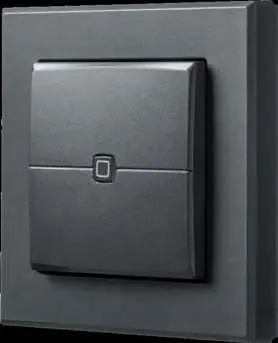
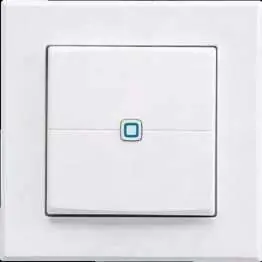
- The device consists of a stable, exchangeable frame and two intuitive buttons for operation.
- The rear side includes the mounting plate interface for screws or adhesive strips.
Model compatibility
- Compatible with 55mm switch frames from major manufacturers.
- Can be used in stand-alone (Push-to-Pair) mode.
- Compatible with Homematic IP Access Point or Central unit.

Manual page author
David Miller
Documentation analyst
Organizes user manual content into clear summaries, with attention to model details, product context, and everyday usability.