Garden / Hedge Trimmers
Operator's Manual for Husqvarna EP 121B, EP 271B, EP 371B, EP 601B Concrete Vibrator
Comprehensive operator's manual for the Husqvarna EP 121B, EP 271B, EP 371B, and EP 601B concrete vibrators. Includes safety instructions, operation procedures, maintenance, troubleshooting, and technical specifications.
Table of contents
Manual images
Click an image to enlargeQuick guide from the manual
This manual provides essential instructions for the safe and efficient operation of the Husqvarna EP 121B, EP 271B, EP 371B, and EP 601B concrete vibrators. These tools are designed for professional use to remove air bubbles from wet concrete. Always read the safety chapter before use. Ensure the air compressor is properly connected and the air pressure is within the specified range (5-7 bar). Regular lubrication is critical for the longevity of the pneumatic motor.
Product overview
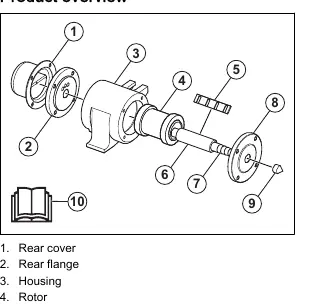
The concrete vibrator consists of a pneumatically operated motor with minimal moving parts. Key components include the rear cover, rear flange, housing, rotor, lamella, shaft, air connector, and front flange. The rating plate on the unit provides the type, serial number, and air requirements.
Safety instructions
General Safety: This is a dangerous tool if used incorrectly. Only approved, trained personnel should operate the equipment. Always use personal protective equipment (PPE), including a protective helmet, hearing protection, respiratory protection, eye protection, protective gloves, steel-toed boots, and long-sleeved work clothing.
Operational Safety: Ensure you know how to stop the product quickly in an emergency. Keep the work area clean and bright. Do not use the product in areas where fire or explosions can occur. Ensure clothes, long hair, and jewelry do not get caught in moving parts.
Pneumatic Hose Safety: A loose pneumatic air hose can move randomly and with force. Always check hoses and connectors for damage. Do not disconnect a pressurized hose; stop the compressor and release pressure first.
Operation
To start and stop the product:
- Drain water from the air compressor tank.
- Push air through the air hose to drain any remaining water.
- Ensure the connector filter is clean and seals are undamaged.
- Lubricate the product.
- Connect the product to the air compressor and start the compressor.
- To stop, simply stop the air compressor.
Operating tips: Place the product in the (A) positions as indicated in the manual. If the product does not start, turn the flanges, shaft, and lamella 90 degrees.
Maintenance
Lubrication: The product is delivered without oil. Use an automatic lubricator within 10 meters of the product. If not installed, lubricate manually daily or every 4 hours of continuous operation by adding 4 cm3 of non-detergent oil into the air hose coupling.
Cleaning: Do not use a high-pressure washer. Use fuel to clean parts and remove concrete from surfaces before it hardens.
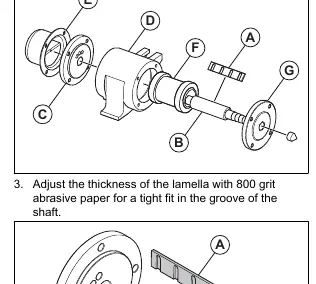
Disassembly and Assembly: The manual provides detailed steps for disassembling the unit (disconnecting air, removing covers, screws, and flanges) and reassembling it. When replacing the lamella, ensure it is adjusted with 800-grit abrasive paper for a tight fit and kept in oil overnight before assembly.
Troubleshooting
If the product does not start, check for air pressure, blocked hoses, or a blocked air exhaust. If vibrations are not constant, check the centrifugal force, mounting, or if the concrete form is sufficiently rigid. In dusty or moist environments, disassemble and clean the unit with fuel and re-lubricate.
Technical data
The manual lists specific frequencies (8800-9350 rpm), centrifugal forces, and air consumption rates for each model (EP 121B, EP 271B, EP 371B, EP 601B). Operating air pressure is 6 bar (87 PSI), with a minimum of 5 bar (72 PSI) and a maximum of 7 bar (101 PSI).
Manufacturer information
Husqvarna
Practical help
Common problems
Product does not start
Check if the air compressor is on, the air hose is connected correctly, and the hose is not blocked or twisted. Ensure the air exhaust is not blocked.
Vibrations are not constant
Check if the centrifugal force is sufficient, the air pressure is correct, the product is mounted correctly, or if the concrete form is rigid enough.
Product does not operate in dusty environments
Disassemble and clean all parts with fuel, then lubricate and reassemble.
Product does not operate in moist environments
Moisture may have mixed with the oil. Disassemble, clean with fuel, and re-lubricate. If the lamella is water-logged, replace it.
Before use
- Drain water from the air compressor tank.
- Check that the connector filter is clean.
- Examine connector seals for damage.
- Lubricate the product (if no automatic lubricator is installed).
- Verify air pressure is between 5 and 7 bar (72-101 PSI).
Specs in practice
- Centrifugal force
- The force generated by the vibrator, measured in Newtons (N).
- Air consumption
- The volume of air required for operation, measured in l/min or cfm.
Images and diagrams
- Product Overview: Identifies the rear cover, housing, rotor, lamella, shaft, and air connector.
- Disassembly/Assembly: Illustrates the sequence for removing and installing the rotor, lamella, and flanges.
Model compatibility
- Use high-frequency products for vertical concrete forms.
- Use lower-frequency products for horizontal concrete forms.

Manual page author
David Miller
Documentation analyst
Organizes user manual content into clear summaries, with attention to model details, product context, and everyday usability.