Health / Medical Devices
Precision Medical Flowmeter User Manual (1MFA, 4MFA, 6MFA, 8MFA Series)
Quick guide for the Precision Medical Flowmeter (1MFA, 4MFA, 6MFA, 8MFA Series). Learn about installation, operation, safety precautions, cleaning, and troubleshooting.
Quick answers from the manual
Quick answer
- The Precision Medical Flowmeter is a medical device for administering medical gases. It must be operated in a vertical position, kept free of oil/grease, and inspected for damage before each use. p. 2, 6
Key actions
- Adjust flow by turning the knob counterclockwise to increase and clockwise to decrease. p. 6
First start
- Remove from packaging, inspect for damage, connect to gas source, and verify the float ball is at the bottom. p. 2, 6
Problems and fixes
Will not shut off
Replace Tetraseal and/or Housing or Replace Body Assembly
p. 5
Sticking Float Ball
Clean Flow Tube & Float Ball
p. 5Maintenance and reset
- Clean exterior surfaces with a cloth dampened with a mild detergent and water. Wipe dry. p. 5
Technical specifications
| Parameter | Value | Meaning | Pages |
|---|---|---|---|
| Flow Range | 0-200 cc to 0-70 l/min | Range of calibrated flow output | p. 4 |
Where to find it in the PDF
- Specifications p. 4
- Troubleshooting p. 5
Table of contents
Manual images
Click an image to enlargeQuick Guide to Precision Medical Flowmeter
The Precision Medical Flowmeter is a medical device intended for use by physicians, respiratory therapists, and authorized hospital personnel to administer selected doses of medical gases to a patient. This manual covers the 1MFA, 4MFA, 6MFA, and 8MFA series.
Safety Information
WARNING: Read the manual before installing or operating. Failure to follow instructions may result in serious injury or death.
- MRI Safety: Some models are MR Conditional (1.5T). Consult the manual for specific MRI labeling requirements.
- Fire/Explosion Risk: Do not use or store oils, greases, or organic lubricants on or near the device. Do not use near flames or flammable substances. Do not smoke in the area.
- Handling: Do not autoclave or gas sterilize with EtO. Do not immerse in liquid.
- Operation: Must be operated in a vertical, upright position.
Operating Instructions
- Ensure the knob is in the OFF position.
- Connect the flowmeter to the appropriate gas source. Verify the gas and pressure requirements on the flowmeter body.
- Verify the float ball is at the very bottom of the flow tube. If it is not, the product may be leaking.
- Adjusting Flow: Turn the knob counterclockwise to increase flow and clockwise to decrease flow.
- Set the flow by aligning the center of the float ball with the indicator lines on the flow tube.
- To obtain maximum flush flow, turn the knob fully counterclockwise.
Cleaning and Maintenance
Disconnect all connections before cleaning. Clean exterior surfaces with a cloth dampened with a mild detergent and water. Wipe dry with a clean cloth. Do not clean with aromatic hydrocarbons.
Troubleshooting
If the flowmeter fails to function, consult your provider. Common issues include:
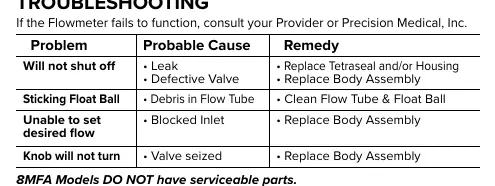
- Will not shut off: Likely a leak or defective valve. Replace tetraseal or body assembly.
- Sticking float ball: Likely debris in the flow tube. Clean the flow tube and float ball.
- Unable to set desired flow: Likely a blocked inlet. Replace body assembly.
- Knob will not turn: Likely a seized valve. Replace body assembly.
Note: 8MFA models do not have serviceable parts.
Technical Specifications
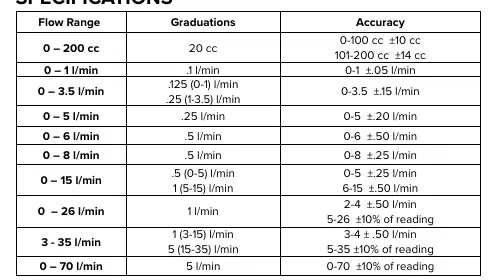
The flowmeter is calibrated at specific inlet pressures at 70°F (21°C). Accuracy varies by flow range. Flush flow is the output when the indicator is beyond the highest calibrated graduation. Transport and storage requirements are -40°F (-40°C) to 140°F (60°C).
Practical help
Common problems
Will not shut off
Check for leaks or a defective valve. Replace the tetraseal or the body assembly.
Sticking float ball
Clean the flow tube and float ball to remove debris.
Unable to set desired flow
Check for a blocked inlet. Replace the body assembly if necessary.
Knob will not turn
The valve may be seized. Replace the body assembly.
Before use
- Inspect the device for any visual damage before use.
- Ensure the flowmeter is operated in a vertical, upright position.
- Verify that all connections are tight and leak-free.
- Confirm the prescribed flow before administering to the patient.
- Check the flowmeter labeling for specific flow restrictions.
- Use only oxygen-safe leak detectors.
Specs in practice
- Transport/Storage
- The device must be stored between -40°F (-40°C) and 140°F (60°C).
Images and diagrams
- The flow tube must be vertical for accurate readings.
- The knob turns counterclockwise to increase flow and clockwise to decrease flow.
- The float ball must be at the bottom when the device is off.
Model compatibility
- MRI Conditional: 1.5T MR systems only (for MRI labeled models).
- Do not use oils, greases, or organic lubricants.
- Do not autoclave or gas sterilize with EtO.

Manual page author
Michael Turner
Technical manual editor
Reviews PDF manuals for structure, safety notes, and practical product details so readers can find the right information quickly.