Tools / Air Tools Painting
User Manual for Sealey HVLP740 Suction Feed HVLP Spray Gun
Quick guide for the Sealey HVLP740 spray gun. Includes setup instructions, air supply requirements, operating techniques, cleaning procedures, and troubleshooting tips.
Table of contents
Manual images
Click an image to enlargeQuick guide from the manual
The Sealey HVLP740 is a suction-feed HVLP (High Volume Low Pressure) spray gun designed for professional workshop use. To ensure optimal performance and longevity, always disconnect the air supply before performing any maintenance or cleaning. The gun requires a clean, dry air supply at a maximum of 43psi. Always use a leader hose to connect the gun to your air line to prevent vibration damage to the internal seals.
Safety
- Always wear approved respiratory protection and safety eye goggles.
- If using isocyanate-based finishers, use a clean air breathing apparatus and cover all exposed skin.
- Do not exceed the maximum air pressure of 43psi.
- Never point the spray gun at yourself, other persons, or animals.
- Disconnect from the air supply when not in use.
Specifications
- Standard Setup: 1.7mm
- Available Setups: 1.2mm, 1.3mm, 1.4mm, 2.0mm
- Air Pressure: 43psi
- Air Consumption: 16cfm
Operation
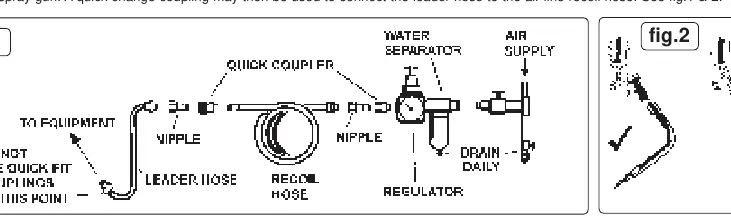
Air Supply: Ensure the air supply is clean and dry. Drain the air tank daily to prevent water from entering the air line, which can ruin paint finishes. Use a minimum hose diameter of 1/4 inch I.D. If using hoses longer than 8 meters, increase line pressure to compensate.
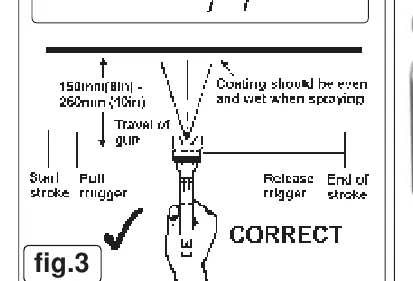
Spraying Technique: Hold the gun perpendicular to the surface, maintaining a distance of 150mm to 250mm. Start the stroke before squeezing the trigger and release it before finishing the stroke to ensure an even finish. Overlap each stroke slightly.
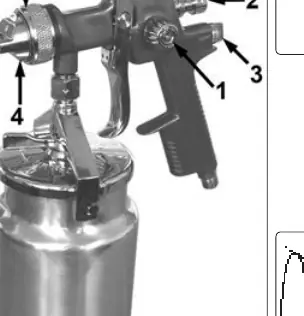
Adjustments: Use the adjustment knobs to control paint flow, atomizing air, and air input. The air nozzle can be rotated to achieve either a horizontal or vertical fan spray pattern. In normal operation, the wings on the nozzle should be horizontal for a vertical fan pattern.
Maintenance and Cleaning
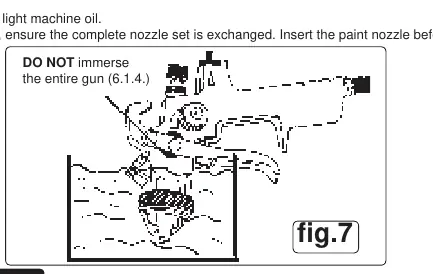
Cleaning: It is critical to clean the gun after every use. Disconnect from the air supply, then immerse only the front end of the gun in solvent—do not immerse the entire gun, as this will dissolve the lubricants on the rubber seals. Use the provided bristle brush to remove accumulated paint. Flush the gun with clean solvent and wipe the exterior with a solvent-dampened rag.
Nozzle Assembly: If you need to clean the nozzle holes, use a tool softer than brass; never use steel instruments. Lubricate the gun daily with light machine oil.
Troubleshooting
If you experience a faulty spray pattern, it is usually due to improper cleaning or dried material. Soak the affected parts in solvent to soften the material. Do not use metal tools to poke into the nozzle openings.
- Fan pattern clogged to one side: Dissolve material in the side ports with solvent.
- Split or uneven spray pattern: Remove the air nozzle and wipe the fluid tip with a rag dampened with solvent. Tighten the air nozzle.
- Gun spitting: Clean the back of the fluid nozzle and the nozzle seat in the gun body. Ensure the nozzle is secured tightly.
- Material bubbles in cup: Tighten the paint nozzle or ensure the air nozzle is fully screwed in.
Manufacturer information
Sealey Group
Practical help
Common problems
Fan pattern clogged to one side
Dissolve material in the side ports with solvent. Do not use metal instruments to poke into the opening.
Split or uneven spray pattern
Remove the air nozzle and wipe the fluid tip using a rag dampened with solvent. Tighten the air nozzle.
Gun spitting
Remove the fluid nozzle, clean the back of the nozzle and the nozzle seat in the gun body using a rag dampened with thinner. Replace and secure tightly.
Material bubbles in paint cup
The paint nozzle is not tight enough or the air nozzle is not completely screwed in. Tighten parts accordingly.
Before use
- Ensure the air supply is clean and does not exceed 43psi.
- Connect a leader hose to the spray gun to prevent vibration damage.
- Check that all hose connections are secure.
- Ensure the air valve/trigger is in the off position before connecting to the air supply.
- Verify the correct nozzle size (1.7mm standard) is installed for your material.
Specs in practice
- Air Pressure (43psi)
- Maximum operating pressure. Exceeding this will cause excessive wear and potential danger.
- Air Consumption (16cfm)
- Ensure your air compressor is capable of supplying this volume of air continuously.
- Nozzle Sizes
- 1.7mm is standard. Other sizes (1.2, 1.3, 1.4, 2.0mm) are available separately for different material viscosities.
Images and diagrams
- Fig 1: Recommended air supply setup including water separator and regulator.
- Fig 3: Correct spraying technique showing perpendicular movement and stroke overlap.
- Fig 4: Adjustment knobs for paint flow, atomizing air, and air input.
- Fig 7: Correct cleaning method, immersing only the front end of the gun.
Model compatibility
- Suitable for waterborne paint.
- Requires a minimum hose diameter of 1/4 inch I.D.

Manual page author
Michael Turner
Technical manual editor
Reviews PDF manuals for structure, safety notes, and practical product details so readers can find the right information quickly.