Electronics / Cables & Adapters
StarTech USB to Serial Adapter Cable
Quick-start guide for StarTech USB to Serial Adapter cables. Includes driver installation steps for Windows and macOS, LED indicator explanations, and pinout diagrams.
Quick answers from the manual
Quick answer
- This adapter connects serial peripheral devices to a computer via USB. Drivers usually install automatically; if not, download them from the StarTech support website. p. 1
Key actions
- Install Drivers p. 1
- Verify Installation p. 2
Problems and fixes
Drivers not installed
Download the driver package from the StarTech support website and run the setup file.
p. 1Technical specifications
| Parameter | Value | Meaning | Pages |
|---|---|---|---|
| Pin 1 | DCD | Data Carrier Detect | p. 1 |
| Pin 2 | RXD | Receive Data | p. 1 |
| Pin 3 | TXD | Transmit Data | p. 1 |
Where to find it in the PDF
- Quick-Start Guide p. 1
- Regulatory and Warranty p. 2
Table of contents
Manual images
Click an image to enlargeQuick guide from the manual
The StarTech USB to Serial Adapter is designed to connect serial peripheral devices to a computer via a USB-A port. In most supported operating systems, drivers will install automatically. If the device is not recognized, you must download the appropriate driver package from the StarTech support website.
Installation
If the drivers do not install automatically, follow these steps:
Windows
- Navigate to the product support page on the StarTech website.
- Click the Drivers/Downloads tab.
- Download the appropriate Driver Package.
- Right-click the downloaded file and select Extract All.
- Browse the extracted folder and run the Setup file.
- Follow the on-screen instructions to complete the installation.
- Connect the adapter to an available USB-A port.
macOS
- Navigate to the product support page on the StarTech website.
- Click the Drivers/Downloads tab.
- Download the appropriate Driver Package.
- Double-click the downloaded file.
- Open the folder matching your macOS version and run the Installer file.
- Follow the on-screen instructions to complete the installation.
- Connect the adapter to an available USB-A port.
Verifying Installation
Windows
- Open Device Manager.
- Expand the Ports (COM & LPT) section.
- Right-click the COM Port and select Properties to confirm the driver is installed and working.
macOS
- Open System Information.
- Expand the Hardware section and click USB.
- Confirm that the COM Port appears in the list.
LED Indicators
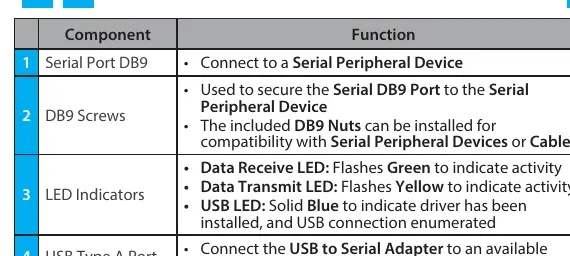
- Data Receive LED: Flashes Green to indicate activity.
- Data Transmit LED: Flashes Yellow to indicate activity.
- USB LED: Solid Blue indicates the driver is installed and the USB connection is enumerated.
Pinout Diagram
The adapter uses a standard RS-232 DB9 configuration:
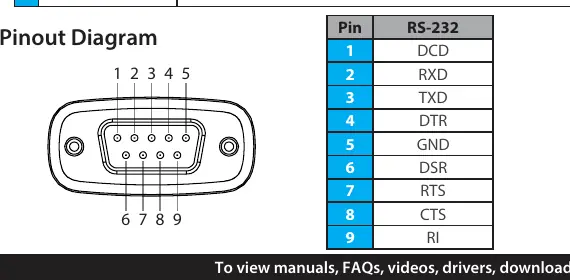
- Pin 1: DCD
- Pin 2: RXD
- Pin 3: TXD
- Pin 4: DTR
- Pin 5: GND
- Pin 6: DSR
- Pin 7: RTS
- Pin 8: CTS
- Pin 9: RI
Practical help
Common problems
Drivers did not install automatically
Visit the StarTech support website for your specific model, download the driver package, and run the setup or installer file manually.
Device not recognized by the computer
Check Device Manager (Windows) or System Information (macOS) to verify the COM port is listed and the driver is active.
Before use
- Ensure you have a computer with an available USB Type-A port.
- Identify your specific model (1P3FFCB-USB-SERIAL, 1P6FFC-USB-SERIAL, or 1P10FFC-USB-SERIAL).
- Verify the peripheral device connection requirements.
- Ensure you have internet access to download drivers if automatic installation fails.
Specs in practice
- Data Receive LED
- Flashes Green when the device is receiving data.
- Data Transmit LED
- Flashes Yellow when the device is transmitting data.
Images and diagrams
- The component diagram identifies the DB9 port, screws, LED indicators, and the USB connector.
- The pinout diagram details the 9-pin RS-232 configuration for serial communication.
Model compatibility
- Requires a USB Type-A enabled computer.
- Compatible with Windows and macOS operating systems.

Manual page author
Michael Turner
Technical manual editor
Reviews PDF manuals for structure, safety notes, and practical product details so readers can find the right information quickly.