Music / Instruments
Thorn Bad Cash Flexible Overdrive Pedal
Quick guide for the Thorn Bad Cash Flexible Overdrive pedal. Learn about controls, power requirements, and tonal shaping options.
Table of contents
Quick guide from the manual
The Thorn Bad Cash is a flexible overdrive pedal designed for a wide range of tones. Before using the pedal, ensure you have a compatible power supply (9-18 VDC, center negative). Battery operation is not supported. Always connect your guitar to the input and the amplifier to the output using standard 1/4 inch instrument cables. Disconnect power before changing signal cables to prevent damage or noise.
Device Overview
The pedal features a comprehensive set of controls for precise tonal shaping:
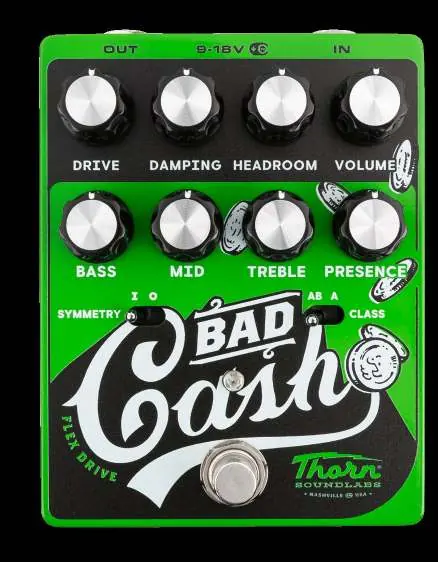
- Drive: Adjusts input gain. Higher settings increase overdrive/distortion.
- Damping: A variable filter reducing low-frequency content before the overdrive circuit. Higher settings (5 o'clock) result in tighter bass, while lower settings (7 o'clock) provide a more open low end.
- Headroom: Sets the clipping threshold of the output stage. 7 o'clock provides maximum headroom (minimum distortion), while 5 o'clock provides minimum headroom (maximum distortion).
- Volume: Controls the final output signal level.
- Tone Stack (Bass, Mid, Treble): Active controls to boost or cut specific frequencies. 12 o'clock is the neutral/flat position.
- Presence: Used to tame or enhance the upper extremes of the high-frequency range.
Sound Shaping Switches
The pedal includes two switches to alter the character of the distortion:
- Symmetry Switch: Toggles between asymmetrical (O) and symmetrical (I) clipping. Symmetrical clipping is generally smoother, while asymmetrical clipping offers an edgier, ragged bite.
- Class Switch: Changes output characteristics between Class AB (push-pull, smoother tone) and Class A (single-ended, raw and edgy response).
Power and Connections
The pedal requires a 9-18 VDC power supply with a 5.5 x 2.1 mm barrel plug (center negative). Do not exceed 18V. Using transformer-isolated power supplies is recommended to minimize noise. Always disconnect the power supply and signal cables before moving the pedal.
Maintenance and Safety
To ensure the longevity of your pedal:
- Clean only with a soft, dry cloth. Do not use abrasive cleaners, alcohol, solvents, or chemical-impregnated cloths.
- Do not use excessive force on control knobs.
- Avoid dropping the pedal or exposing it to extreme temperatures, humidity, or dusty environments.
- Do not modify the pedal without authorization.
Practical help
Common problems
Excessive noise or hum
Ensure you are using a transformer-isolated power supply. Daisy chains and non-pedal specific power supplies may introduce noise.
Bottom end sounds loose or flabby
Increase the DAMPING control setting (towards 5 o'clock) to reduce low-frequency content entering the circuit.
Distortion sounds too harsh or edgy
Try switching the SYMMETRY switch to the Symmetrical (I) position or the CLASS switch to AB for a smoother response.
Before use
- Verify power supply is 9-18 VDC, center negative.
- Ensure no battery is being used (battery operation is not supported).
- Connect guitar to the input jack and amplifier to the output jack.
- Set all knobs to 12 o'clock for a neutral starting point.
- Disconnect power before changing signal cables.
Specs in practice
- Center negative
- The polarity of the power plug; the center pin must be negative.
Images and diagrams
- 1: Output jack
- 2: Power supply input
- 3: Input jack
- 4-8: Gain and Tone controls
- 9-10: Character switches (Symmetry and Class)
Model compatibility
- Not compatible with battery power.
- Requires 5.5 x 2.1 mm barrel plug.
- Compatible with standard 1/4 inch instrument cables.

Manual page author
Emily Carter
User documentation editor
Prepares concise manual descriptions and highlights the most useful setup, operation, and maintenance information for readers.