Music / Guitar Effects
User Manual for Walrus Audio Qi Multi Effects Pedal
Comprehensive user guide for the Walrus Audio Qi multi-effects pedal. Learn about signal routing (series/parallel), preset management, MIDI control, firmware updates, and detailed control descriptions for chorus, delay, and granular...
Table of contents
Manual images
Click an image to enlargeQuick Guide
The Walrus Audio Qi is a multi-effects pedal combining Chorus, Delay, Granular effects, and Reverb. It features stereo operation, preset saving, and advanced routing options. Power the unit using an isolated 9V DC, center-negative power supply (300mA minimum). Daisy chain power supplies are not recommended.
Signal Routing
The Qi offers two routing methods, which can be toggled using the Flow button. The LED indicates the selected mode.
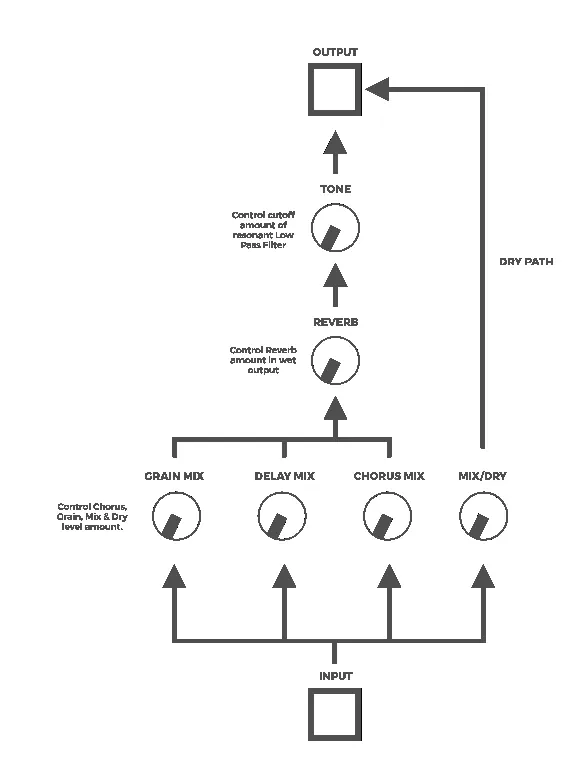
- Series: Effects feed into each other in the order: Chorus > Delay > Grain > Reverb > Tone > Dry > Output. The Mix/Dry knob controls the balance between the dry and wet signal.
- Parallel: Each effect processes the dry input separately, and outputs are summed. The Mix/Dry knob controls the dry level, while individual effect Mix knobs act as faders for each effect's volume.
Controls and Programs
The pedal features several knobs to shape your sound:
- Tone: Controls the cutoff of a resonant low-pass filter.
- Space: Adjusts the hall-style reverb applied to wet effects.
- Chorus: Offers Tri Chorus (three delay lines) and Stereo (180-degree phase offset) modes. Rate and Depth control the LFO modulation.
- Delay: Digital delay with up to two seconds of time. Use the toggle to select tap divisions (quarter, dotted eighth, eighth).
- Grain: Features two modes: Grain Cloud (random samples) and Phrase Sample (rhythmic triggering). Playback modes include Normal, Double-speed (+1 octave), Half-speed (-1 octave), Reverse, and Randomized.
Presets and Modes
The Qi includes three on-board presets (Red, Green, Blue) and a Live mode (White).

- Saving Presets: Dial in your settings, then hold the Bypass and Freeze switches until the preset LED blinks.
- Trails Mode: Toggled by holding the bypass switch for 1 second while applying power. In Trails mode, effects decay naturally after the pedal is turned off.
- Factory Reset: Hold both Bypass and Freeze switches while plugging in power until the Preset LED flashes. Note: This erases all custom presets.
MIDI Control
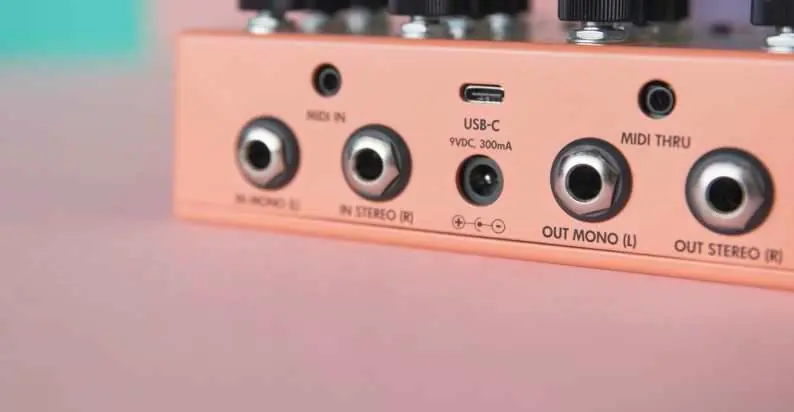
The Qi supports standard MIDI messages via the MIDI IN port. MIDI THRU allows passing messages to other devices. The default MIDI channel is 1. To change the channel, hold the Freeze switch during power-up, then send a Program Change (PC) message to the desired channel.
Firmware Updates
Connect the pedal to a computer via USB-C and visit walrusaudio.io using a Chrome-based browser to check for and install firmware updates.
Specifications
- Input Impedance: 1M Ohms
- Output Impedance: 220 Ohms
- Frequency Response: 20Hz to 20kHz
- Inputs/Outputs: 2 x 1/4 inch unbalanced TS
- Power: 9V DC, center-negative, 300mA minimum
Official resources from the manual
Practical help
Common problems
No sound or dry signal only
Check the Mix/Dry knob position and ensure the routing mode (Series vs Parallel) is set correctly for your desired signal path.
Presets not saving
Ensure you hold down both the Bypass and Freeze switches until the preset LED blinks to confirm the save.
MIDI not responding
Verify that the MIDI channel of your controller matches the pedal's MIDI channel (default is 1).
Reverb not applying to dry signal
This is normal behavior; the Space/Reverb control only applies to the wet effects, not the dry signal.
Before use
- Use an isolated 9V DC, center-negative power supply (300mA minimum).
- Avoid using daisy chain power supplies to prevent noise.
- Connect your instrument to the Input jacks.
- Connect your amplifier or interface to the Output jacks.
- Ensure the pedal is in the desired routing mode (Series or Parallel) using the Flow button.
Specs in practice
- Input Impedance
- 1M Ohms, standard for guitar pickups to maintain signal integrity.
- Output Impedance
- 220 Ohms, suitable for driving long cables to amplifiers or interfaces.
- Frequency Response
- 20Hz to 20kHz, covering the full audible spectrum.
- Power Requirement
- 9V DC, center-negative, 300mA minimum; requires isolated power.
Images and diagrams
- Series Routing: Shows signal passing through Chorus, Delay, Grain, Reverb, and Tone sequentially.
- Parallel Routing: Shows dry input split to each effect, then summed at the output.
Model compatibility
- USB-C port is strictly for firmware updates via walrusaudio.io.
- MIDI THRU port allows daisy-chaining other MIDI-enabled devices.
- Requires Chrome-based browser for firmware updates.

Manual page author
David Miller
Documentation analyst
Organizes user manual content into clear summaries, with attention to model details, product context, and everyday usability.