Computers / Cooling Systems
Installation Manual for Alphacool GPX-N 1070-M02 GPU Water Cooler
A comprehensive installation guide for the Alphacool GPX-N 1070-M02 GPU water cooler. Includes step-by-step assembly instructions, thermal pad placement, backplate installation, and maintenance tips.
Table of contents
Manual images
Click an image to enlargeQuick guide from the manual
This document provides instructions for installing the Alphacool GPX-N 1070-M02 water cooler on a graphics card. Key requirements include using an antistatic mat, ensuring correct thermal pad placement, and performing a leak test before final operation. The installation requires careful handling to avoid damaging components.
Preparation and dismantling
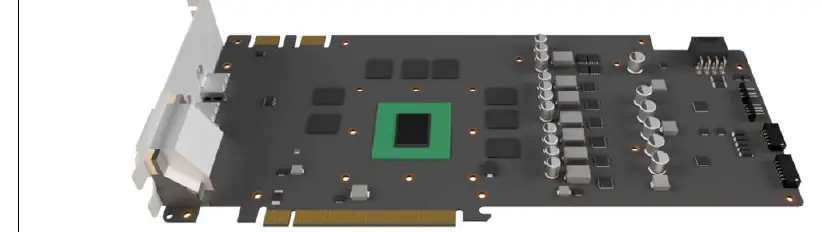
Place your hardware on an antistatic mat. Begin by dismantling the original cooler from the graphics card. Carefully remove the screws at the back of the card and unhook the fan connector. If the original cooler uses thermal glue, exercise extreme caution to avoid damaging parts. Clean the hardware thoroughly of any thermal paste or pad residues using a solvent such as alcohol.
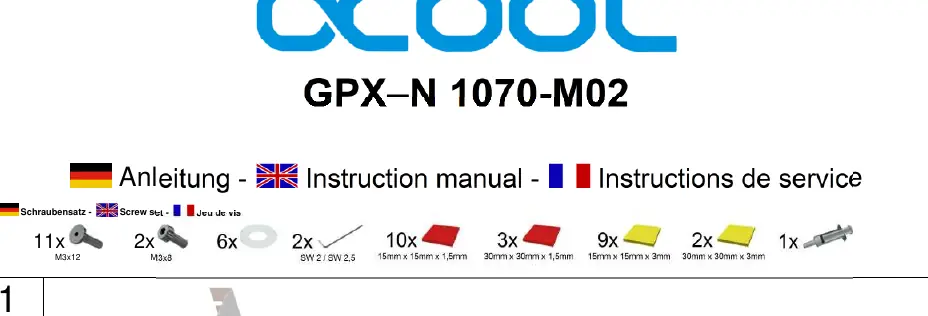
Thermal paste and pad application
Apply a thin, even layer of thermal paste to the GPU using a plastic strip or spreader. The layer should be less than 1mm thick to prevent contamination of surrounding components. For the thermal pads, remove the protective film from both sides and place them as follows:
- Memory chips: Use 15mm x 15mm x 1.5mm pads.
- Voltage converters: Use 30mm x 30mm x 1.5mm pads, which must be trimmed to size.
Cooler assembly
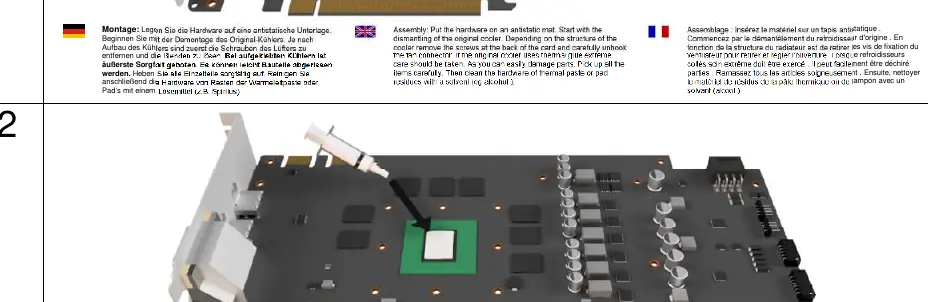
Place the assembled cooler on the graphics card. Ensure the contact surfaces on the bottom of the cooler are clean. If there is a protective film on the cooler base, remove it before installation. Mount the screws with washers as shown in the manual, but do not tighten them fully yet.
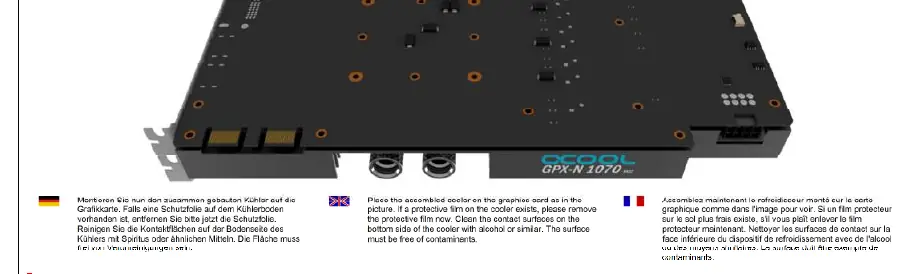
Backplate installation
Apply the remaining thermal pads to the back of the card:
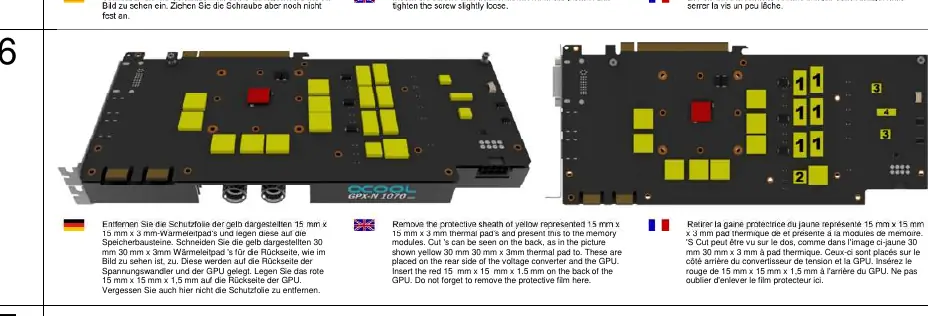
- Memory modules: Use 15mm x 15mm x 3mm pads.
- Voltage converter and GPU: Use 30mm x 30mm x 3mm pads (trimmed to size) and 15mm x 15mm x 1.5mm pads.
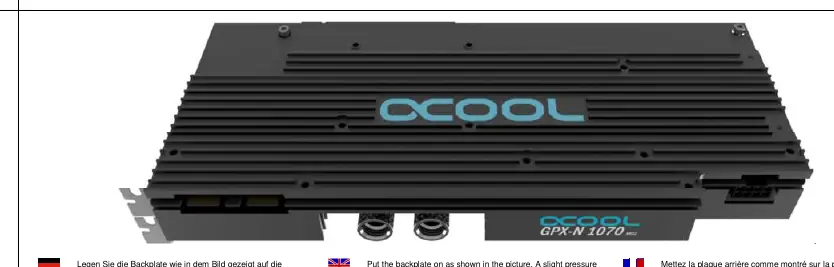
Place the backplate on the graphics card. Apply slight pressure to ensure optimal contact between the backplate, cooler, and graphics card.
Final tightening and testing
Screw the cooler together by tightening the screws crosswise with one turn each. After approximately 12 hours of using the graphics card, tighten all screws again to ensure a secure fit. The graphics card is ready for use once the installation is complete.
Safety and maintenance
Do not use tools like wrenches or pliers to tighten connectors, as this can damage plastic parts or threaded connections. Use only connectors with a sealing ring and tighten them by hand. The maximum water pressure in the cooling loop should not exceed 0.8 bar. Always perform a leak test before final installation.
Practical help
Common problems
Cooler not making contact
Ensure thermal paste is applied evenly and thermal pads are the correct thickness and placed in the right locations.
Leaking
Check that all connectors are hand-tightened and have sealing rings. Perform a leak test before full operation.
Overheating
Verify that the pump is functioning and coolant is flowing through the system.
Before use
- Prepare an antistatic mat.
- Clean all old thermal paste and pad residues from the GPU.
- Verify all thermal pads are the correct size and thickness.
- Remove all protective films from thermal pads and the cooler base.
- Perform a leak test before final installation.
- Ensure the pump is running when switching on the hardware.
Specs in practice
- Max Water Pressure
- 0.8 bar. Do not exceed this pressure in the cooling loop.
- Tightening Schedule
- Initial finger-tightening, followed by a final tightening after 12 hours of use.
- Thermal Pad Thickness
- Varies between 1.5mm and 3mm depending on the component location.
Images and diagrams
- Thermal pad placement diagrams show specific locations for 15x15mm and 30x30mm pads.
- Crosswise tightening pattern is required for even pressure distribution.
Model compatibility
- Designed specifically for the GPX-N 1070-M02 model.
- Not suitable for children under 6 years due to small parts.

Manual page author
Michael Turner
Technical manual editor
Reviews PDF manuals for structure, safety notes, and practical product details so readers can find the right information quickly.