Plumbing / Showers & Tubs
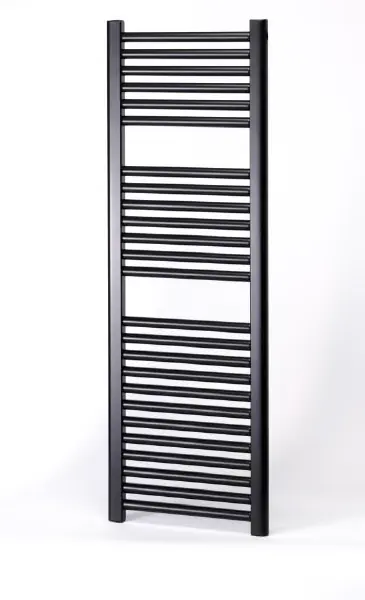
Installation Instructions for Better Bathrooms Pisa Towel Rail
Quick installation guide for the Better Bathrooms Pisa Towel Rail. Includes tools required, safety precautions, step-by-step mounting instructions, and maintenance tips.
Quick answers from the manual
Quick answer
- This document provides installation instructions for the Better Bathrooms Pisa Towel Rail, including safety guidelines, required tools, mounting steps, and maintenance advice. p. 1, 2, 3, 4
Key actions
- Install the air vent p. 3
- Mount the radiator p. 4
- Bleed the radiator p. 4
Maintenance and reset
- Regular cleaning with a soft cloth and soapy water. p. 4
Where to find it in the PDF
- Installation Instructions p. 1, 2, 3, 4
Table of contents
Manual images
Click an image to enlargeQuick guide from the manual
This document provides essential installation and maintenance instructions for the Pisa Towel Rail. Installation should be carried out by a qualified professional or a fully competent person in accordance with relevant British and European Standards. Ensure the wall is strong enough to support the weight of the radiator when filled with water.
Tools required
- Drill and drill bit
- Residual Current Device (RCD) - recommended
- Pozi Drive or Flathead screwdriver
- PTFE tape
- Measuring tape
- Spirit level
- Pencil
Safety precautions
- Check for hidden pipes or cables before drilling.
- Wear necessary personal protective equipment (PPE), including safety eyewear.
- Handle the product with care.
- Keep small parts away from children.
- Use an RCD when using power tools near water.
Installation steps
- Remove the radiator from packaging. Apply sufficient PTFE tape to valve-tail threads and silicone thread sealant to threaded components with O-rings.
- Screw the air vent into the top hole of the radiator.
- Ensure the wall is strong enough to hold the radiator filled with water. Note: Supplied wall plugs and screws are for masonry walls; alternative fixings may be required for other wall types.
- Mark bracket positions using the radiator and a spirit level.
- Drill four holes and insert wall plugs.
- Screw the round external brackets into the wall plugs.
- Screw the round internal bracket to the front cover plate; these connect through the radiator horizontal bar.
- Mount the radiator by sliding the internal brackets into the external brackets on the wall.
- Secure the radiator by tightening the grub screws into the side of the external brackets using a hexagonal key.
- Make connections to the heating circuit and remove trapped air using the air vent.
Care and maintenance
Regular cleaning with a soft cloth will keep the surface looking new. Soapy water can be used to remove stubborn stains, then buff dry with a soft cloth. Do not use abrasive or chemical cleaners as these will damage the surface finish over time.
Manufacturer information
Better Bathrooms
Practical help
Common problems
Drill wandering on tiled surfaces
Apply a piece of insulating tape or masking tape to the wall before drilling.
Small parts lost during installation
When working near a basin or bath, insert the plug into the waste to prevent parts from falling down the drain.
Radiator not heating properly
Remove trapped air using the air vent; this step may need to be repeated to ensure all air is removed.
Before use
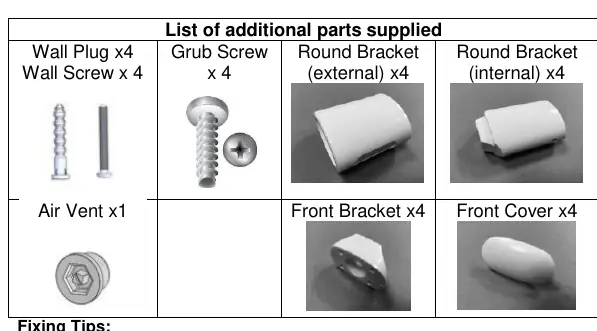
- Check all components are present against the parts list
- Verify wall strength
- Check for hidden pipes or cables in the wall
- Ensure you have all required tools
- Wear appropriate PPE
Images and diagrams
- The manual includes a parts list diagram showing the wall plugs, screws, grub screws, round brackets (internal/external), air vent, front brackets, and front covers.
Model compatibility
- Supplied wall plugs and screws are intended for masonry walls; alternative fixings may be required depending on the wall type.

Manual page author
David Miller
Documentation analyst
Organizes user manual content into clear summaries, with attention to model details, product context, and everyday usability.