Power / Batteries & Chargers
Eco-Worthy LiFePO4 Battery User Manual
Quick guide for Eco-Worthy LiFePO4 batteries (12V 8Ah-50Ah). Includes technical specifications, BMS parameters, charging methods for mains and solar, and troubleshooting steps.
Table of contents
Quick Guide
This manual covers the operation and maintenance of Eco-Worthy LiFePO4 batteries ranging from 12V 8Ah to 12V 50Ah. These batteries feature a built-in Battery Management System (BMS) to protect against over-voltage, under-voltage, and short circuits. Always ensure your charging equipment is compatible with LiFePO4 chemistry to maintain battery health and longevity.
Specifications
The following parameters apply to the Eco-Worthy LiFePO4 series:
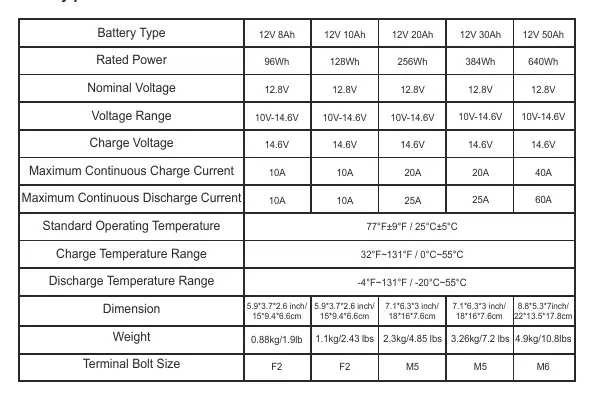
- Nominal Voltage: 12.8V
- Voltage Range: 10V - 14.6V
- Charge Voltage: 14.6V
- Standard Operating Temperature: 25°C ± 5°C (77°F ± 9°F)
- Charge Temperature Range: 0°C to 55°C (32°F to 131°F)
- Discharge Temperature Range: -20°C to 55°C (-4°F to 131°F)
Refer to the product label for specific capacity (Ah) and terminal bolt size (F2, M5, or M6) relevant to your specific model.
BMS Parameters
The internal BMS provides automatic protection:
- Over-voltage: Triggers at 14.5V-14.6V; recovers at 13.9V-14.2V.
- Under-voltage: Triggers at 9.2V-9.5V; recovers at 10.5V-10.8V.
- Short Circuit: Triggers at 50A (8Ah/10Ah), 100A (20Ah/30Ah), or 200A (50Ah). Recovery requires removing the short circuit.
Charging Methods
Mains Power
The ideal charging method is using a dedicated lithium iron phosphate battery charger programmed with the appropriate voltage limits. Most lead-acid battery chargers are also compatible, provided the output voltage matches the LiFePO4 standard charge voltage.
Solar Power
You can charge the battery using solar panels. Ensure you use a charge controller with a LiFePO4 or Li-ion battery mode. Both PWM and MPPT controllers are suitable. If no controller is used, the internal BMS provides protection, but direct connection without a controller is not recommended due to potential BMS failure risks.
Troubleshooting
- Battery not fully charging: Verify that your charger or controller output voltage is compatible with LiFePO4 requirements (14.6V).
- Capacity issues: If batteries are connected in series/parallel and do not reach rated capacity, the charging process may be unbalanced. Disconnect the batteries and charge them individually to verify the condition of each unit.
- Over-discharge protection: If the battery triggers over-discharge protection, remove the load or inverter and continue charging until it recovers. If it fails to recover, use a solar panel or a power source with a voltage higher than 15V to jump-start the battery.
Manufacturer information
ECO-WORTHY
Practical help
Common problems
Battery does not reach full charge
Check if the charger/controller output voltage is set to 14.6V and is compatible with LiFePO4 chemistry.
Connected batteries do not reach rated capacity
The charging process may be unbalanced. Disconnect the batteries and charge them individually to check their condition.
Battery triggered over-discharge protection
Remove the load or inverter. Continue charging until it recovers. If it still won't charge, use a power source >15V to jump-start it.
Before use
- Verify the charger output voltage matches the LiFePO4 standard charge voltage (14.6V).
- Ensure solar controllers are set to LiFePO4 or Li-ion mode.
- Check the terminal bolt size (F2, M5, or M6) for your specific battery model.
- Confirm operating temperatures are within the specified range (0°C-55°C for charging).
Specs in practice
- Nominal Voltage
- 12.8V is the standard operating voltage for these LiFePO4 batteries.
- Charge Voltage
- 14.6V is the required voltage to fully charge the battery.
Model compatibility
- Compatible with most lead-acid battery chargers.
- Compatible with both PWM and MPPT solar charge controllers.
- Solar controllers must support LiFePO4 or Li-ion battery modes.

Manual page author
David Miller
Documentation analyst
Organizes user manual content into clear summaries, with attention to model details, product context, and everyday usability.