HVAC / Thermostats & Controls
User Manual for JUNG Room thermostat RTR230
Quick guide for the JUNG RTR230 room thermostat. Learn how to install, wire, set temperature limits, and operate your 230V heating control system.
Table of contents
Manual images
Click an image to enlargeQuick guide from the manual
The JUNG RTR230 is an electronic room temperature controller designed for 230V electrothermal valve drives. Important: Installation and electrical connection must only be performed by electrically skilled persons. Always disconnect the power supply before working on the device to prevent electric shock. The device requires a calibration period of approximately 90 minutes after the initial power-on, during which control deviations may occur.
Device components
The thermostat consists of the following parts:
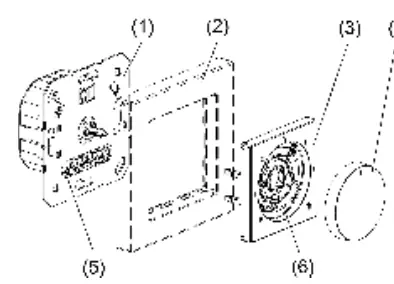
- Room temperature controller insert
- Frame
- Central plate
- Control knob
- Internal temperature sensor
- Adjustment rings for temperature limits
During renovation, ensure the internal temperature sensor is not painted over or covered in dirt.
Installation and wiring
The device is designed for mounting in an appliance box compliant with DIN 49073. For optimal performance, follow these guidelines:
- Recommended height: 1.50 m on interior walls.
- Avoid interference: Do not mount near heat sources (ovens, refrigerators), draughts (near doors), or in direct sunlight.
- Placement: Do not install behind curtains, shelf walls, or in multiple combinations with heat-generating devices like dimmers.
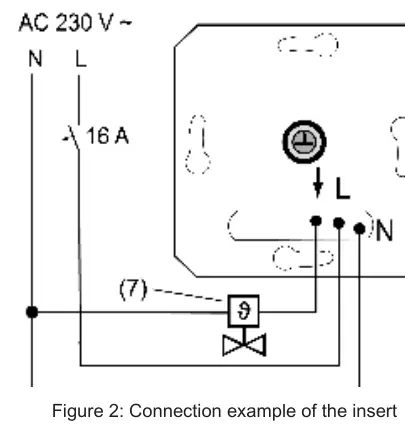
- Wiring: Connect the electrothermal valve drive to the insert according to the provided connection diagram. Ensure terminals are at the bottom when fitting the device.
Operation
The room temperature is adjusted manually using the control knob. Turning the knob to the right or left changes the setpoint temperature. The middle position corresponds to approximately 20 °C. The adjustable range is between 5 °C and 30 °C.
Setting temperature limits
You can restrict the temperature setting range using the adjustment rings located on the central plate:
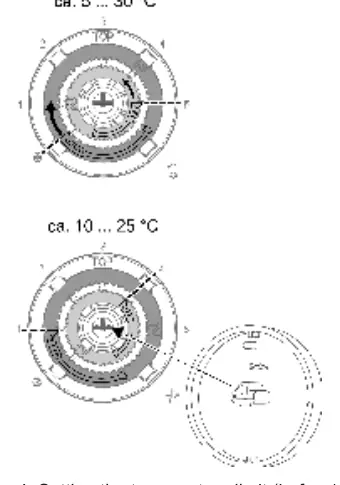
- Pull the control knob off the central plate (by hand or using a suitable tool).
- Turn the large blue adjustment ring clockwise to set the desired minimum temperature (each notch is approx. 1 °C).
- Turn the small red adjustment ring anticlockwise to set the desired maximum temperature.
- Replace the control knob, ensuring the coding on the knob and rotary axle aligns.
Technical data
The device operates on AC 230 V with a mains frequency of 50/60 Hz. It supports 1 to 10 valve drives with a connected load of up to 20 W. The ambient operating temperature range is -5 °C to +45 °C. The device features a valve protection function that opens and closes the valve once a week.
Practical help
Common problems
Device not regulating temperature correctly
Check the installation location. Ensure it is not near heat sources, draughts, or direct sunlight, which can affect the internal sensor.
Control deviations immediately after installation
The unit calibrates itself within the first 90 minutes of operation. Wait for this period to complete.
Before use
- Ensure installation is performed by an electrically skilled person.
- Disconnect the power supply before starting any work.
- Verify the valve drive is a 230V 'deenergised closed' type.
- Check that the appliance box meets DIN 49073 standards.
- Ensure the installation height is approximately 1.50 m.
Specs in practice
- Rated voltage
- AC 230 V
- Setting range
- 5 °C to 30 °C
- Connected load
- Max 20 W
- Controller class
- Class IV (2% contribution to energy efficiency)
Images and diagrams
- Figure 1: Exploded view of the thermostat components including the insert, frame, and control knob.
- Figure 2: Wiring diagram showing connections for AC 230V supply and the thermal valve drive.
- Figure 4: Visual guide on how to adjust the internal temperature limit rings.
Model compatibility
- Compatible with electrothermal valve drives (230V, 'deenergised closed').
- Requires mounting in an appliance box according to DIN 49073.

Manual page author
Emily Carter
User documentation editor
Prepares concise manual descriptions and highlights the most useful setup, operation, and maintenance information for readers.