Music / Guitar Effects
Tone City Model M Distortion Pedal User Manual
Quick guide for the Tone City Model M Distortion pedal. Learn about control functions, technical specifications, power requirements, and how to operate the high-gain British-style distortion and boost features.
Table of contents
Quick guide from the manual
The Tone City Model M is a high-gain distortion pedal designed to provide a classic British-style sound with dynamic, amp-like characteristics. This manual outlines the control layout, connection requirements, and technical specifications necessary for proper operation.
Device Overview
The pedal features a variety of controls to shape your tone and manage the boost function. Ensure all connections are made before powering on the device.
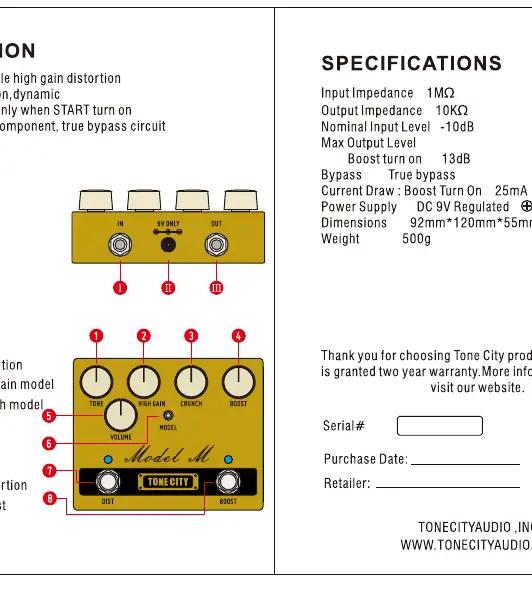
- Input Jack: Connect your guitar or instrument cable here.
- Output Jack: Connect this to your amplifier or the next pedal in your signal chain.
- DC Adapter Jack: Connect a DC 9V regulated power supply.
- Tone Control: Adjusts the high-frequency content of the distortion.
- High Gain Control: Adjusts the intensity of the high-gain distortion circuit.
- Crunch Control: Adjusts the crunch/mid-gain characteristics.
- Boost Control: Sets the level of the boost function.
- Output Level Control: Sets the overall volume of the pedal.
- Model Select: Allows switching between different distortion models.
- Distortion Footswitch: Engages or bypasses the distortion effect.
- Boost Footswitch: Engages or bypasses the boost function (only available when the distortion is active).
Specifications
- Input Impedance: 1MΩ
- Output Impedance: 10KΩ
- Nominal Input Level: -10dB
- Max Output Level (Boost on): 13dB
- Bypass: True bypass
- Current Draw: 25mA
- Power Supply: DC 9V Regulated
- Dimensions: 92mm x 120mm x 55mm
- Weight: 500g
Practical help
Common problems
No sound output
Ensure the pedal is powered by a DC 9V regulated supply and that the input/output cables are securely connected.
Boost function not working
The boost function is only available when the distortion effect is turned on. Ensure the main distortion footswitch is engaged.
Before use
- Verify you are using a DC 9V regulated power supply.
- Connect your instrument to the Input Jack.
- Connect the Output Jack to your amplifier.
- Ensure the pedal is placed on a stable surface.
Specs in practice
- Current Draw (25mA)
- Ensure your power supply can provide at least 25mA of current to operate the pedal correctly.
- Input Impedance (1MΩ)
- Standard impedance for guitar pickups to ensure optimal frequency response and clarity.
Images and diagrams
- The pedal layout includes two rows of knobs for tone shaping and two footswitches for effect control.
- The top row controls Tone, High Gain, Crunch, and Boost levels.
- The bottom row includes the Output Level, Model Select, and the two footswitches (Distortion and Boost).
Model compatibility
- Requires a DC 9V regulated power supply.
- Designed for standard electric guitar signals.

Manual page author
Michael Turner
Technical manual editor
Reviews PDF manuals for structure, safety notes, and practical product details so readers can find the right information quickly.