Toys / RC Models & Drones
User Manual for E-flite Turbo Timber Evolution 1.5m
Comprehensive user manual for the E-flite Turbo Timber Evolution 1.5m RC aircraft. This guide covers assembly, transmitter setup, SAFE Select and AS3X configuration, flight tips, maintenance, and troubleshooting.
Table of contents
Manual images
Click an image to enlargeQuick Guide from the Manual
The E-flite Turbo Timber Evolution 1.5m is a sophisticated RC aircraft. Before your first flight, ensure you have a 6+ channel transmitter with Spektrum DSM2/DSMX technology. The aircraft requires a 14.8V 3200mAh 4S 30C LiPo battery. Always perform a range check, verify control surface directions, and ensure the Center of Gravity (CG) is set to 60mm +/- 5mm back from the leading edge of the wing at the root.
Model Assembly
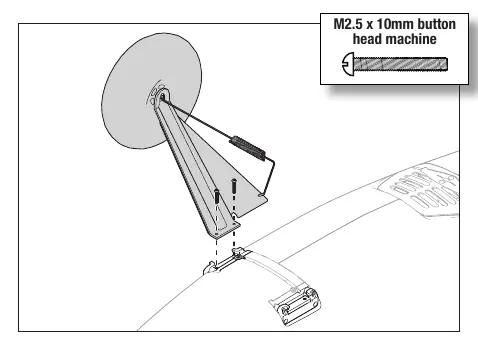
Landing Gear Installation: Remove the spring clamp assembly. Insert the landing gear into the fuselage pockets and secure with the included M2.5 x 10mm machine screws. Mount the spring assemblies to the fuselage using 3 x 10mm self-tapping screws and clamp them together with 2 x 6mm self-tapping screws.
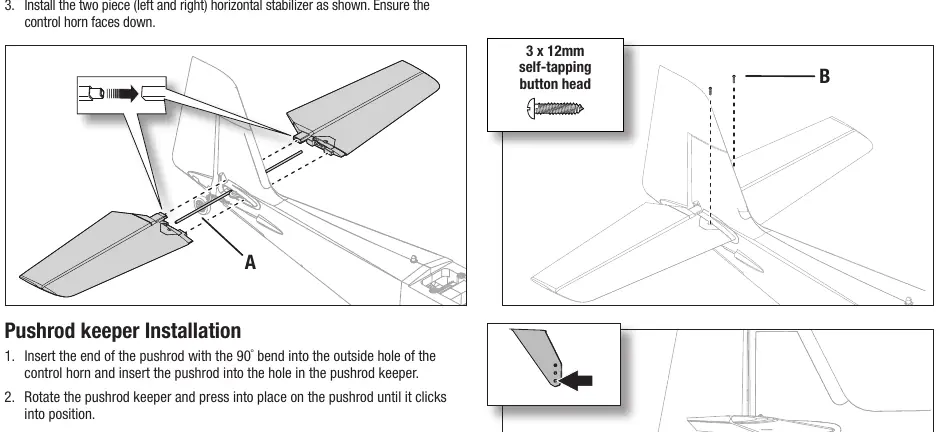
Horizontal Stabilizer: Slide the joiner (A) into the fuselage. Install the left and right stabilizer pieces, ensuring the control horn faces down. Secure with two 3 x 12mm self-tapping screws.
Wing Installation: Insert the wing joiner tube (B) and slide the wing halves together. Secure with the wing bracket (C). Connect the wing wiring to the fuselage sockets and secure the wing using the M6 x 30mm nylon screws.
Transmitter Setup
Start with a blank ACRO model. Set the wing type to 1 Aileron, 1 Flap. Ensure all servo reversing is set to Normal and Travel Adjust is 100%. Recommended dual rates and exponential settings are provided in the manual for both High and Low rates.
Binding and SAFE Select
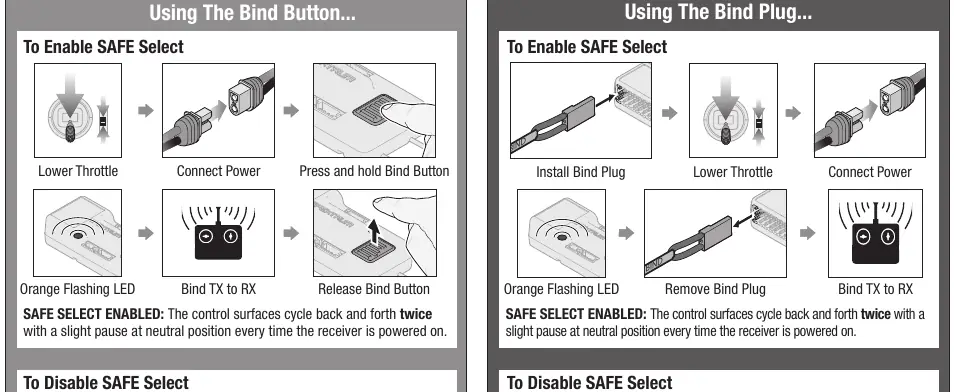
The aircraft features SAFE Select technology. You can enable or disable SAFE Select during the binding process. If enabled, you can assign a switch to toggle between SAFE Select and AS3X modes. Always ensure the transmitter sticks and throttle trim are at neutral before binding.
Battery Installation and ESC Arming
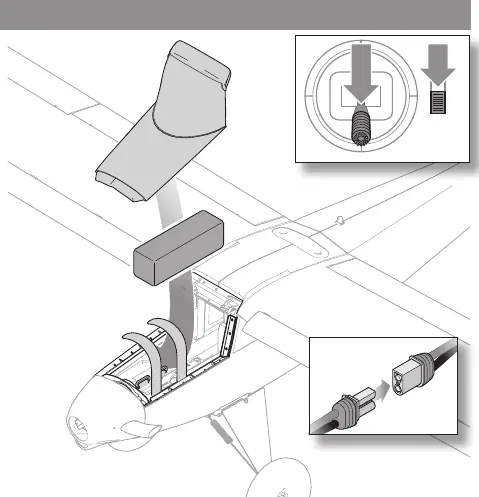
Lift the rear of the canopy hatch to access the battery compartment. Secure the battery with hook and loop straps. Connect the battery to the ESC. Keep the aircraft immobile for a few seconds after connection to allow the system to initialize. The ESC will sound a series of tones when ready.
Flying Tips
Takeoff: Face the aircraft into the wind. Use low rate and flaps in the takeoff position. Gradually increase throttle to 3/4 and steer with the rudder. As the tail lifts, gently pull back on the elevator.
Landing: Land into the wind. Use high rate elevator. During descent, use a small amount of throttle, then lower to 1/4 and deploy flaps for a smoother, slower landing.
Troubleshooting
- Oscillation: Check for a loose receiver, imbalanced propeller, or worn parts. Ensure all fasteners are tight.
- Aircraft will not bind: Move the transmitter further away from the aircraft, ensure the bind plug is installed correctly, and check battery charge.
- Motor power pulses: The ESC may have triggered the Low Voltage Cutoff (LVC). Recharge or replace the flight battery.
- Controls reversed: Perform the Control Direction Test and adjust settings on your transmitter.
Practical help
Common problems
Aircraft will not respond to throttle
Ensure throttle is at idle and trim is at lowest setting. Check that the throttle channel is not reversed and the motor is connected to the ESC.
Oscillation during flight
Check for loose receiver, imbalanced propeller, or worn parts. Tighten all fasteners and ensure the receiver is secure.
Aircraft will not bind to transmitter
Move transmitter further away from the aircraft, ensure bind plug is installed correctly, and check battery charge.
Motor power pulses or loses power
The ESC may have triggered the Low Voltage Cutoff (LVC). Recharge or replace the flight battery.
Before use
- Charge the flight battery fully.
- Set transmitter to a blank ACRO model.
- Bind the aircraft to your transmitter.
- Check Center of Gravity (60mm +/- 5mm back from wing root leading edge).
- Perform Control Direction Test.
- Perform AS3X Control Response Test.
- Ensure all linkages move freely.
Specs in practice
- Center of Gravity (CG)
- 60mm +/- 5mm back from the leading edge of the wing at the root.
- Flight Timer
- Recommended setting is 7 minutes.
Images and diagrams
- Landing gear assembly and mounting to fuselage.
- Horizontal stabilizer installation steps.
- Wing installation and connector routing.
- Battery installation and ESC connection.
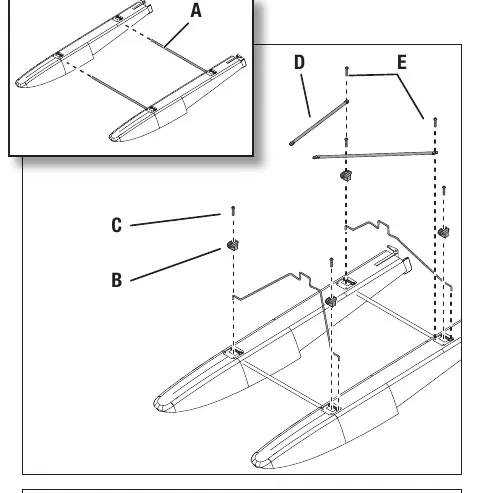
- Float installation steps (optional).
Model compatibility
- Requires 6+ channel transmitter with Spektrum DSM2/DSMX technology.
- Recommended battery: 14.8V 3200mAh 4S 30C LiPo with IC3/EC3 connector.

Manual page author
Michael Turner
Technical manual editor
Reviews PDF manuals for structure, safety notes, and practical product details so readers can find the right information quickly.