Automotive / Garage Equipment
User Manual for Vestil EHN-40-C 2-Ton Foldable Engine Hoist
Quick guide for the Vestil EHN-40-C 2-Ton Foldable Engine Hoist. Includes operating instructions, load capacities, safety warnings, and assembly diagram.
Quick answers from the manual
Quick answer
- The Vestil EHN-40-C is a 2-ton foldable engine hoist. It is operated via a hydraulic pump handle and release valve to raise and lower loads. p. 1, 3
Key actions
- Raise load p. 3
- Lower load p. 3
First start
- Purge air from hydraulic system p. 3
Problems and fixes
Poor lifting performance
Purge air from the hydraulic system.
p. 3Technical specifications
| Parameter | Value | Meaning | Pages |
|---|---|---|---|
| Max Capacity | 4000 lbs | Maximum load capacity at position 1 | p. 2 |
Where to find it in the PDF
- Title and Model p. 1
- Specifications and Warnings p. 2
- Operating Instructions p. 3
- Assembly Diagram p. 4
- Parts List p. 5
Table of contents
Manual images
Click an image to enlargeQuick guide from the manual
This document provides operating instructions and safety guidelines for the Vestil EHN-40-C 2-Ton Foldable Engine Hoist. Before using the equipment, ensure you have read and understood the manual to prevent damage or injury. Always verify that the hoist is on an even surface and that all nuts and bolts are tight before use.
Specifications
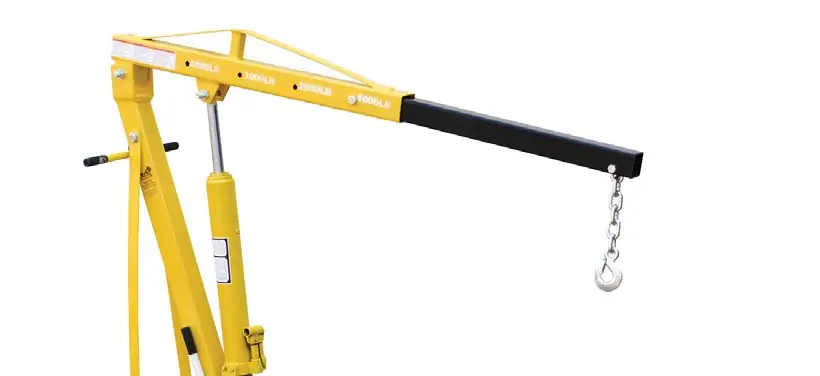
The hoist features variable lifting capacities depending on the jib position:
- Position 1: 4000 lbs
- Position 2: 3000 lbs
- Position 3: 2000 lbs
- Position 4: 1000 lbs
Lifting Height: 86 inches at minimum jib extension; 102 inches at maximum jib extension.
Operating Instructions
Important: If the hoist exhibits poor lifting performance, air may be trapped in the hydraulic system. To purge air, fully open the release valve (turn counterclockwise), hold the boom down, and operate the pump handle rapidly several times.
Raising a Load
Close the release valve by turning the handle clockwise to a snug-tight position. Do not overtighten.
Lowering a Load
Open the release valve by turning the handle counterclockwise very slowly. The speed of lowering is controlled by the degree to which you turn the handle.
Safety Warnings
- Do not overload: Never exceed the safe working loads indicated on the jib.
- Surface: Never use the hoist on an uneven floor surface, as this could cause tipping.
- Locking: Always lock the legs and jib in position before lifting a load.
- Maintenance: Before each use, ensure all nuts and bolts are correctly fitted and tight. Do not substitute supplied high-strength hardware with inferior types.
- Usage: The pump long ram is designed for lifting purposes only, not for supporting loads.
Assembly and Parts
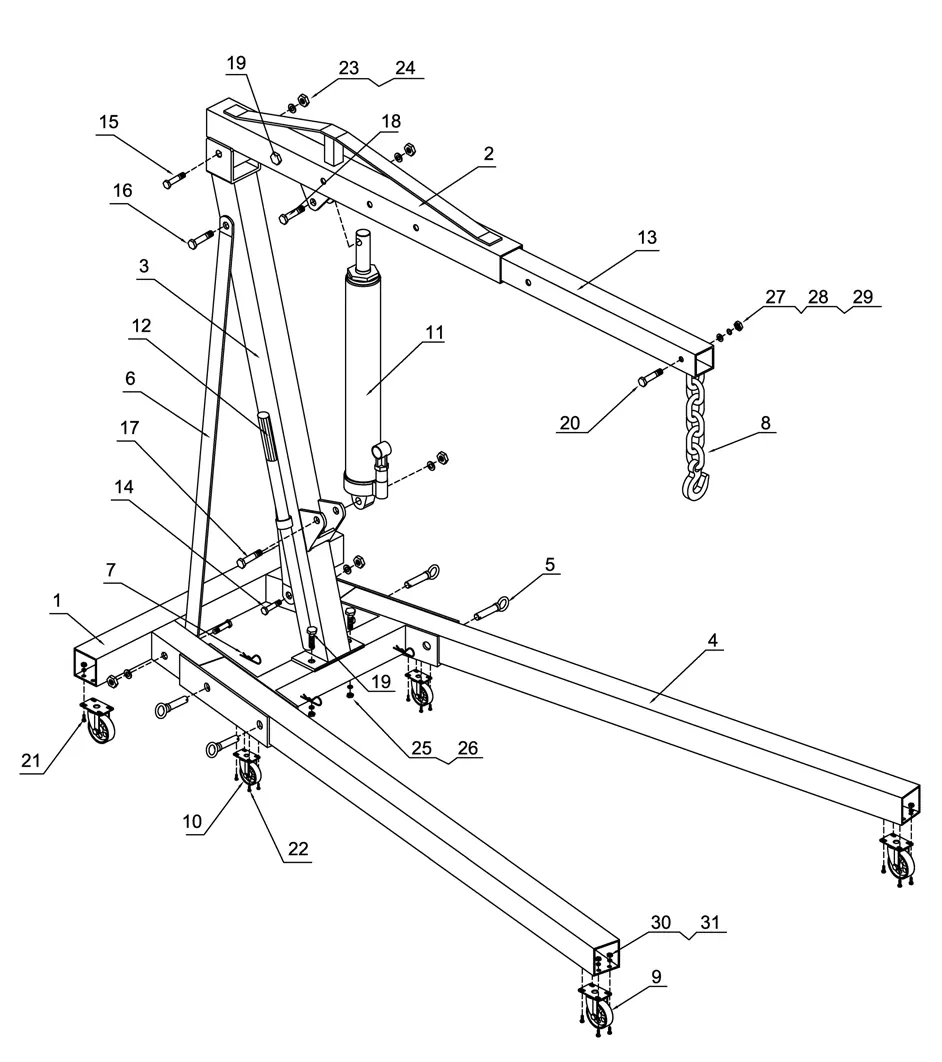
The manual includes an assembly diagram and a comprehensive parts list detailing 31 components, including the base, boom, main post, legs, castors, and hydraulic jack. Ensure all parts are accounted for and correctly assembled according to the diagram before operation.
Practical help
Common problems
Poor lifting performance
Purge air from the hydraulic system by opening the release valve and operating the pump handle rapidly while holding the boom down.
Before use
- Ensure the hoist is on an even floor surface.
- Check that all nuts and bolts are correctly fitted and tight.
- Verify the legs and jib are locked in position.
- Ensure the load does not exceed the capacity for the specific jib position.
- Confirm the hydraulic release valve is closed before attempting to lift.
Specs in practice
- Lifting capacity
- Varies by jib position: 4000 lbs (Pos 1) to 1000 lbs (Pos 4).
- Max. Lifting height
- 86 inches at minimum jib extension, 102 inches at maximum.
- Overall width
- 42 inches.
Images and diagrams
- The assembly diagram illustrates the connection points for the main post, boom, legs, and hydraulic jack.
- The parts list identifies 31 specific components, including bolts, nuts, washers, and castors, required for assembly.
Model compatibility
- Do not substitute supplied high-strength nuts and bolts with inferior types.

Manual page author
Emily Carter
User documentation editor
Prepares concise manual descriptions and highlights the most useful setup, operation, and maintenance information for readers.