Home / Security
Installation Guide for Honeywell VM721V1 AMR 2-Pin Speed Sensor
Quick installation and technical guide for the Honeywell VM721V1 AMR 2-Pin Speed Sensor. Includes soldering precautions, electrical characteristics, and mounting orientation.
Quick answers from the manual
Quick answer
- The VM721V1 is an AMR 2-Pin Speed Sensor. It requires a supply voltage of 4.0V to 24V and operates in temperatures from -40°C to 150°C. p. 1
Key actions
- Soldering the sensor p. 1
- Cleaning the sensor p. 1
Technical specifications
| Parameter | Value | Meaning | Pages |
|---|---|---|---|
| Supply Voltage | 4.0V to 24V | Operating voltage range | p. 1 |
| Switching Frequency | 35 kHz | Maximum switching frequency | p. 1 |
Where to find it in the PDF
- General Information and Operating Characteristics p. 1
- Application Requirements and Diagrams p. 2
- Mounting and Dimensions p. 3
Table of contents
Manual images
Click an image to enlargeQuick guide from the manual
The Honeywell VM721V1 is an Anisotropic Magnetoresistive (AMR) 2-Pin Speed Sensor designed to detect the speed of a ring magnet encoder target. This document provides essential installation, soldering, and technical specifications required for proper integration.
Soldering and Assembly
CAUTION: Improper soldering can damage the product. Follow these guidelines:
- Ensure leads are adequately supported during any forming or shearing operation to prevent stress inside the plastic case.
- Limit exposure to high temperatures.
- Wave solder at 250°C to 260°C (482°F to 500°F) for a maximum of three seconds.
- Burrs are allowed only if the full lead length passes through a 0.68 mm (0.027 in) diameter hole.
- ESD Precautions: The device is ESD sensitive (Class 3). Handle only at a static-free workstation.
Cleaning
CAUTION: Do not use pressure wash, as high-pressure streams can force contaminants into the package. Use an agitated rinse to clean the sensor.
Mounting Orientation
The sensor can be mounted in either Radial or Axial orientation relative to the ring magnet encoder target. Ensure the sensing element edge distance is maintained according to the application requirements.
Technical Specifications
Key operating characteristics (over supply voltage range at -40°C to 150°C):
- Supply Voltage: 4.0V to 24V.
- Switching Frequency: Up to 35 kHz.
- Duty Cycle: 40% to 60%.
- Operating Temperature: -40°C to 150°C.
- Storage Temperature: -40°C to 150°C.
Pinout
The sensor features two pins:
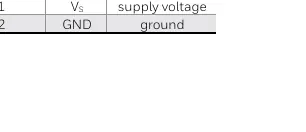
- Pin 1: VS (Supply Voltage)
- Pin 2: GND (Ground)
Manufacturer information
Honeywell International Inc.
Practical help
Common problems
ESD Damage
Handle the device only at a static-free workstation. It is classified as ESD Sensitivity Class 3.
Improper Soldering
Support leads during forming/shearing to avoid internal stress. Wave solder at 250°C-260°C for max 3 seconds.
Cleaning Contamination
Do not use pressure wash. Use an agitated rinse instead.
Before use
- Verify supply voltage is within the 4.0V to 24V range.
- Ensure the operating environment is between -40°C and 150°C.
- Check for large, stray magnetic fields in the vicinity that may affect performance.
- Prepare a static-free workstation for handling.
- Confirm the ring magnet encoder target is compatible.
Specs in practice
- Supply Voltage
- Operating range is 4.0V to 24V.
- Switching Frequency
- Maximum frequency is 35 kHz.
- Operating Temperature
- Device functions between -40°C and 150°C.
Images and diagrams
- Radial and Axial mounting orientation diagrams.
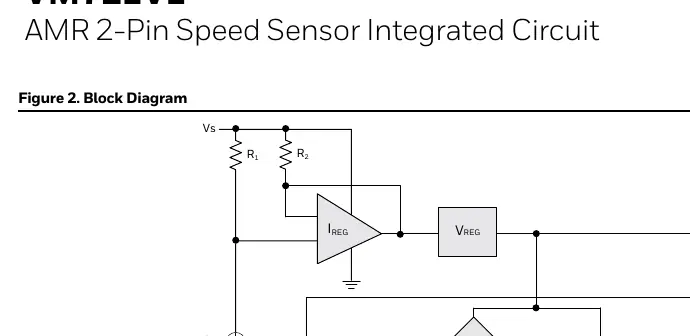
- Block diagram showing internal bridge design and signal processing.
- Basic application circuit showing connection to power supply and metering resistor.
- Transfer characteristics showing current output relative to North/South poles.
Model compatibility
- Designed for use with ring magnet encoder targets.

Manual page author
Michael Turner
Technical manual editor
Reviews PDF manuals for structure, safety notes, and practical product details so readers can find the right information quickly.